






Definition & Meaning
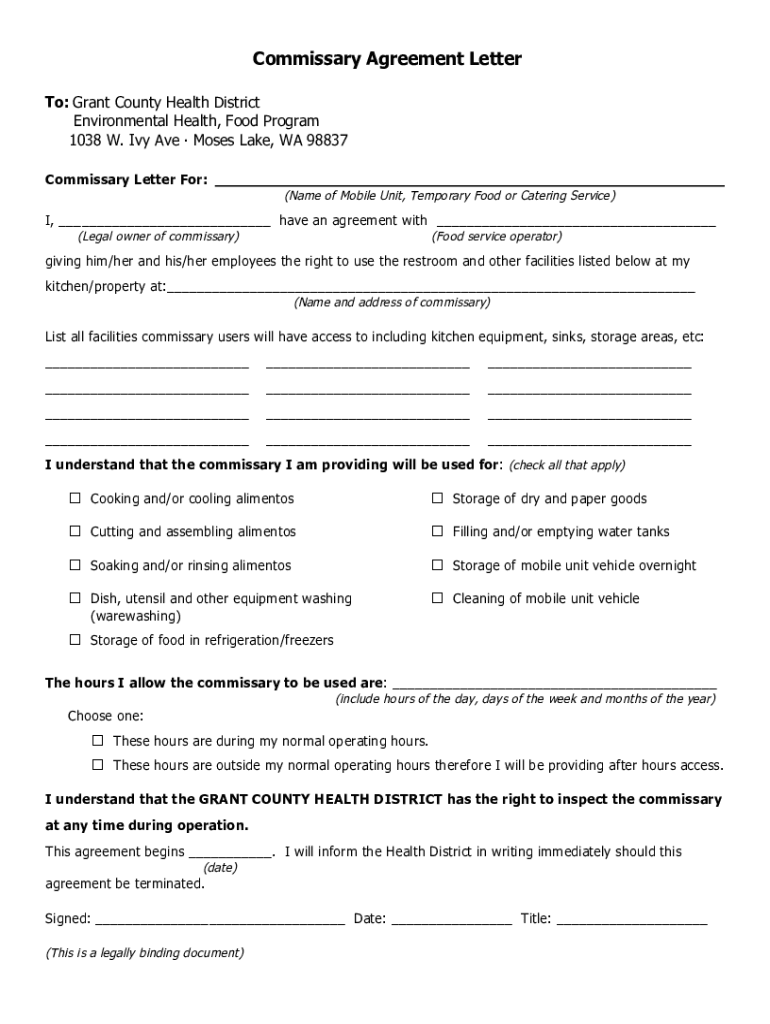
A Commissary Agreement Letter doc is a formal document used between food service operators and the legal owners of a commissary. It grants access to specific facilities necessary for food preparation and storage. This document outlines the responsibilities and rights of both parties involved, including access to kitchen equipment, agreed-upon hours of operation, and compliance with health inspections by entities like the Grant County Health District.
Importance of the Document
- Facilitates Operations: Ensures that food service operators have the necessary access to commercial kitchen facilities.
- Legal Compliance: Helps satisfy regulatory requirements enforced by health authorities such as regular inspections.
- Clear Responsibilities: Establishes a mutual understanding between the operator and the commissary owner, preventing potential disputes.
Key Elements of the Commissary Agreement Letter doc
The Commissary Agreement Letter includes several critical components necessary for its effectiveness and enforceability.
Main Components
- Parties Involved: Identification of the food service operator and the commissary's legal owner.
- Facility Scope: Details on facility areas accessible to the operator for use.
- Operational Times: Specifications of the hours during which the operator can utilize the commissary.
- Equipment Use: Lists the kitchen equipment available to the operator and any limitations on use.
- Health Inspections: Compliance terms regarding health inspections by designated authorities.
Examples
- A food truck operator agreeing with a commercial kitchen for overnight use during non-peak hours.
- A caterer utilizing storage facilities within a commissary to manage food inventory effectively.
Steps to Complete the Commissary Agreement Letter doc
Completing a Commissary Agreement Letter doc involves several steps to ensure both parties have a clear, mutual understanding.
Step-by-Step Process
- Identify Parties: Clearly list the contact information and roles of both the operator and commissary owner.
- Clarify Facility Access: Specify the areas of the commissary the operator will have access to.
- Set Operational Hours: Define the timeframes acceptable for facility use.
- Outline Equipment Use: Clearly describe any equipment the operator may use and corresponding rules.
- Include Compliance Terms: Ensure the document specifies the necessity for compliance with local health inspection requirements.
- Review & Sign: Both parties should carefully review the document to ensure clarity and then sign to formalize the agreement.
How to Use the Commissary Agreement Letter doc
To make the most out of a Commissary Agreement Letter doc, users must understand its proper usage in real-world contexts.
Practical Application
- Start by Reviewing the Terms: Both parties should thoroughly go through the terms to ensure all clauses align with their expectations.
- Manage Day-to-Day Activities: Use the document to guide daily operations to ensure compliance with the agreed-upon terms, like access times and equipment usage.
- Prepare for Emergencies: Reference the document for protocols and contact details in case of emergencies or unforeseen events that affect operations.
Who Typically Uses the Commissary Agreement Letter doc
The Commissary Agreement Letter doc is primarily used by those involved in food service operations that require access to commercial kitchen facilities.


Typical Users
- Food Truck Operators: These professionals often need external kitchen space when their vehicles lack full cooking facilities.
- Caterers: Businesses offering catering services require temporary premises to prepare and store food before events.
- Pop-up Restaurant Owners: Entrepreneurs who test food concepts in temporary locations also utilize these agreements for short-term kitchen use.
Legal Use of the Commissary Agreement Letter doc
Understanding the legal implications of using a Commissary Agreement Letter doc is crucial for regulatory compliance and safeguarding business interests.
Legal Considerations
- Enforceability: The document should meet local jurisdictional standards to be enforceable in court.
- Health Compliance: Operators must follow health codes and inspection requirements dictated in the agreement.
- Amendment Procedures: Any changes to the agreement terms typically require written consent from both parties to ensure continued legal protection.
State-Specific Rules for the Commissary Agreement Letter doc
Regulations and requirements governing commissaries can vary by state, affecting the specifics of an agreement.
Key Variations
- Health Regulations: Some states may have more stringent health checks or food safety certifications necessary.
- Licensing Requirements: States might require specific licenses for commissary operations that must be documented within the agreement.
- Zoning Laws: Local zoning laws can impact operational hours or types of permissible commercial activities in commissary kitchens.
Important Terms Related to the Commissary Agreement Letter doc
Familiarity with key terminology is essential for understanding and using a Commissary Agreement Letter doc effectively.
Glossary of Terms
- Commissary: A commercial kitchen facility used by food service operators that lack full kitchens.
- Operator: The entity or individual who uses the commissary under the agreement terms.
- Licensor: The legally licensed owner of the commissary granting access to the operator.
- Inspection: Evaluations carried out by health officials to ensure compliance with food safety standards.
- Equipment: Any kitchen tool or appliance made available for the operator's use under the agreement.
Understanding these components can lead to a more effective use of the Commissary Agreement Letter, ensuring seamless food service operations and compliance with necessary legal and health requirements.