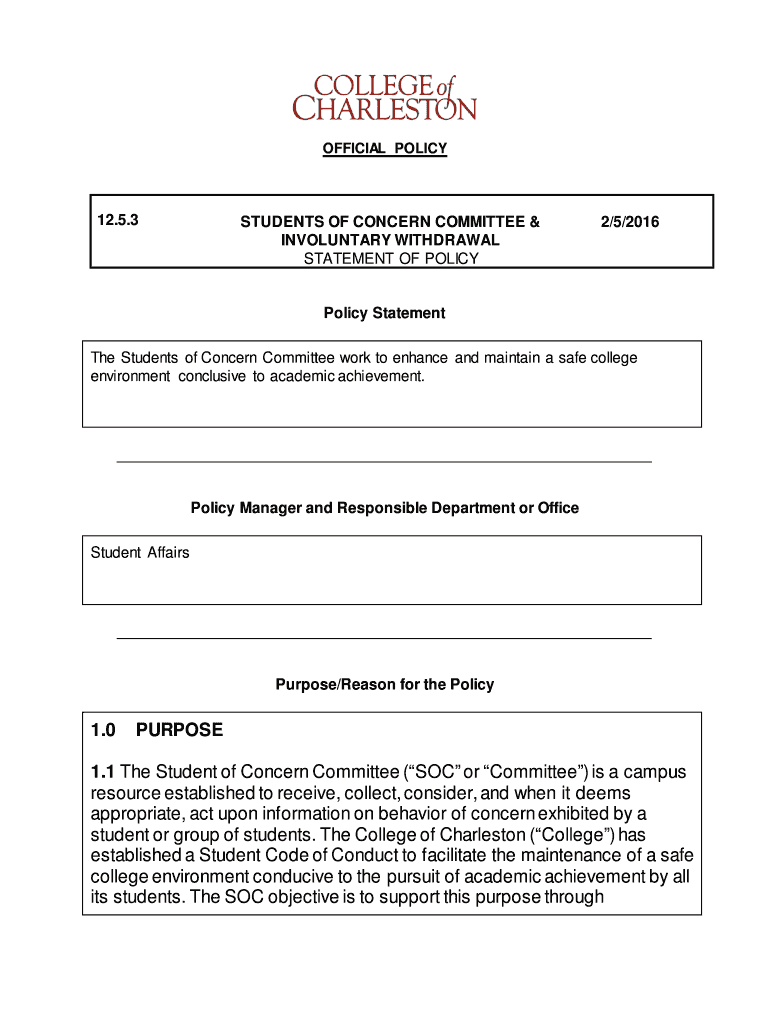







Definition and Meaning of the Form
The "Students of Concern Committee and Involuntary Withdrawal Statement of" is a policy tool used within academic institutions to manage and address student behaviors that may pose a threat to themselves or others. This form outlines the procedures and protocols to mitigate risks associated with concerning student behavior. Its primary objective is to maintain a safe learning environment by balancing the needs of individual students with the safety of the community.
Components of the Form
- Committee Role: Defines the responsibilities and composition of the Students of Concern Committee (SOC).
- Intervention Procedures: Details the steps and criteria for initiating an intervention.
- Involuntary Withdrawal: Outlines the process for removing a student from the institution if necessary.
Purpose in the College Context
This form is essential for colleges to align with federal regulations while providing a framework for supporting students and protecting the community. It is considered a key document ensuring that all actions taken comply with privacy and education laws.
Who Typically Uses the Form
The form is primarily used by members of the Students of Concern Committee, including faculty, administrative staff, and mental health professionals. Their role is to evaluate student cases and implement appropriate interventions.


Stakeholders Involved
- Faculty and Staff: Identify and refer students displaying concerning behaviors.
- Counseling Services: Provide assessments and recommendations.
- Student Affairs: Coordinate interventions and manage communication.
Decision-Making Process
SOC members collaborate to review cases, with decisions grounded in consensus while ensuring that any action taken aligns with institutional policies and applicable laws.
Key Elements of the Form
The "Students of Concern Committee and Involuntary Withdrawal Statement of" contains several critical elements that guide the committee's decisions and actions.
Elements Outlined
- Privacy Guidelines: Ensures compliance with FERPA and other privacy laws.
- Action Plans: Specifies measures to support the student and mitigate risks.
- Re-enrollment Criteria: Defines conditions that must be met for a student to return.
Considerations for Use
Each element is crafted to ensure that students' rights are protected and that interventions are fair and justified. The form is structured to provide a clear roadmap for handling complex situations involving student welfare.
Steps to Complete the Form
Completing the form involves a series of procedural steps designed to collect and assess relevant information regarding the student of concern.
- Identification: Faculty or staff member initiates the process by identifying a concerning behavior.
- Referral: The concerned student is referred to the SOC for evaluation.
- Assessment: The committee conducts assessments through interviews and reviews of available data.
- Action Proposal: The SOC proposes an action plan, including any recommendations for involuntary withdrawal if necessary.
- Documentation: The completed form and all supporting documents are securely archived.
Ensuring Accuracy
All steps include checks and balances to ensure the accuracy and fairness of the process. Documentation is crucial for transparency and accountability.
State-Specific Rules
Different states may have specific requirements or laws that influence how the form is utilized, particularly with regard to privacy and involuntary withdrawal practices.
Variations by State
- California: Requires adherence to additional state privacy regulations.
- New York: May necessitate coordination with state mental health services.
- Florida: Offers specific protections for students with disabilities.
Impact on Form Handling
The handling of the form might vary based on state-mandated policies, requiring SOC members to stay informed on regional legal developments.
Legal Use and Compliance
The use of the "Students of Concern Committee and Involuntary Withdrawal Statement of" must align with legal standards to ensure its enforceability.
Governing Laws
- FERPA: Governs the privacy of student educational records.
- ADA: Protects students with disabilities.
- Clery Act: Requires reporting and response protocols for campus safety.
Compliance Measures
Institutions must implement rigorous compliance checks to ensure the form and associated procedures do not violate students' legal rights.
Important Terms Related to the Form
Understanding key terms associated with this form is essential for SOC members and other stakeholders involved in the process.
Glossary of Terms
- Involuntary Withdrawal: The non-consensual removal of a student due to safety risks.
- Risk Assessment: Evaluation of potential dangers posed by the student.
- SOC (Students of Concern Committee): The responsible body for managing and mitigating student behavior concerns.
Importance of Clarity
Clear definitions of these terms help in delineating roles and responsibilities and prevent misunderstandings during the process.
Examples of Using the Form
Practical scenarios illustrate how the form is employed in real-world situations and the outcomes of its use.
Case Study: Student A
- Scenario: Displays escalating disruptive behavior that threatens peers.
- Actions Taken: SOC reviews the case, conducts risk assessment, and recommends temporary removal.
- Outcome: Student enters a behavioral intervention program and is later re-enrolled.
Real-world Impact
These examples emphasize the form's role in providing structured solutions that prioritize both individual support and community safety.