Current Neuropharmacology Copyright Letter 2026

Get Form
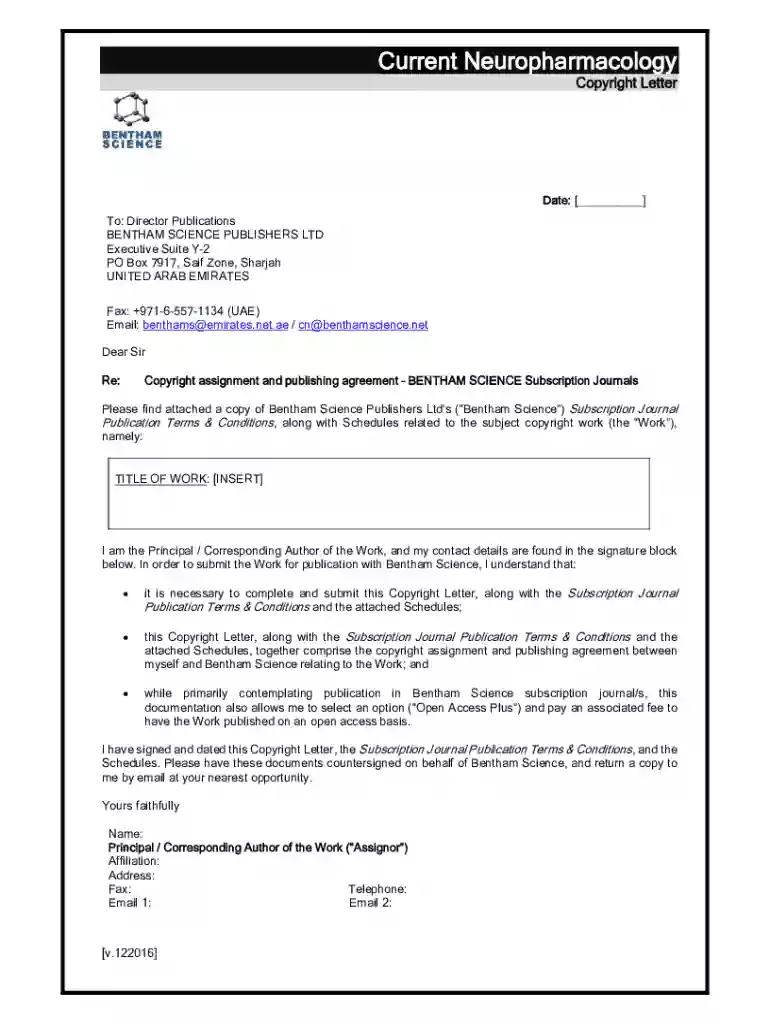
Current Neuropharmacology Copyright Letter Preview on Page 1

Here's how it works

01. Edit your form online
Type text, add images, blackout confidential details, add comments, highlights and more.

02. Sign it in a few clicks
Draw your signature, type it, upload its image, or use your mobile device as a signature pad.

03. Share your form with others
Send it via email, link, or fax. You can also download it, export it or print it out.

Definition and Meaning of the Current Neuropharmacology Copyright Letter

The Current Neuropharmacology Copyright Letter is a legal document that functions as a copyright assignment and publishing agreement. It facilitates the transfer of copyright from the authors to Bentham Science Publishers Ltd for works to be published in Bentham's scientific journals. The document outlines the agreement terms, including the transfer of publication rights, author responsibilities, open access options, and conflict of interest protocols. It ensures that the publisher has the necessary rights to disseminate the work while protecting the intellectual property rights of the authors involved. Additionally, the letter serves as a formal record of the agreement, detailing all obligations both parties have agreed to.

Key Elements of the Current Neuropharmacology Copyright Letter

Understanding the fundamental components of this copyright letter is crucial for authors. Key elements include:

  • Copyright Transfer: Authors agree to transfer copyright ownership to Bentham Science Publishers for publication purposes, allowing the publisher to reproduce and distribute the work.
  • Open Access Plus Option: Authors have the choice to publish their work as open access, which involves additional terms concerning distribution and accessibility.
  • Author Responsibilities: Authors must disclose any competing interests and ensure the originality of the submitted work.
  • Indemnities: Specifies the liability clauses for authors, protecting Bentham Science from potential legal issues arising from disputes over originality or co-authorship.

Important Terms Related to the Current Neuropharmacology Copyright Letter

There are several critical terms and definitions within the copyright letter:

  • Principal/Corresponding Author: The main contact responsible for communication with the publisher and ensuring compliance with all requirements.
  • Authorship: Guidelines outline who qualifies as an author and how they must be represented in the document.
  • Conflict of Interest: Disclosure of any financial or personal relationships that could influence the research or publication.

Steps to Complete the Current Neuropharmacology Copyright Letter

Authors need to follow certain steps to complete the copyright letter correctly:

  1. Review the Terms: Carefully read through the terms and conditions mentioned to understand all responsibilities and rights.
  2. Fill in Author Information: Provide complete details for all contributing authors, including affiliations and contact information.
  3. Assign Copyright: Explicitly acknowledge the transfer of copyright to Bentham Science to move forward with the publication process.
  4. Disclose Conflicts: Ensure any conflicts of interest are fully disclosed within the document.

Why Should You Use the Current Neuropharmacology Copyright Letter?

This letter is crucial for various reasons:

  • Legal Compliance: Ensures all legal documentation is in place for the journal to distribute the publication.
  • Intellectual Property Protection: Safeguards author rights while transferring necessary distribution rights to the publisher.
  • Streamlined Publishing: Facilitates the smooth processing of the article through Bentham's publishing system, enabling the work to reach a larger audience.

Legal Use of the Current Neuropharmacology Copyright Letter

Legal compliance is ensured through precise language and conditions within the copyright letter, which align with international publishing standards. Bentham Science, as the licensee, is empowered legally to reproduce and distribute the work, providing warranties against claims that might affect publication. Authors need to be aware that any breach in the agreement may bring about legal action, including the reversal of the publication agreement.

Software Compatibility and Accessibility

With modernization, the document supports digital formats and can be completed and submitted through various online platforms. This flexibility allows for:

  • Digital Completion: Filling out electronically in compliance with all digital documentation practices.
  • Software Support: Compatibility with PDF readers and editors for electronic signing and submission.

Examples of Using the Current Neuropharmacology Copyright Letter

Real-world applications of this document often include cases such as:

  • Collaborative Research Publications: Multi-author papers requiring a clear understanding of copyright and authorship roles.
  • Subscription-Based Journals: Employing this document to access Bentham Science's established network and reputation in scientific publishing.
  • Open Access Publishing Decisions: Utilizing open-access options to align with authors’ dissemination preferences.

By addressing these aspects thoroughly, the Current Neuropharmacology Copyright Letter serves as a comprehensive tool for authors and publishers, ensuring transparent and legally compliant publication processes.

be ready to get more

Complete this form in 5 minutes or less

Get form

Got questions?

We have answers to the most popular questions from our customers. If you can't find an answer to your question, please contact us.
Contact us
Article Publishing Charge (APC): USD 4,300 (excluding taxes). The amount you pay may be reduced during submission if applicable. Review this journals open access policy.
Current Neuropharmacology is an international, peer-reviewed journal on all aspects of Neuropharmacology, published monthly (print online) by Bentham Science Publishers.
The latest impact factor of current neuropharmacology is 4.8 which was recently updated in June, 2024. The impact factor (IF) is a measure of the frequency with which the average article in a journal has been cited in a particular year.
Declaration of interests All authors must disclose any financial and personal relationships with other people or organizations that could inappropriately influence or bias their work.
Neuropharmacology is the study of the effects of drugs on the nervous system, with the goal of developing compounds that offer therapeutic benefit in humans with psychiatric and neurological disease.

Security and compliance

At DocHub, your data security is our priority. We follow HIPAA, SOC2, GDPR, and other standards, so you can work on your documents with confidence.

Learn more
ccpa2
pci-dss
gdpr-compliance
hipaa
soc-compliance

People also ask

Therefore, we require a declaration of interests section in which all authors disclose any financial or other interests related to the submitted work that (1) could affect or have the perception of affecting the authors objectivity or (2) could influence or have the perception of influencing the content of the
A conflict of interest can also be known as competing interest. A conflict of interest can occur when you, or your employer, or sponsor have a financial, commercial, legal, or professional relationship with other organizations, or with the people working with them, that could influence your research.

Related links