Residential Aged Care Property details for Services Australia and 2026

Get Form
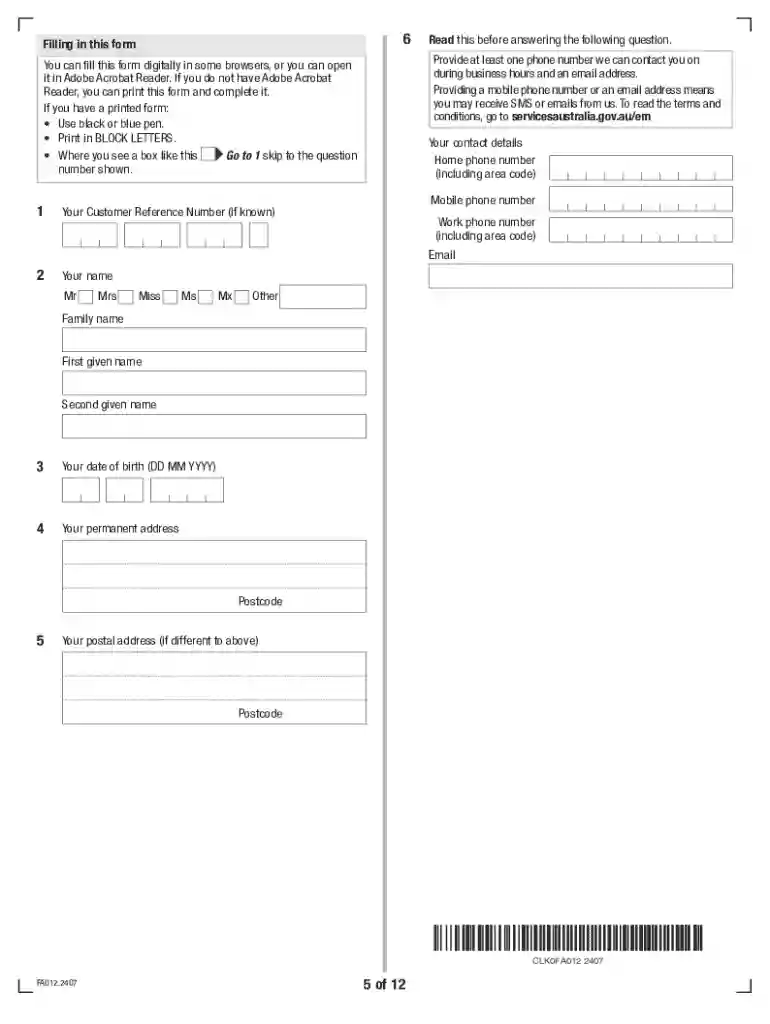
Residential Aged Care Property details for Services Australia and Preview on Page 1

Here's how it works

01. Edit your form online
Type text, add images, blackout confidential details, add comments, highlights and more.

02. Sign it in a few clicks
Draw your signature, type it, upload its image, or use your mobile device as a signature pad.

03. Share your form with others
Send it via email, link, or fax. You can also download it, export it or print it out.

Definition and Purpose of the Residential Aged Care Property Details Form

The "Residential Aged Care Property details for Services Australia" form is an essential document used to collect information about property owned by individuals entering residential aged care. This form assists Services Australia in assessing an individual's financial situation, which plays a critical role in determining the level of government assistance and fees applicable to aged care services. By providing detailed property information, individuals can ensure accurate assessments and avoid potential discrepancies in their aged care costs.

Key Information Included in the Form

  • Property Address: Complete address of the property or properties owned by the individual.
  • Ownership Details: Information about ownership structure, including any co-owners and their respective shares.
  • Property Valuation: Current market value of the property, which may be determined through professional appraisal or recent market data.
  • Encumbrances: Any existing mortgages or loans against the property, along with outstanding balances.
  • Property Rental Status: Information on rental income if the property is being leased to tenants.

Steps to Complete the Residential Aged Care Property Details Form

Completing the Residential Aged Care Property Details form involves several key steps to ensure accurate and complete information submission:

  1. Gather Necessary Documents:

    • Collect property deeds, recent valuation reports, mortgage statements, and rental agreements.
  2. Fill Out Personal Information:

    • Enter the individual's name, contact details, date of birth, and other personal identifiers as requested.
  3. Provide Detailed Property Information:

    • Complete sections regarding each property's address, owner details, and valuation figures.
  4. Disclose Financial Liabilities:

    • Document any debts or encumbrances attached to the property, providing account and lender information.
  5. Review and Submit:

    • Double-check the form for completeness and accuracy, ensuring all required fields are filled. Submit the completed form to Services Australia through the designated channels.

Who Typically Uses the Residential Aged Care Property Details Form

This form is predominantly used by older individuals planning a transition into residential aged care facilities. It is also highly utilized by family members, legal representatives, and financial advisers who assist seniors in managing their financial affairs. Understanding who utilizes this form helps streamline the application and reduces errors associated with form completion.


decoration image ratings of Dochub

Typical Users

  • Seniors: Individuals entering aged care need to provide accurate property details to Services Australia.
  • Family Members: Sons, daughters, or other relatives assisting with financial management.
  • Financial Advisers: Professionals helping seniors manage assets and care costs.
  • Legal Representatives: Lawyers or estate planners overseeing estate and asset management.

Importance of the Residential Aged Care Property Details Form

Submitting complete and accurate details about residential properties aids Services Australia in assessing eligibility for government subsidies and calculating appropriate care fees. Accurate reporting ensures that individuals access the correct level of financial support and minimizes potential disputes or overpayments due to misunderstandings of property-related finances.

Benefits of Accurate Submission

  • Fair Fee Assessment: Ensures proper evaluation of fees based on current financial status.
  • Access to Subsidies: Determines eligibility for government subsidies accurately.
  • Avoiding Overcharges: Prevents overpayment due to incorrect property valuation or unreported liabilities.

Required Document List for Form Completion

Before completing the Residential Aged Care Property Details form, gather all necessary supporting documents. These documents are essential for verification and to support the information provided on the form.

Necessary Documents

  • Property Deeds or Titles: Evidence of ownership and property description.
  • Recent Appraisal or Market Valuation Report: Current valuation of the property.
  • Mortgage or Loan Statements: Details of any financial liabilities against the property.
  • Rental Agreements or Income Records: Proof of any income generated from the property.

Submission Methods for the Residential Aged Care Property Details Form

Submitting the completed form to Services Australia can be done through several channels, ensuring flexibility and convenience for applicants. Each submission method has its benefits, depending on the individual's preference and accessibility.

Available Submission Methods

  • Online Submission: Fastest and most convenient, available through Services Australia's official portal.
  • Mail Submission: Option for those who prefer physical documentation.
  • In-Person Submission: Direct submission at a Services Australia office for those who require assistance or verification.

Legal Considerations for the Residential Aged Care Property Details Form

When completing the Residential Aged Care Property Details form, it is essential to consider the legal implications involved, particularly concerning privacy and data accuracy. This ensures compliance with regulations and safeguards against legal repercussions.

Legal Aspects

  • Privacy Concerns: Adherence to privacy laws and protection of personal information.
  • Accuracy Obligations: Legal requirement to provide truthful and complete information.
  • Consent for Verification: Acknowledgment that Services Australia may verify submitted data with third parties to ensure accuracy.

State-Specific Regulations Impacting Residential Aged Care Property Details

While the form is standardized, certain aspects may vary based on state-specific laws or guidelines. Understanding these differences ensures compliance with local regulations and appropriate reporting.

Notable State-specific Considerations

  • Property Valuation Standards: Differences in how property is valued across states.
  • Rental Income Taxation: State-specific rules for taxing rental income disclosed in the form.
  • Governing Laws: Variations in state laws regarding property disclosures and care eligibility.

Providing comprehensive and precise information on these sections allows individuals and their advisors to navigate the requirements of the Residential Aged Care Property Details form efficiently. This ensures proper planning for aged care entry, fee assessment, and government subsidy eligibility.

be ready to get more

Complete this form in 5 minutes or less

Get form

Got questions?

We have answers to the most popular questions from our customers. If you can't find an answer to your question, please contact us.
Contact us
The Aged Care Quality and Safety Commission (ACQSC) is the national regulator of funded aged care services. Under the new Act, it will be responsible for: protecting and enhancing the safety and wellbeing of people accessing aged care services.
To ensure each resident receives the right type and amount of care, most assisted living communities categorize residents according to one of three levels of care needs: basic or low-care, intermediate or medium-care, and advanced or high-care.
Who is eligible? You may be eligible for government-funded aged care services if you are 65 years of age or older (50 years or older if you identify as an Aboriginal or Torres Strait Islander person or aged 50 to 64 years and are homeless or at risk of homelessness) and need help to do the things you used to.
If you rent out the home, its value may count towards the Age Pension assets and income test, depending on when you moved into aged care. If you keep the home without renting it out, it is exempt from the Age Pension assets test for two years from the date that you moved into aged care.
Aged care services in Australia. We fund aged care providers to deliver services, including: Residential aged care services. In-home care services. Flexible care services. Services for older people with a disability. Services for First Nations people. Services for people with dementia. Services for diverse groups.

Security and compliance

At DocHub, your data security is our priority. We follow HIPAA, SOC2, GDPR, and other standards, so you can work on your documents with confidence.

Learn more
ccpa2
pci-dss
gdpr-compliance
hipaa
soc-compliance
be ready to get more

Complete this form in 5 minutes or less

Get form

People also ask

According to the Australian government, there are 3 main types of aged care: residential, short-term and home care.
How many aged care sites are there in Australia? As of June 2022, the Australian Government has approved 811 aged care providers to deliver residential care, home care, and other senior services across 2,671 Commonwealth-subsidised facilities nationally.

Related links