Definition & Meaning
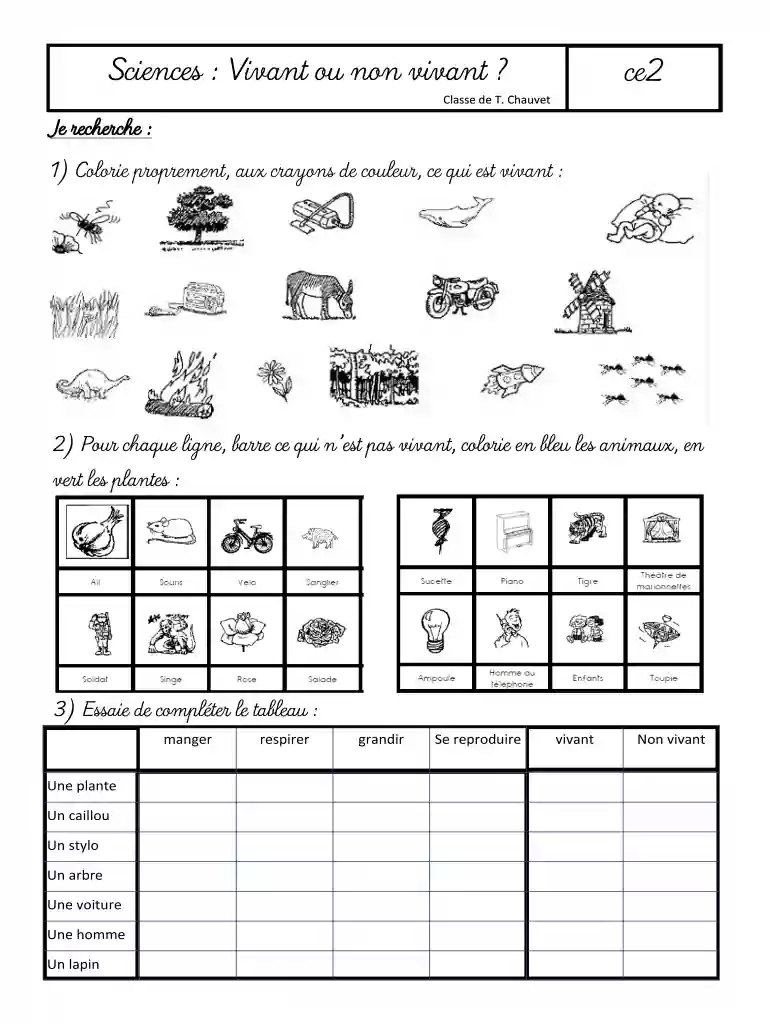
The "valuation vivant non vivant ce1 pdf" is an educational resource designed for CE1-level students, focusing on differentiating living from non-living things. It serves as a learning tool to help children understand fundamental biological concepts. The core objective of this material is to teach students how to identify, categorize, and comprehend various characteristics that define living beings, such as growth, reproduction, and response to stimuli.
Characteristics of Living Things
- Growth and Development: Living things undergo various life stages, including growth and development.
- Reproduction: They have the ability to reproduce, ensuring the continuation of their species.
- Response to Environment: Living entities react to changes in their surroundings, demonstrating adaptability.
Key Features of Non-Living Things
- Inability to Grow: Non-living things do not experience growth.
- No Reproduction Capability: They cannot reproduce or create offspring.
- Lack of Response: Non-living objects do not respond to environmental stimuli.
How to Use the Valuation Vivant Non Vivant CE1 PDF
To effectively use this PDF, educators and students can follow structured activities designed to enhance learning.
Engaging Activities
- Coloring Sheets: Students can color images of living organisms, which helps them visually distinguish them from non-living objects.
- Categorization Tasks: Learners can sort pictures into living and non-living categories to reinforce classification skills.
- Writing Exercises: Activities include writing about the characteristics of living things, encouraging students to articulate their understanding.
Integration in Curriculum
- Incorporate the PDF into daily lesson plans.
- Use it as a supplement for hands-on activities in science classes.
- Assign as homework to reinforce classroom learning.
Steps to Complete the Valuation Vivant Non Vivant CE1 PDF
Completing the worksheet involves several steps that guide students through the learning process.
- Read Instructions: Begin by reading through each activity's instructions carefully.
- Complete Coloring Tasks: Engage with the coloring activities to familiarize with the types of living entities.
- Categorize Using Images: Identify images of organisms and place them in the correct category.
- Write Descriptions: Utilize the space provided to write about the characteristics of the categorized images, reinforcing comprehension.
Key Elements of the Valuation Vivant Non Vivant CE1 PDF
The document contains various educational components that enrich the learning experience.
Core Components
- Visual Aids: Illustrated images for coloring and categorization tasks.
- Instructional Prompts: Clear directions that guide students through each section.
- Activity Sections: Segmented areas for different types of exercises, including identification and descriptive writing.
Supplemental Materials
- Examples of living and non-living entities.
- Definitions and explanations of key biological concepts.
- Interactive sections to enhance engagement and participation.
Important Terms Related to Valuation Vivant Non Vivant CE1 PDF
Understanding the terminology within the PDF is crucial for effective utilization.
Essential Vocabulary
- Organism: Any living entity, including plants, animals, and microorganisms.
- Habitat: The natural environment in which a living organism resides.
- Adaptation: Traits that enhance an organism's ability to survive in its environment.
Supporting Concepts
- Life Cycle: The stages an organism goes through from birth to death.
- Ecology: The study of interactions between organisms and their environment.
Form Submission Methods (Online / Mail / In-Person)
While this specific PDF is a classroom resource, knowing how educational forms can generally be submitted proves useful.
General Submission Methods
- Online Platforms: Some educational assessments can be submitted through online educational portals.
- Mail: Physical worksheets may be mailed to an instructor if remote submission is required.
- In-Person: Completed worksheets can be handed directly to teachers in classroom settings.
Digital vs. Paper Version
Understanding the advantages of different formats is essential for utilizing educational resources effectively.
Comparison of Formats
- Digital Version: Offers ease of accessibility and the ability to integrate multimedia elements such as videos.
- Paper Version: Allows for tactile engagement, ideal for activities like coloring and writing exercises.
Considerations
- Digital versions can be easily distributed via email or educational platforms.
- Paper versions may promote traditional engagement and reduce screen time.
Software Compatibility
Ensuring compatibility with software and devices enhances usability.
Compatible Platforms
- Adobe Reader: Essential for accessing and filling out PDF documents.
- Google Classroom: Can facilitate distribution and submission of digital educational resources.
- Interactive Whiteboards: Useful for collective classroom activities and interactions.
Functional Benefits
- Allows for easy sharing and collaboration in classroom settings.
- Facilitates remote learning and accessibility across different devices and operating systems.