




01. Edit your form online
Type text, add images, blackout confidential details, add comments, highlights and more.

Type text, add images, blackout confidential details, add comments, highlights and more.

Draw your signature, type it, upload its image, or use your mobile device as a signature pad.

Send it via email, link, or fax. You can also download it, export it or print it out.
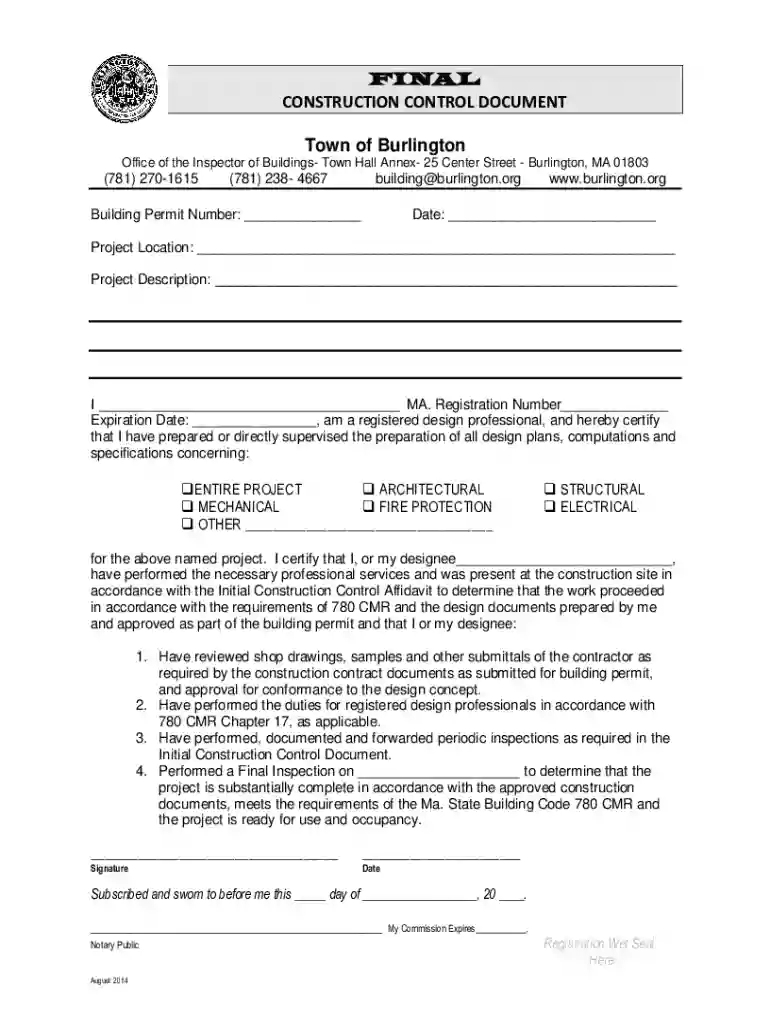
Construction control requirements in the Town of Burlington refer to a set of regulations and documents including the Construction Control Document. This document certifies that a registered design professional has prepared and supervised project construction plans. It ensures adherence to local building codes, such as Massachusetts State Building Code 780 CMR, ensuring projects meet safety and structural integrity standards. This requirement outlines the responsibilities of design professionals, including inspections and compliance checks.
Understanding and using the construction control requirements in Burlington involve familiarizing oneself with the specific standards set by local authorities. A registered design professional, such as an architect or engineer, is typically responsible for ensuring compliance. They must supervise the project from the planning stages through completion, conduct mandatory inspections, and verify that all work aligns with approved plans and codes. Documentation of each phase is crucial for assessment and future reference.
Hire a Registered Design Professional: Engage an architect or engineer registered in Massachusetts who will be responsible for the project's compliance.
Preparation of Plans: Develop detailed construction plans that comply with local building codes and regulations, particularly 780 CMR.
Submit for Approval: Submit these plans to the town's building department for review and obtain necessary approvals.
Conduct Inspections: Schedule and complete required inspections at various stages of construction to ensure consistent compliance.
Notary and Signatures: Complete the document with required signatures and notary acknowledgments to confirm its validity.
Final Submission: Once all stages are completed, submit the final document to the appropriate local authority to finalize compliance.
The construction control requirements have legally binding implications, particularly concerning adherence to safety standards and codes. Non-compliance can lead to penalties, project delays, or legal actions. The document must be handled with accuracy and diligence, ensuring all information is correct and verified. Design professionals must understand their legal responsibilities under these guidelines.


Consider a case where an architect in Burlington is tasked with the renovation of a public library. The architect must ensure new designs conform to current codes and receive approval from the town's building department. As the project progresses, detailed inspections confirm each construction phase maintains code compliance, securing the project's legitimacy and safety.
Failing to adhere to Burlington's construction control requirements can lead to significant consequences. Penalties may involve fines, mandated cessation of construction activities, or legal disputes. Non-compliance could also result in increased project costs due to required alterations or repairs, emphasizing the importance of adhering to all protocols.
While based on Massachusetts's broader construction codes, Burlington may have additional specific requirements. This could include variations in code interpretation, additional inspections, or localized environmental considerations. It is essential for professionals to consult with local authorities to understand these nuances fully.
We've got more versions of the construction control requirements town of burlington form. Select the right construction control requirements town of burlington version from the list and start editing it straight away!
At DocHub, your data security is our priority. We follow HIPAA, SOC2, GDPR, and other standards, so you can work on your documents with confidence.
This site is intended to be a repository of planning, design, and construction standards and guidance documents adopted by the City of Burlington
May 4, 2022 Erosion control (during construction in the City). Watershed planning. Capital improvement projects. Public outDocHub and education.Read more
These additional criteria include the use of green and sus- tainable remediation technologies, habitat and resource restoration, watershed considerations,


