




01. Edit your form online
Type text, add images, blackout confidential details, add comments, highlights and more.

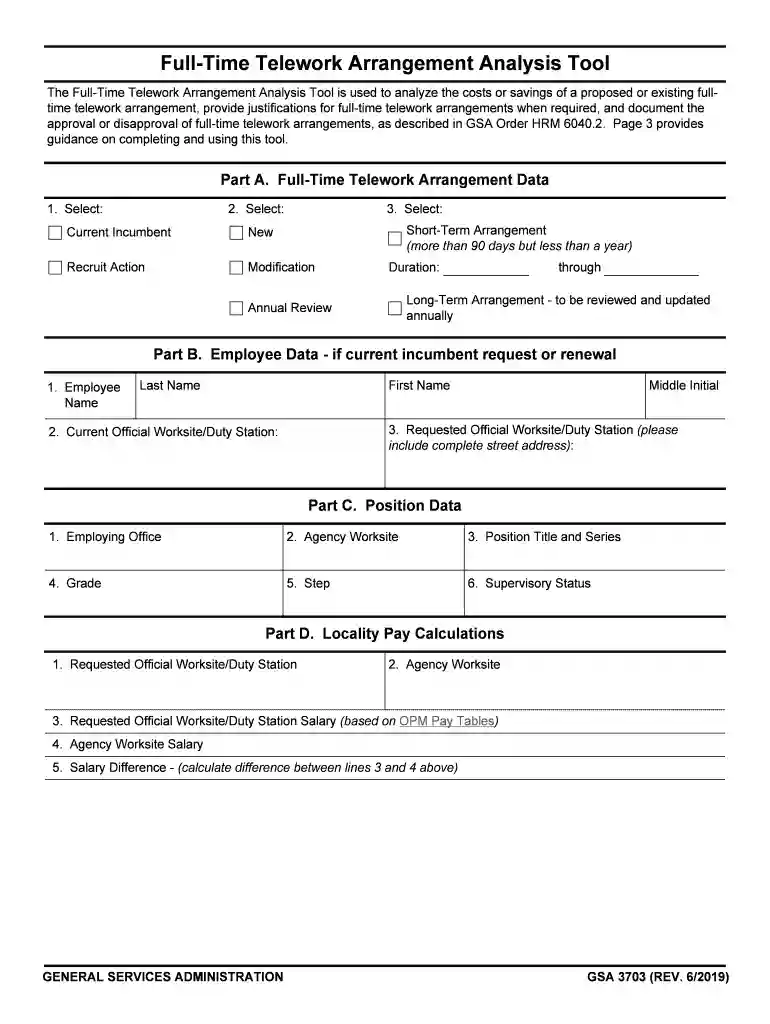
Type text, add images, blackout confidential details, add comments, highlights and more.

Draw your signature, type it, upload its image, or use your mobile device as a signature pad.

Send it via email, link, or fax. You can also download it, export it or print it out.
The GSA 3703 - Full-Time Telework Arrangement Analysis Tool is a crucial instrument for organizations to evaluate the viability and benefits of implementing full-time telework arrangements. It plays a vital role in aligning telework proposals with organizational goals and legal frameworks, ensuring both efficiency and compliance.
This tool is designed to conduct a detailed analysis of the costs and savings associated with full-time telework arrangements, aligning with the standards set by GSA Order HRM 6040.2. The tool assists organizations in assessing various factors such as employee eligibility, feasibility, and financial implications before deciding to approve telework arrangements.
The GSA 3703 tool can typically be accessed through the General Services Administration's official website or via internal HR departments in organizations that utilize GSA standards for workforce management.
The primary users of the GSA 3703 tool are HR professionals, department managers, and organizational policy makers within both private and public sectors. It is particularly valuable for large enterprises and government agencies evaluating telework policies.
Adhering to legal requirements is paramount. The tool ensures that proposals are compliant with relevant labor laws and organizational policies. The analysis must include considerations related to labor rights, employee agreements, and compliance with federal regulations such as the ESIGN Act when integrating electronic documentation processes.
The GSA 3703 tool is an instrumental resource for organizations seeking to implement or review full-time telework policies. By providing a structured approach to evaluate, justify, and implement telework arrangements, it supports optimized workforce management and operational efficiency.
We've got more versions of the GSA 3703 - Full-Time Telework Arrangement Analysis Tool form. Select the right GSA 3703 - Full-Time Telework Arrangement Analysis Tool version from the list and start editing it straight away!
At DocHub, your data security is our priority. We follow HIPAA, SOC2, GDPR, and other standards, so you can work on your documents with confidence.
analysis 1581 analyst 1582 analysts 1583 analytic 1584 analytica 1585 arrangement 2276 arrangements 2277 arranger 2278 arranges 2279 arranging 2280Read more
Nov 20, 2025 Full-Time Telework Agreement. Information. Form Number: GSA3703A; Current Revision Date: 11/2025; Authority or Regulation: ADM 6040.1A.Read more


