
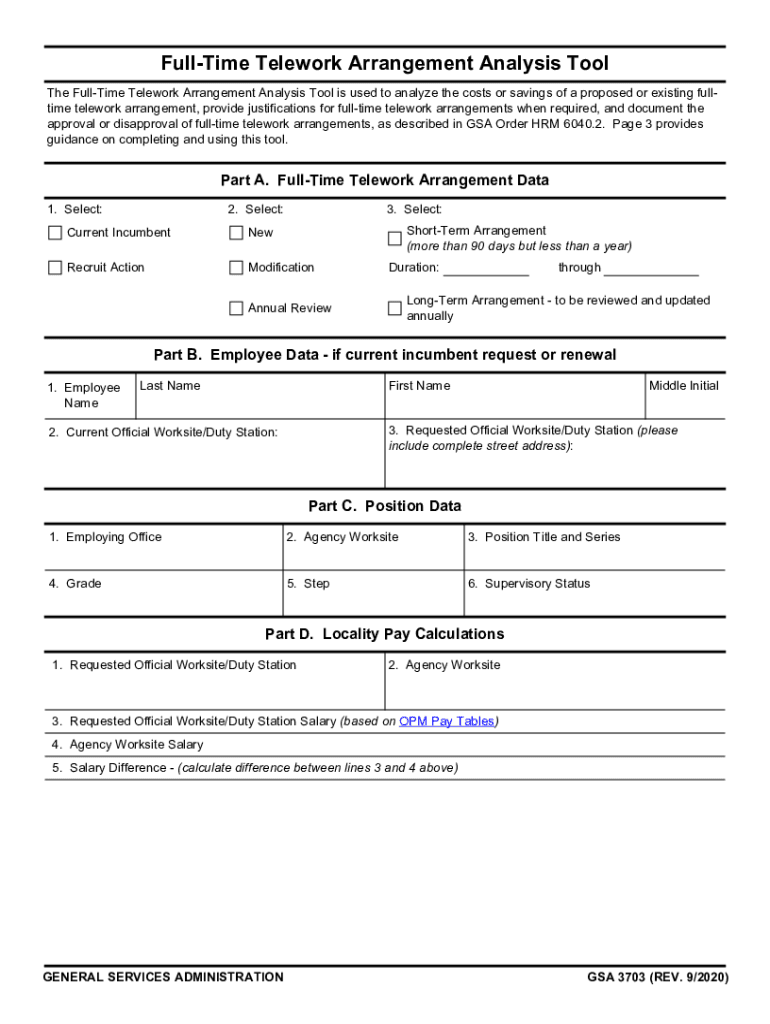







Definition and Purpose of GSA Form 3703 "Full-Time Telework Arrangement Analysis Tool"
GSA Form 3703, also known as the Full-Time Telework Arrangement Analysis Tool, serves as a comprehensive instrument to evaluate the financial implications of full-time telework arrangements. This tool is crafted in alignment with GSA Order HRM 6040.2, designed specifically to analyze costs and savings associated with telework. With sections for detailed data collection on employee roles and positions, locality pay calculations, and travel budget development, the form ensures a robust cost-benefit analysis. Additionally, it requires justifications for telework approvals and involves multiple supervisory level authorizations.
Steps to Complete the GSA Form 3703
-
Employee and Position Details: Begin by filling out the employee's information, including name, position, and department. This section also requires the employee's telework eligibility status and any relevant prior telework history.
-
Locality Pay and Financial Calculations: Use this section to calculate the financial elements related to the telework arrangement. Include specifics on locality pay rates, adjustments needed, and cost differences between working from the office versus remote work.
-
Travel Budget Development: Itemize potential travel expenses that might occur as a result of telework and compare these with office-based travel requirements. Ensure comprehensive data on frequency, purpose, and mode of travel.
-
Additional Costs and Savings Evaluation: Document potential savings in areas such as office space, utilities, and commuting expenses. Weigh these against any additional costs for technology or workspace set-up.
-
Justifications and Approval Needs: Provide detailed rationale supporting the telework arrangement. Explain how it aligns with organizational goals and outline the required approvals from supervisory levels, capturing their feedback and decisions.
Key Components of GSA Form 3703
- Data Collection: Sections dedicated to capturing detailed employee data, such as location, job responsibilities, and eligibility for telework.
- Cost-Benefit Analysis: Comprehensive analysis comparing telework costs against savings, including travel and locality expenses.
- Justification and Approval: Finalizing the telework decision requires supervisory endorsements, justifying the arrangement in terms of productivity and cost-efficiency.
Who Typically Uses the GSA Form 3703?
The GSA Form 3703 is primarily utilized by government agencies and departments within the United States that are tasked with evaluating and approving telework arrangements for their employees. This form involves input from various levels of management, including human resource managers, financial analysts, and direct supervisors, who collaborate to ensure the telework plan aligns with strategic organizational objectives.


Legal Considerations and Compliance
When utilizing the GSA Form 3703, it is crucial to adhere to established legal protocols directed by GSA Order HRM 6040.2. This encompasses maintaining privacy and confidentiality of employee data, ensuring fair and unbiased telework assessments, and aligning all telework arrangements with federal telework statutes and regulations. The legal framework necessitates a thorough justification for each telework decision, documented appropriately on the form and endorsed by supervisory entities.
Important Terminology and Concepts
- Locality Pay: Adjustments in pay based on geographical differences in living costs.
- Cost-Benefit Analysis: A systematic process to evaluate financial impacts, costs, and benefits of teleworking.
- Telework Eligibility: Criteria determining an employee's qualification for remote work based on their role and responsibilities.
How to Obtain GSA Form 3703
The GSA Form 3703 can be accessed online through the official GSA website or internal agency portals dedicated to human resource and employee management. Employees and managers involved in telework evaluations should ensure they retrieve the most current version of the form, as outlined by their agency's telework policy.
Examples and Case Studies of Using GSA Form 3703
An agency considering a shift to more remote work might utilize the GSA Form 3703 to quantify potential savings in office space reductions while assessing any costs related to technological infrastructure. A case study could examine a department that successfully implemented telework, realizing considerable savings in commuting costs, which were documented and analyzed using this tool to support their decision-making process.
State-Specific Guidelines and Rules
While GSA Form 3703 is standardized for federal use, implementation of telework arrangements may be subject to additional state-specific labor laws and regulations. Agencies should integrate these considerations into their telework arrangements, adjusting locality pay and compliance measures to reflect state laws where employees reside or perform telework duties.




