




01. Edit your pipp login online
Type text, add images, blackout confidential details, add comments, highlights and more.

Type text, add images, blackout confidential details, add comments, highlights and more.

Draw your signature, type it, upload its image, or use your mobile device as a signature pad.

Send ea110 via email, link, or fax. You can also download it, export it or print it out.
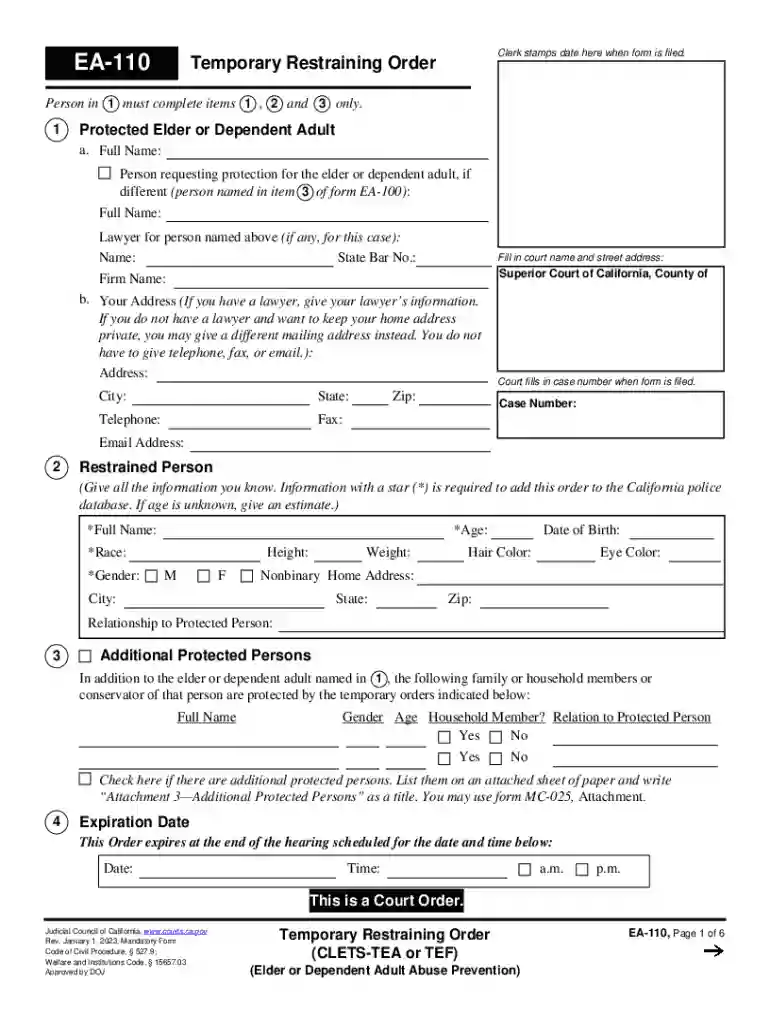
The EA-110 Temporary Restraining Order, also known as CLETS-TEA or TEF, serves as a legal safeguard specifically designed to protect elders or dependent adults from abuse. This form is part of the legal framework that allows courts to impose temporary restrictions on the alleged abuser, ensuring the safety and well-being of the protected individual. It addresses various areas such as personal conduct, stay-away orders, and firearm restrictions, playing a critical role in preventing further harm and providing immediate legal intervention.
Obtaining an EA-110 Temporary Restraining Order involves navigating the legal system effectively. The process typically begins with the filing of a petition in the court by the elder or dependent adult seeking protection or by someone legally permissible to file on their behalf. The petitioner must provide detailed information about the alleged abuse, including evidence and any supporting documents. Courts generally evaluate the urgency of the circumstances and decide on issuing the temporary order quickly, often within a matter of days.
Gather Evidence: Collect all necessary documentation and evidence that supports the allegations of abuse or harassment.
Complete the Forms: Accurately fill out the EA-110 form, ensuring all information about the parties involved and the nature of the abuse is clearly detailed.
File with the Court: Submit the completed form to the appropriate court, along with any required filing fees.
Attend a Court Hearing: Be prepared to attend a court hearing, where you may need to testify or provide further evidence.
Several key elements define the EA-110 Temporary Restraining Order, each specifically tailored to safeguard the protected individual:
Personal Conduct Orders: Prohibiting actions by the restrained person such as calling, messaging, or visiting the protected individual.
Stay-Away Orders: Requiring the restrained person to maintain a certain distance from the protected individual, their residence, workplace, or other specified locations.
Firearm Prohibitions: Explicitly banning the restrained person from possessing firearms for the duration of the order, with requirements to surrender any held weapons.
Legally, the EA-110 Temporary Restraining Order is robust in providing immediate protection and can be used in various scenarios involving potential threats or attacks. It mandates compliance from the restrained individual with legal penalties for violation. Understanding the legal implications is crucial for both petitioners and those subjected to the order. It emphasizes the seriousness of the courts’ stance on protection against abuse and the importance of adhering to its terms.
Proper completion of the EA-110 form is essential for swift processing and effectiveness. Each section of the form requires specific information:
Identification of Parties: Clearly identify the protected person(s) and the restrained individual, including full names and addresses.
Detailed Description of Circumstances: Provide a comprehensive account of the incidents leading to the request for protection, ensuring detail and clarity to validate the urgency and necessity of the order.
Request for Orders: Outline the specific protections sought, such as stay-away or no-contact provisions.
The application and enforcement of the EA-110 may vary slightly by state due to differing state laws concerning elder abuse and restraining orders. Familiarizing oneself with the specific provisions and procedural nuances applicable in one’s jurisdiction is vital. Local legal assistance or advocacy groups can provide state-specific guidance to ensure compliance and optimize the protection order’s efficacy.
Understanding the terminology associated with the EA-110 Temporary Restraining Order is crucial for navigating its application:
These terms help clarify the roles and responsibilities of the individuals involved in the legal proceedings.
Real-world scenarios where an EA-110 Temporary Restraining Order might be used include situations involving repeated harassment or threats against an elderly person by a caregiver or family member. Case studies provide insight into the practical application of the form and reinforce its critical role in protecting vulnerable individuals from harm.
Non-compliance with an EA-110 Temporary Restraining Order can have significant legal repercussions, including arrest, fines, or imprisonment for the restrained individual. This underscores the order's binding nature and the consequences of violating its terms. Law enforcement involvement ensures that orders are taken seriously and actions are swiftly corrected in the interest of justice and safety.
These sections comprehensively cover the essential aspects of the EA-110 Temporary Restraining Order, providing depth and clarity to equip individuals with the information needed to understand, obtain, and correctly utilize this legal tool.
We've got more versions of the pipp login form. Select the right pipp login version from the list and start editing it straight away!
At DocHub, your data security is our priority. We follow HIPAA, SOC2, GDPR, and other standards, so you can work on your documents with confidence.
Jan 1, 2026 Temporary Restraining Order (CLETS-TEA or TEF) (Elder or Dependent Adult Abuse Prevention) This must be done within 24 hours of being served
EA-110 and DV-110 (Temporary Restraining Order) will be examined to verify TRO status. ) allows confirmation of awarding of a PRO. Temporary Restraining Order


