




01. Edit your form online
Type text, add images, blackout confidential details, add comments, highlights and more.

Type text, add images, blackout confidential details, add comments, highlights and more.

Draw your signature, type it, upload its image, or use your mobile device as a signature pad.

Send it via email, link, or fax. You can also download it, export it or print it out.
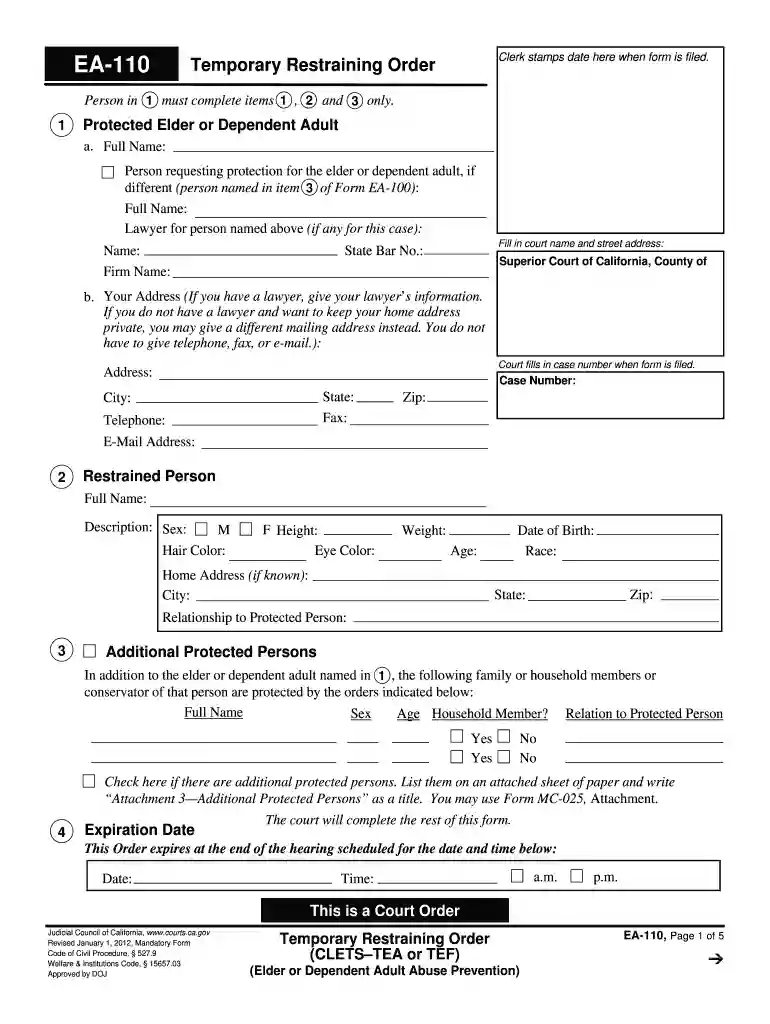
The EA-110 Response 2012 form is a critical document used in legal scenarios concerning elder or dependent adult abuse. It serves as a formal response to a restraining order, allowing the restrained individual to present their side of the story in court. Law enforcement and courts take this form seriously, as it can influence the court's decision on whether to uphold, modify, or dismiss the restraining order. Unlike other legal forms, it specifically addresses the unique dynamics of elder abuse cases, including personal conduct orders and firearm restrictions.
Filling out the EA-110 Response form involves several precise steps to ensure the court receives a clear and convincing response.
Having a clear understanding of this process can significantly affect the outcome of the restraining order hearing.
Completing the EA-110 Response form requires careful attention to each section:
Each section of the form must be meticulously filled out to provide a proper and respectful response to the court.
This form comprises several essential components that guide the legal process:
Thorough completion of these sections can provide a comprehensive defense in the restraining order process.
In the United States, responding to a restraining order requires strict adherence to legal standards. The EA-110 Response form must be completed and submitted according to court procedures to effectively dispute a restraining order. It serves an essential role in ensuring that the restrained party has an opportunity to be heard and present evidence in their defense. Failing to respond can result in the automatic granting of the restraining order, emphasizing its importance in legal proceedings.
Individuals who have been served with a temporary restraining order concerning elder or dependent adult abuse are the primary users of this form. This includes not only the alleged abusers but can also extend to legal guardians or representatives who may respond on their behalf. Legal counsel often assists in the preparation and submission of this form to ensure adherence to all legal protocols.


While the EA-110 form is standard across the United States, specific state laws may influence how it is used and processed.
Understanding these nuances is vital for a successful legal response to a restraining order.
Failure to respond to a restraining order using the EA-110 Response form can result in severe legal consequences. These might include:
Complying with all requirements of the form is essential to avoid these penalties and ensures an opportunity for-fair legal representation.
We've got more versions of the ea 110 response 2012 form form. Select the right ea 110 response 2012 form version from the list and start editing it straight away!
At DocHub, your data security is our priority. We follow HIPAA, SOC2, GDPR, and other standards, so you can work on your documents with confidence.


