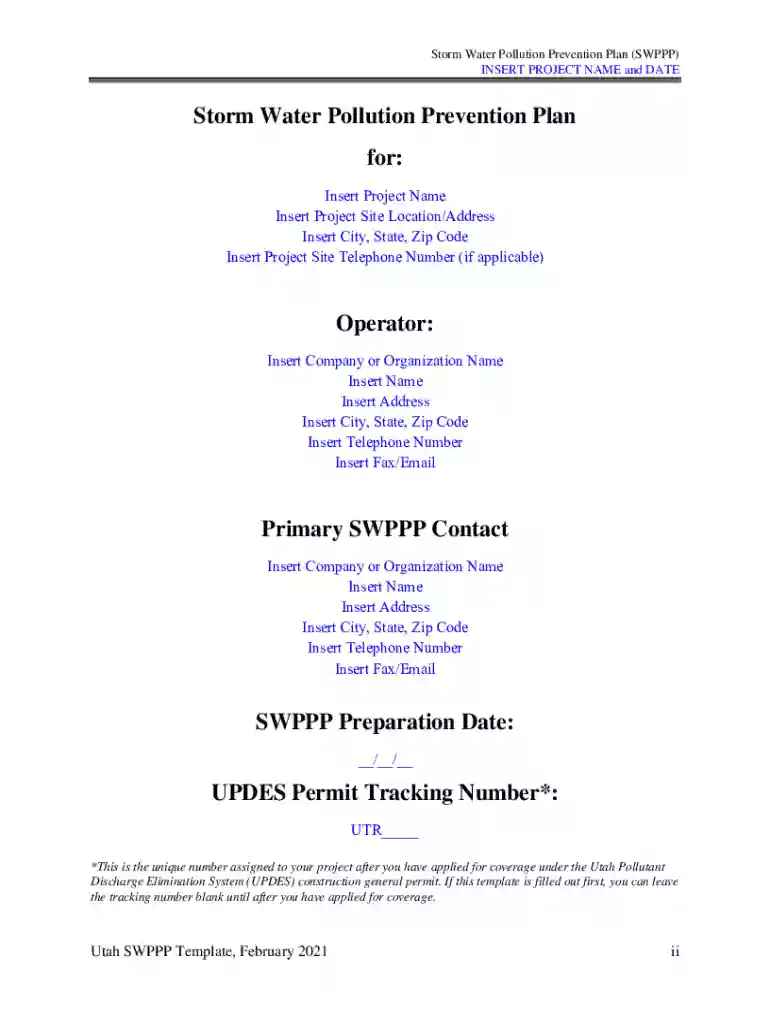
: SWPPP Template (Utah)Instructions DWQ has developed this 2026

Get Form
: SWPPP Template (Utah)Instructions DWQ has developed this Preview on Page 1

Here's how it works

01. Edit your form online
Type text, add images, blackout confidential details, add comments, highlights and more.

02. Sign it in a few clicks
Draw your signature, type it, upload its image, or use your mobile device as a signature pad.

03. Share your form with others
Send it via email, link, or fax. You can also download it, export it or print it out.

How to use or fill out the SWPPP Template (Utah) Instructions DWQ has developed this with our platform

Form edit decoration
9.5
Ease of Setup
DocHub User Ratings on G2
9.0
Ease of Use
DocHub User Ratings on G2
  1. Click ‘Get Form’ to open it in the editor.
  2. Begin by inserting your project name and date at the top of the form. This sets the context for your SWPPP.
  3. In Section 1, provide contact information for all responsible parties involved in storm water management. Ensure that each member's responsibilities are clearly defined.
  4. Move to Section 2 and describe the nature of construction activities. Include estimates of disturbed areas and a brief description of major phases.
  5. In Section 3, detail discharge information and identify receiving waters. Make sure to check if any waters are impaired or high quality.
  6. Continue through each section, following instructions carefully. Customize sections as needed based on site-specific conditions.
  7. Once completed, review all entries for accuracy and clarity before saving or sharing your document.

Start using our platform today to easily fill out your SWPPP Template for free!

See more : SWPPP Template (Utah)Instructions DWQ has developed this versions

We've got more versions of the : SWPPP Template (Utah)Instructions DWQ has developed this form. Select the right : SWPPP Template (Utah)Instructions DWQ has developed this version from the list and start editing it straight away!
Versions Form popularity Fillable & printable
2021 4.9 Satisfied (23 Votes)
2019 4.4 Satisfied (30 Votes)
be ready to get more

Complete this form in 5 minutes or less

Get form

Got questions?

We have answers to the most popular questions from our customers. If you can't find an answer to your question, please contact us.
Contact us
There are many important factors that must be included in the development of an effective SWPPP, including site-specific potential pollutant sources, drainage scenarios, structural control devices and the identification of accountable pollution prevention team members.
The purpose of the SWPPP is to control runoff from a construction site. The Qualified SWPPP Practitioner (QSP) is the person responsible for ensuring compliance with the SWPPP.
A SWPPP is a written document that identifies the industrial activities conducted at the site, including any structural control practices, which the industrial facility operator will implement to prevent pollutants from making their way into stormwater discharges.
What is required by a construction stormwater permit? Your permit requires you to control and eliminate storm water pollution sources through the development and implementation of a Storm Water Pollution Prevention Plan (SWPPP).
One of the most common mistakes operators make is using a generic SWPPP template without tailoring it to the specific site conditions and state requirements. Every construction site has unique topography, soil composition, and water drainage patterns that must be accounted for in the plan.

Security and compliance

At DocHub, your data security is our priority. We follow HIPAA, SOC2, GDPR, and other standards, so you can work on your documents with confidence.

Learn more
ccpa2
pci-dss
gdpr-compliance
hipaa
soc-compliance

People also ask

7 Steps of SWPPP Planning and Implementation Step 1: Perform a Worksite Assessment. Step 2: Develop a Site Plan. Step 3: Identify Sediment and Erosion Control BMPs. Step 4: Develop Training Procedures Proper BMPs. Step 5: Implement Good Housekeeping BMPs. Step 6: Conduct Frequent Inspections. Step 7: Stabilize the Area.

Related links