
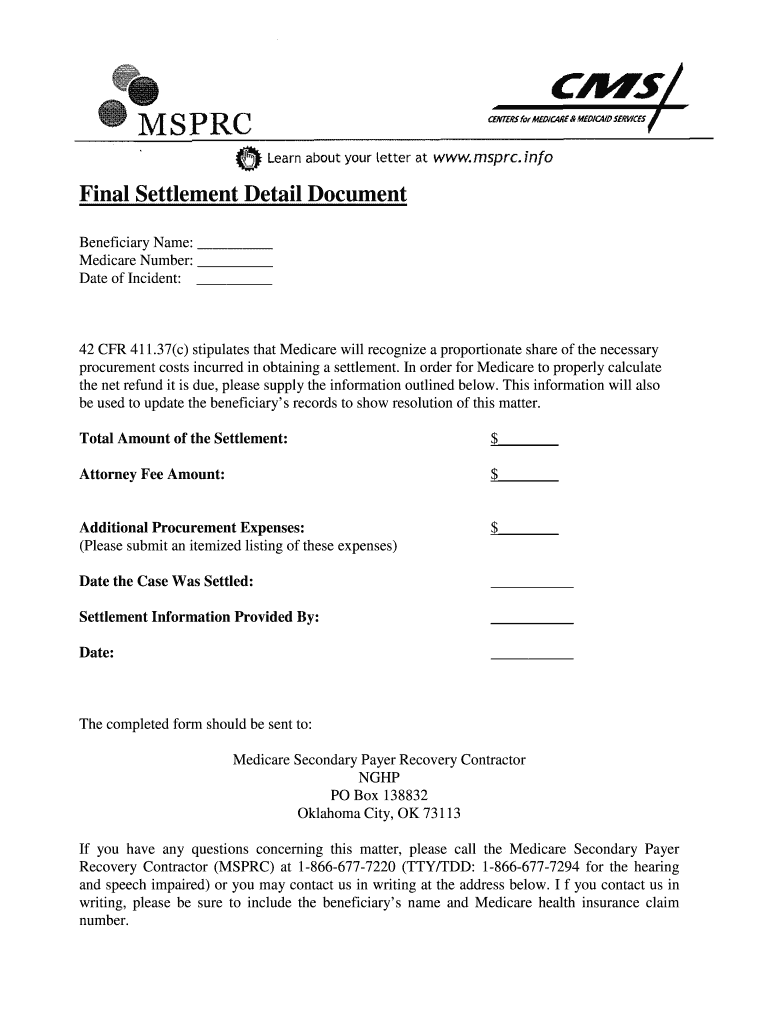







Overview of the CMS Final Settlement Detail Document
The CMS Final Settlement Detail document is an essential tool for Medicare beneficiaries and their attorneys, providing the necessary information for calculating the net refund due to Medicare after a settlement. This document plays a pivotal role in managing and resolving Medicare's secondary payment obligations. Understanding its components and usage is crucial for compliance and efficient processing.
Key Information Required in the Document
The CMS final settlement detail document mandates specific information to ensure accurate processing and compliance with Medicare regulations. The required fields typically include:
- Beneficiary's Name: The full name of the individual receiving Medicare benefits.
- Medicare Number: The unique identifier assigned to the beneficiary for tracking and record-keeping.
- Total Settlement Amount: The total monetary amount agreed upon in the settlement.
- Attorney Fees: A detailed account of the legal fees incurred during the settlement process.
- Additional Procurement Expenses: Any additional costs associated with obtaining the settlement.
- Settlement Date: The date on which the settlement was finalized.
Accurate completion of these sections is vital for Medicare to update their records and resolve any outstanding obligations effectively.
Instructions for Completing the Form
Completing the CMS final settlement detail document requires careful attention to detail. Below are steps to ensure the form is filled out correctly:
- Gather Required Information: Collect all necessary data such as the beneficiary's personal details and settlement information before beginning the form.
- Fill Out Identifying Information: Start by entering the beneficiary's name and Medicare number accurately to prevent delays in processing.
- Detail the Settlement Amount: Clearly state the total settlement amount in the specified section, ensuring that it aligns with the official settlement paperwork.
- Disclose Fees and Expenses: Provide a concise breakdown of attorney fees and any other related costs to ensure transparency.
- Review for Completeness: Before submitting, carefully review the completed form to verify all fields are filled out and calculations are accurate.
Following these steps minimizes the risk of errors and expedites the review process by Medicare.
Submission and Processing of the Document
Once the CMS final settlement detail document is completed, it must be submitted to the designated Medicare Secondary Payer Recovery Contractor (MSPRC). The following outlines the typical submission methods:
- Mail: Send the completed document via postal service to the MSPRC, ensuring you use the correct address provided by Medicare.
- Online Submission: Depending on the options available, an online portal may be used for direct submission, making the process more efficient.
- Tracking the Submission: After submitting, keep a record of the submission method and any confirmation received to track the progress of processing.
Timely submission is essential as it helps in quick resolution and prevents any penalties or delays in payments.
Importance of Compliance with Medicare Regulations
Ensuring compliance with Medicare's guidelines related to the final settlement detail document is paramount. Non-compliance can lead to penalties and delays that affect both the beneficiary's financial situation and the attorney's obligations. Key compliance considerations include:
- Timeliness: Adhering to submission deadlines to avoid penalties.
- Accuracy: Ensuring all information is complete and correct to facilitate prompt processing.
- Documentation: Maintaining records of all communications and submissions related to the settlement for reference in case of inquiries by Medicare.
Remaining informed about Medicare’s regulations and any changes helps beneficiaries and their representatives navigate the settlement process effectively.
Common Scenarios Involving the Form
Different scenarios may arise that require the use of the CMS final settlement detail document. Understanding these situations can enhance preparedness:
- Personal Injury Settlements: Individuals receiving settlements from injury claims often need to submit this document as part of the settlement process.
- Workers' Compensation Cases: Beneficiaries who have received workers' compensation benefits may also be required to complete this document to address Medicare's interests.
- Divorce Settlements: When settlements involve alimony or other support payments, the CMS document might be necessary to clarify Medicare's recovery rights.
Being aware of these situations can help in anticipating the need for the final settlement detail document and its implications.
Example Case: Processing a Personal Injury Settlement
Consider a scenario where an individual, John, receives a settlement from a personal injury lawsuit totaling $100,000. The attorney fees amount to $20,000, with $5,000 in additional expenses. John must complete the CMS final settlement detail document including:
- Name: John Smith
- Medicare Number: 123-45-6789
- Total Settlement Amount: $100,000
- Attorney Fees: $20,000
- Additional Procurement Expenses: $5,000
- Settlement Date: January 1, 2024
After completing the form, John ensures it is sent to the correct MSPRC address by mail, keeping a copy for his records to confirm the documentation was submitted correctly.
Understanding the detailed requirements and processes governing the CMS final settlement detail document equips beneficiaries and their legal representatives to effectively navigate the complexities of Medicare settlements and compliance.




