Disposition juvenile form 2026

Get Form
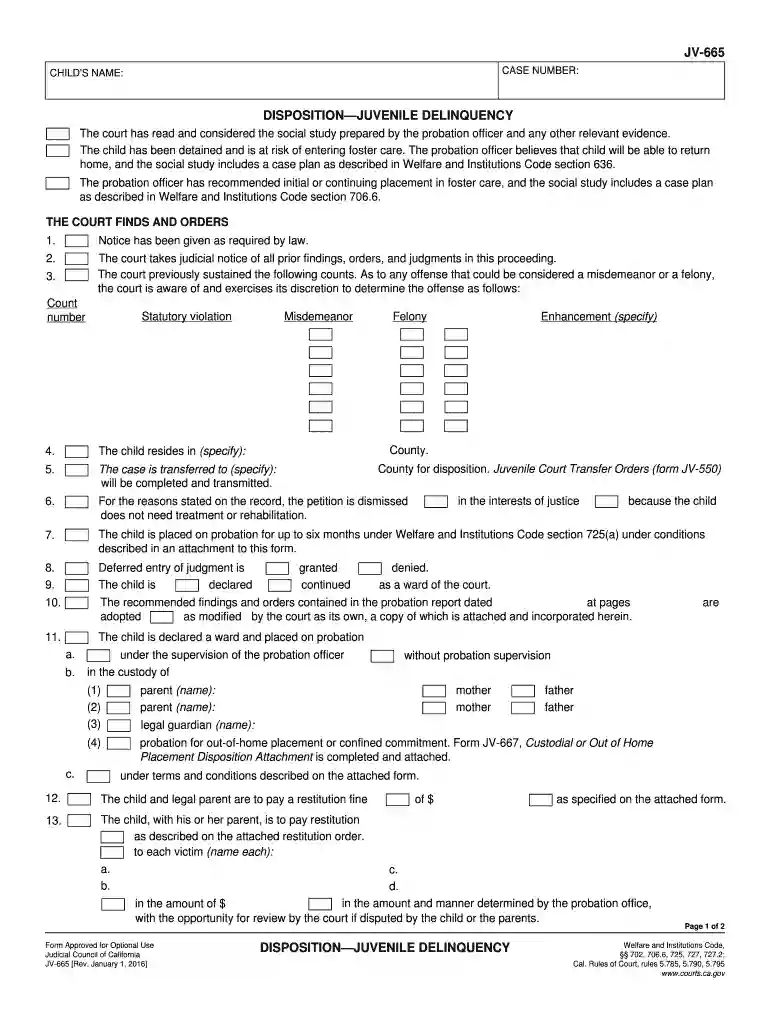
disposition juvenile california Preview on Page 1

Here's how it works

01. Edit your disposition juvenile california online
Type text, add images, blackout confidential details, add comments, highlights and more.

02. Sign it in a few clicks
Draw your signature, type it, upload its image, or use your mobile device as a signature pad.

03. Share your form with others
Send it via email, link, or fax. You can also download it, export it or print it out.

How to use or fill out disposition juvenile form with our platform

Form edit decoration
9.5
Ease of Setup
DocHub User Ratings on G2
9.0
Ease of Use
DocHub User Ratings on G2
  1. Click ‘Get Form’ to open the disposition juvenile form in the editor.
  2. Begin by entering the case number and child's name at the top of the form. This information is crucial for identifying the specific case.
  3. Review the sections regarding court findings and orders. Fill in any required details, such as statutory violations and whether they are misdemeanors or felonies.
  4. Complete the sections related to placement recommendations, including whether the child will be placed in foster care or remain at home, as indicated by the probation officer's report.
  5. Fill out any financial obligations, including restitution amounts owed to victims. Ensure that all names and amounts are accurately specified.
  6. Finalize by reviewing all entries for accuracy before saving your completed form. Use our platform’s features to print or share your document securely.

Start using our platform today to easily fill out your disposition juvenile form for free!

See more disposition juvenile form versions

We've got more versions of the disposition juvenile form form. Select the right disposition juvenile form version from the list and start editing it straight away!
Versions Form popularity Fillable & printable
2023 4.6 Satisfied (29 Votes)
2016 4.8 Satisfied (142 Votes)
2012 4.2 Satisfied (46 Votes)
be ready to get more

Complete this form in 5 minutes or less

Get form

Got questions?

We have answers to the most popular questions from our customers. If you can't find an answer to your question, please contact us.
Contact us
Disposition in the juvenile justice system is similar to sentencing in the adult criminal system. Disposition is the process of deciding what penalties will be given to a juvenile for committing an offense.
If the youth is made a ward of the court, the court can order wardship probation, either with or without the supervision of the Probation Department. Wardship probation with supervision by the Probation Department is the most common juvenile court disposition.
1. a. : a young person : youth. often, specifically : an individual who is under an age fixed by law (such as 18 years) at which he or she would be charged as an adult for a criminal act.
The most common examples of status offenses are chronic or persistent truancy, running away, violating curfew laws, or possessing alcohol or tobacco.)
The juvenile justice process involves nine major decision points: (1) arrest, (2) referral to court, (3) diversion, (4) secure detention, (5) judicial waiver to adult criminal court, (6) case petitioning, (7) delinquency finding/adjudication, (8) probation, and (9) residential placement, including confinement in a

Security and compliance

At DocHub, your data security is our priority. We follow HIPAA, SOC2, GDPR, and other standards, so you can work on your documents with confidence.

Learn more
ccpa2
pci-dss
gdpr-compliance
hipaa
soc-compliance

People also ask

Theft is one of the most prevalent crimes committed by juveniles. This includes shoplifting, stealing personal belongings, or even attempting to take a vehicle. While it might seem minor, theft can lead to docHub legal consequences.
Probation has been called the workhorse of the juvenile justice system according to the Office of Juvenile Justice and Delinquency Prevention, probation is the most common disposition in juvenile cases that receive a juvenile court sanction.
Probation is the most frequent disposition for all juvenile arrests because: It is limitless: unlike training schools or private providers, probation departments cannot limit or control their intake.

Related links