




01. Edit your form online
Type text, add images, blackout confidential details, add comments, highlights and more.

Type text, add images, blackout confidential details, add comments, highlights and more.

Draw your signature, type it, upload its image, or use your mobile device as a signature pad.

Send it via email, link, or fax. You can also download it, export it or print it out.
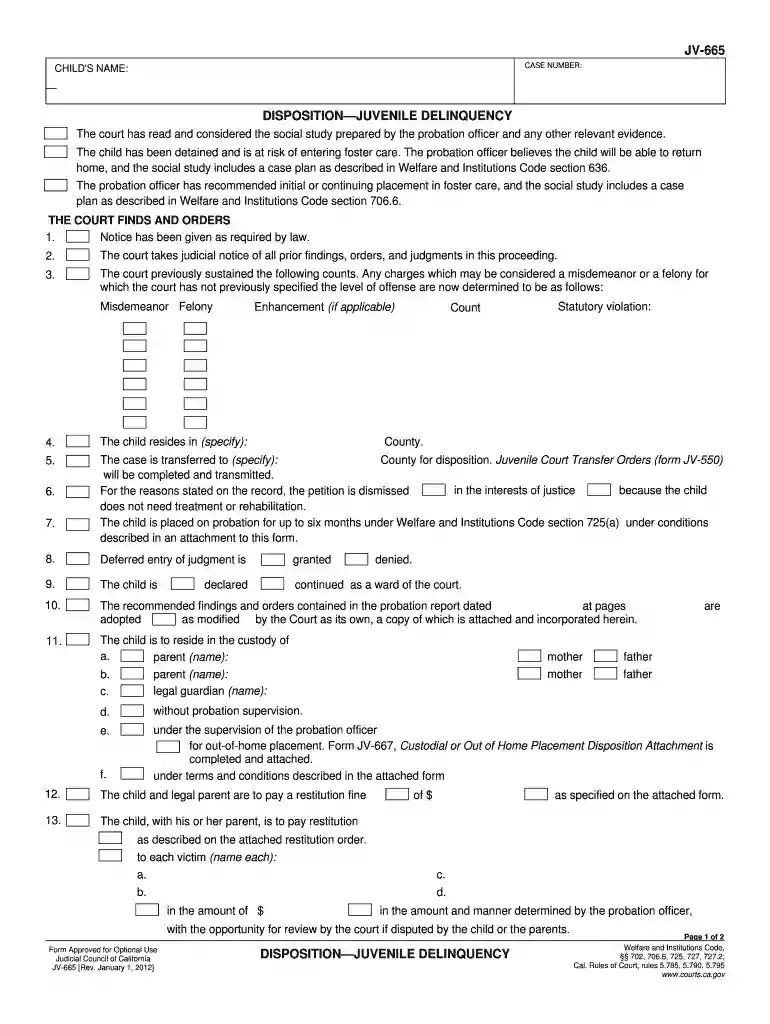
The JV-665 Disposition Juvenile Delinquency Judicial Council forms are pivotal legal documents used in California courts to record the findings and orders in juvenile delinquency cases. These forms serve as a comprehensive record of the court's decisions regarding a juvenile who is at risk of entering foster care due to delinquent behavior. The form details placement options, probation conditions, restitution directives, and other legal obligations that the juvenile and their guardians must adhere to. Utilizing these forms ensures that the legal process is standardized and provides a clear path for rehabilitation and accountability.
Understanding how to properly use the JV-665 forms is crucial for legal professionals and guardians involved in a juvenile delinquency case. The process typically starts with gathering the necessary background information on the juvenile's case, including social studies and evidence that the court might consider. The form must include detailed sections on the court’s decisions about the juvenile’s placement, any conditions of probation, and any required restitution. It's essential to accurately complete each section according to the court’s requirements to ensure compliance and avoid legal complications.
Review Case Details: Gather and review all relevant documents, such as social study reports and evidence presented in court.
Complete the Form: Fill out each section meticulously, addressing all aspects of the court’s findings and orders.
Submit to the Court: Ensure that the completed form is submitted to the relevant judicial body promptly for it to take effect.
Completing the JV-665 form involves several detailed steps to ensure all necessary information is captured. Accurate completion is vital as the form documents the court’s decisions regarding a juvenile’s case.
Header Information: Start by filling in the juvenile’s name, case number, and date of the hearing.
Court Findings: Document the court's findings regarding the juvenile's circumstances and risk factors that led to the delinquency.
Placement Orders: Specify the juvenile’s living arrangements, whether it's foster care, probationary supervision, or another court-approved plan.
Probation Conditions: Clearly detail the terms of probation if applicable, including duration and any tasks or programs the juvenile must complete.
Restitution and Obligations: Outline any financial restitution the juvenile or their guardians are required to make.
Signature Verification: Ensure the form is signed by all required parties, including a judge or authorized court representative.
The JV-665 forms are primarily used by legal professionals, such as attorneys and judges, involved in juvenile delinquency cases. They are also significant for social workers who might need to provide input on the juvenile’s circumstances and potential rehabilitation paths. Guardians or parents of the juvenile are also closely involved, as the form outlines the responsibilities and obligations they and the juvenile are required to fulfill.


Several critical components are integral to the JV-665 forms, each serving a specific purpose in documenting the court’s decisions:
The JV-665 forms are legally binding documents used to enforce court decisions in juvenile delinquency cases. Legal professionals utilize these forms to ensure their clients are complying with court orders, while also using them as a basis for future hearings or appeals. The form serves as an official record that can be referenced by legal institutions and professionals within the juvenile justice system in California.
To illustrate the practical use of the JV-665 forms, consider the case of a juvenile who has been involved in petty theft. After evidence is reviewed, the court may decide that the best course of action is community service and mandatory attendance in a rehabilitation program. The JV-665 form would document this decision, clearly outlining the community service hours and specifics of the program. This documentation assists in monitoring the juvenile's adherence to court orders and provides a formal record in case of non-compliance or further legal proceedings.
The regulations regarding the use and completion of JV-665 forms are specific to California, as they align with state juvenile justice laws. California law mandates that the completion of these forms reflects the state's commitment to rehabilitating juveniles rather than imposing punitive measures. As a result, the forms are detailed in ensuring that every aspect of the juvenile’s care and rehabilitation is considered, from placement to education and family involvement.
There are several ways to submit the JV-665 forms, each offering different advantages:
While the JV-665 is specifically used for juvenile delinquency cases, variations of similar forms may exist for situations involving different types of juvenile proceedings, such as dependency or truancy cases. Understanding the specific form applicable to your situation ensures compliance with legal requirements.
We've got more versions of the JV-665 Disposition Juvenile Delinquency Judicial Council forms - courts ca form. Select the right JV-665 Disposition Juvenile Delinquency Judicial Council forms - courts ca version from the list and start editing it straight away!
At DocHub, your data security is our priority. We follow HIPAA, SOC2, GDPR, and other standards, so you can work on your documents with confidence.
But on a preprinted form (Judicial Council Forms, form JV-665, as rev. Jan. 1, 2007) the court checked a box beside this printed text: The child is
DISPOSITIONJUVENILE DELINQUENCY. The court has read and considered the social study prepared by the probation officer and any other relevant evidence.


