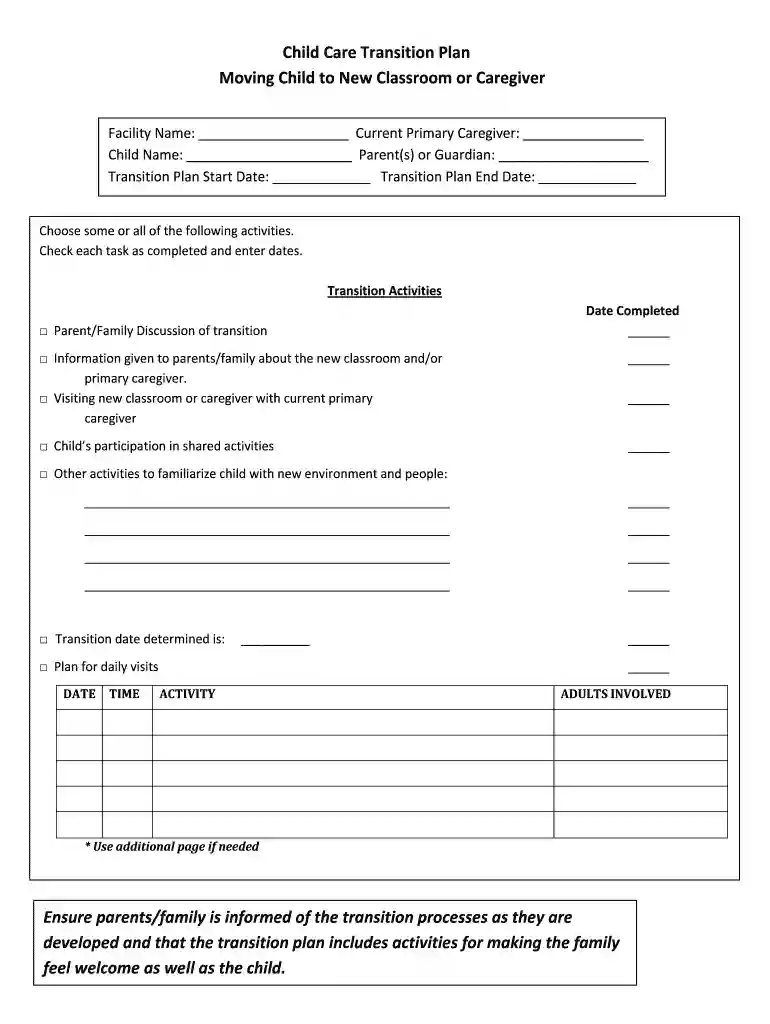
Child Care Transition Plan Child Care Transition Plan 2026

Get Form
free behavior transition plan daycare illinois Preview on Page 1

Here's how it works

01. Edit your free behavior transition plan daycare illinois online
Type text, add images, blackout confidential details, add comments, highlights and more.

02. Sign it in a few clicks
Draw your signature, type it, upload its image, or use your mobile device as a signature pad.

03. Share your form with others
Send daycare behavior transition plan via email, link, or fax. You can also download it, export it or print it out.

How to use or fill out Child Care Transition Plan with our platform

Form edit decoration
9.5
Ease of Setup
DocHub User Ratings on G2
9.0
Ease of Use
DocHub User Ratings on G2
  1. Click ‘Get Form’ to open the Child Care Transition Plan in the editor.
  2. Begin by filling in the Facility Name and Current Primary Caregiver fields. This information is essential for identifying the context of the transition.
  3. Next, enter the Child's Name and Parent(s) or Guardian details. This personalizes the plan and ensures all parties are informed.
  4. Specify the Transition Plan Start Date and End Date. These dates help track the timeline of the transition process.
  5. Review the list of Transition Activities. Check off completed tasks and enter corresponding dates to document progress.
  6. For any additional activities that help familiarize your child with their new environment, write them in the provided space.
  7. Finally, determine and record the transition date, along with a plan for daily visits, including date, time, activity, and adults involved.

Start using our platform today to streamline your Child Care Transition Plan for free!

See more Child Care Transition Plan Child Care Transition Plan versions

We've got more versions of the Child Care Transition Plan Child Care Transition Plan form. Select the right Child Care Transition Plan Child Care Transition Plan version from the list and start editing it straight away!
Versions Form popularity Fillable & printable
2019 4.8 Satisfied (81 Votes)
2016 4.5 Satisfied (48 Votes)
2015 4.4 Satisfied (439 Votes)
2013 4.2 Satisfied (46 Votes)
2012 4.3 Satisfied (29 Votes)
2012 4.8 Satisfied (21 Votes)
be ready to get more

Complete this form in 5 minutes or less

Get form

Got questions?

We have answers to the most popular questions from our customers. If you can't find an answer to your question, please contact us.
Contact us
Transitions in an early childhood setting can refer to contexts such as arriving and departing the centre, graduating from kindergarten to Prep, or moving between age groups in a setting such as a long day care centre.
Strategy 4: Care Transitions From Hospital to Home: IDEAL Discharge Planning Describe what life at home will be like. Review medications. Highlight warning signs and problems. Explain test results. Make followup appointments.
The nursing process functions as a systematic guide to client-centered care with 5 sequential steps. These are assessment, diagnosis, planning, implementation, and evaluation. Assessment is the first step and involves critical thinking skills and data collection; subjective and objective.
The process is lifelong. Transition assessment. Student engagement and self-determination. Academic preparation. Family engagement. Career exploration and employment experience. Preparing for postsecondary education and training. Involvement of others including interagency collaboration. High quality IEPs.
Transitional child care means a program designed to provide child care payments for eligible families that terminated AFDC financial assistance or non- assistance payments sponsored by the department to enable them to maintain self-sufficiency.

Security and compliance

At DocHub, your data security is our priority. We follow HIPAA, SOC2, GDPR, and other standards, so you can work on your documents with confidence.

Learn more
ccpa2
pci-dss
gdpr-compliance
hipaa
soc-compliance

People also ask

Transitions of care are a set of actions designed to ensure coordination and continuity. They should be based on a comprehensive care plan and the availability of well-trained practitioners who have current information about the patients treatment goals, preferences, and health or clinical status.

behavior transition plan