
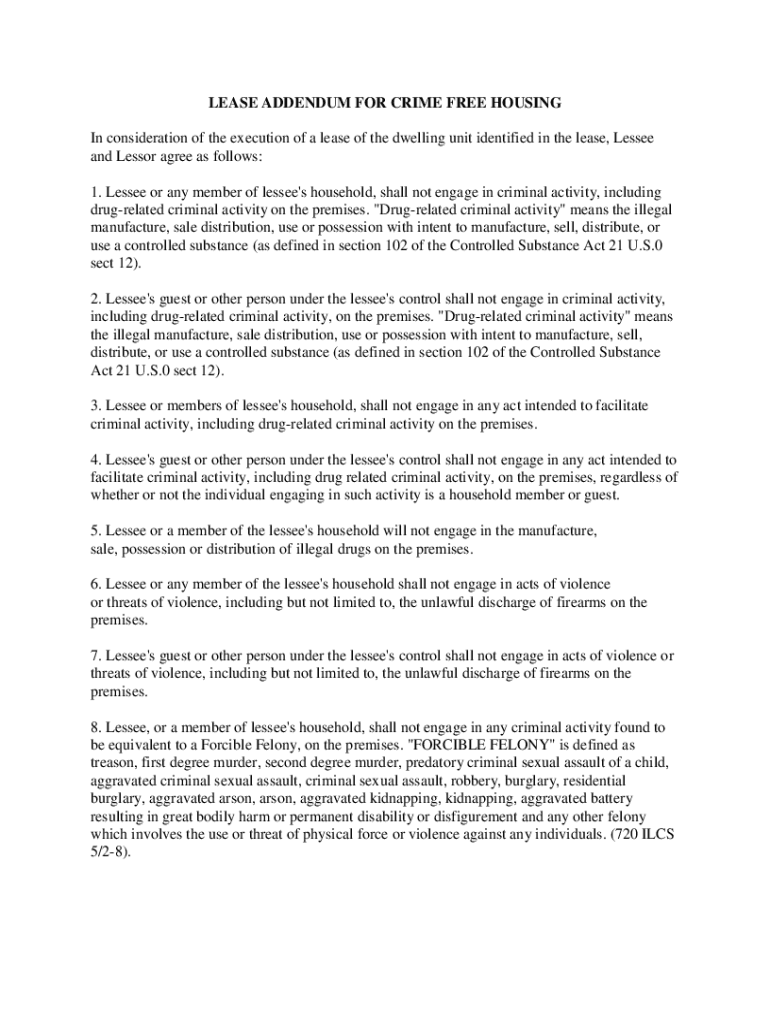







Definition and Purpose of the Lease Addendum for Crime Free Housing 2020
The Lease Addendum for Crime Free Housing 2020 serves as a formal agreement between a landlord and tenant aimed at enhancing the safety and security within residential communities. It outlines strict prohibitions against criminal activities, including drug-related offenses and acts of violence, involving the lessee, their guests, or anyone under their supervision. The core intent of the addendum is to create a safer living environment by clearly stating that any such criminal engagement is deemed a major breach of the rental agreement, potentially leading to eviction. Proof of violation does not require a criminal conviction, ensuring swift action can be taken to address issues.
How to Use the Lease Addendum for Crime Free Housing 2020
Using the Lease Addendum for Crime Free Housing 2020 involves several key steps:
-
Attach the addendum to the lease: When forming the rental agreement, the landlord should attach this addendum to clarify additional conditions.
-
Review with the tenant: Both parties must review the addendum to ensure understanding and agreement.
-
Obtain signatures: The landlord and tenant must sign the addendum to acknowledge their acceptance of its terms.
-
Implement within lease terms: Integrate the stipulations of the addendum within the general lease conditions, ensuring clear communication.
This process helps ensure that both parties are transparent about the expectations and conditions of tenancy relating to crime-free housing.
Steps to Complete the Lease Addendum for Crime Free Housing 2020
Completing the Lease Addendum requires methodical attention to the specified conditions:
-
Read Each Clause: Understand the prohibitions against specific criminal activities listed in the addendum.
-
Ensure Understanding: Discuss any unclear terms with the tenant to guarantee mutual understanding.
-
Signatures: Both parties must sign and date the document to formalize its inclusion in the lease.
-
Secure Documentation: File a copy with the original lease for legal reference and provide a copy to the tenant.
Ensuring accurate completion of the form not only enforces compliance but also protects both landlord and tenant rights.
Key Elements of the Lease Addendum for Crime Free Housing 2020
The addendum consists of several pivotal components:
-
Prohibited Activities: Details types of criminal activities, such as drug use and violence, not allowed on the premises.
-
Enforcement Conditions: Explains actions to be taken in the event of a breach, emphasizing eviction without criminal conviction.
-
Coverage: Specifies that the rules apply to the tenant, household members, guests, and any person under their control.
These elements work collectively to maintain a crime-free residential environment.
Legal Use of the Lease Addendum for Crime Free Housing 2020
The legal application of the Lease Addendum ensures compliance and enforceability:
-
Contracts Law: The addendum functions as part of the binding rental contract subject to general contract laws.
-
Eviction Proceedings: Provides legal backing for eviction proceedings linked to criminal activity violations.
-
Statutory Compliance: Must adhere to federal, state, and local housing codes, ensuring it doesn't infringe on tenant rights.
Using the addendum legally requires a solid understanding of its integration with housing laws and regulations.
State-Specific Rules for the Lease Addendum for Crime Free Housing 2020
State regulations may impact the implementation of the Lease Addendum:
-
Variations in Housing Laws: Different states may have unique statutes affecting crime-free housing policies.
-
Requirement for Signage: Some states might require physical signage informing about crime-free policies.
-
Eviction Requirements: Variance in procedural requirements for eviction based on criminal activities.
Understanding these nuances ensures the addendum's effective application across different jurisdictions.
Important Terms Related to the Lease Addendum for Crime Free Housing 2020
Grasping the terminology within the Lease Addendum is crucial:
-
Material Noncompliance: Breach of a major term resulting in potential lease termination.
-
Premises: The rented property and surrounding areas under tenant control.
-
Conviction: Legal finding of guilt not required for proving violation in this context.
These terms play a core role in interpreting and enforcing the addendum's guidelines.
Who Typically Uses the Lease Addendum for Crime Free Housing 2020
Typical users of the Lease Addendum encompass:
-
Landlords: Incorporating addendums as part of their agreements to enhance property security.
-
Housing Authorities: Implementing crime-free policies within community housing projects.
-
Property Managers: Ensuring adherence to privacy and safety obligations under legal standards.
Understanding the audience for this document helps cater to specific needs within various housing environments.


Examples of Using the Lease Addendum for Crime Free Housing 2020
Practical applications highlight the utility of the addendum:
-
Eviction Case: A tenant hosting frequent dangerous gatherings leading to accelerated eviction processes.
-
Lease Renewal: A landlord offering lease renewal only after stipulating adherence to crime-free terms.
These examples illustrate how the addendum effectively supports maintaining a secure living environment.
How to Obtain the Lease Addendum for Crime Free Housing 2020
Acquiring the addendum can be straightforward:
-
Online Resources: Downloadable from legal document libraries or landlord association websites.
-
Property Management Tools: Available within software providing document templates.
-
Legal Counsel: Custom-designed by attorneys to fit specific landlord requirements.
These varied sources ensure easy access to the necessary forms for landlords and property managers.




