
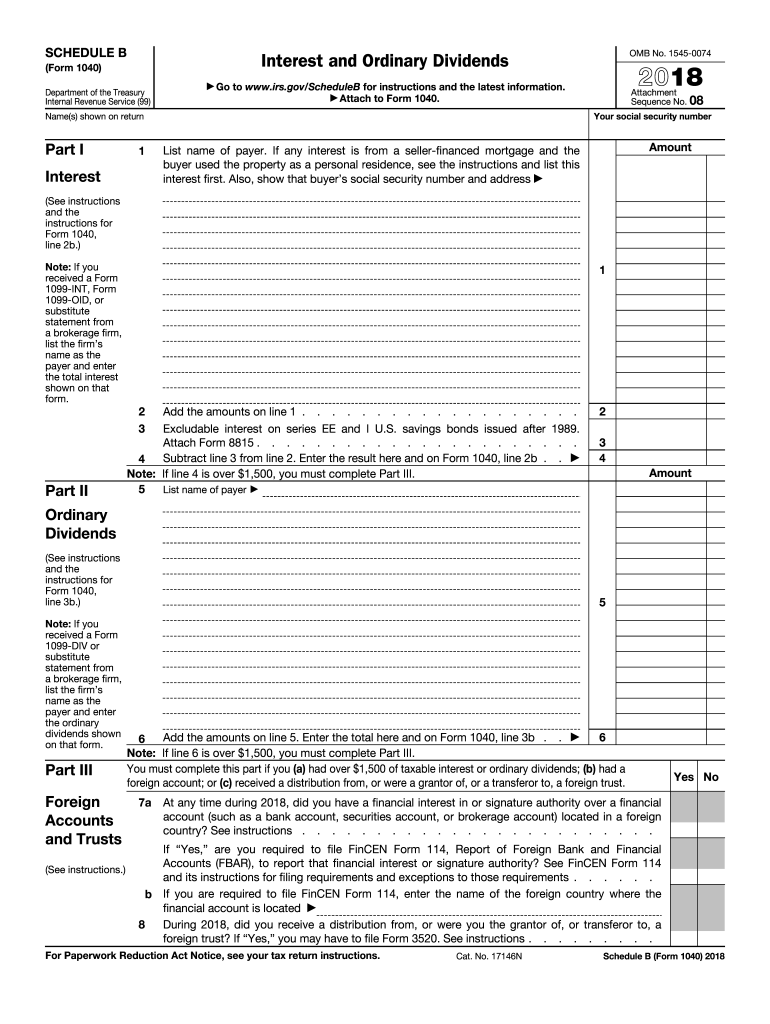







Definition and Meaning
The 2016 Schedule B form is a supplementary tax form used by the Internal Revenue Service (IRS) in the United States. It is specifically designed for taxpayers who need to report interest and ordinary dividend income exceeding $1,500, derived from bank accounts, investments, and other financial instruments. This form is also used to disclose any foreign accounts or trusts. Schedule B is an essential part of the federal income tax filing process for individuals and businesses that meet these criteria, ensuring transparency and compliance with U.S. tax laws.
Key Aspects
- Interest Income: This section requires you to list all sources of interest earnings, such as bank savings accounts or bonds.
- Ordinary Dividends: Here, you report dividends received from stock investments, including mutual funds.
- Foreign Accounts and Trusts: Section III of the form requires taxpayers to indicate whether they had any financial interest in accounts maintained outside the United States or participated in foreign trusts.
How to Use the 2016 Schedule B Form
Utilizing the Schedule B form involves recognizing when it's necessary and accurately filling it out to accompany your 1040 tax return. This ensures that all taxable interest and dividends are appropriately reported to the IRS.
Detailed Instructions
- Identify Requirement: Determine if you need to file Schedule B by assessing whether your interest or dividends exceed $1,500, or if you hold foreign accounts.
- Gather Documentation: Collect all relevant documents, such as 1099-INT or 1099-DIV forms from banks or financial institutions.
- Complete Sections: Fill out Part I for interest income, Part II for dividends, and Part III for foreign accounts and trusts.
- Ensure Accuracy: Double-check all figures and disclosures to avoid penalties or audit triggers.
How to Obtain the 2016 Schedule B Form
You can access the Schedule B form through several methods to ensure it's readily available when needed for tax filing purposes.
Access Points
- IRS Website: Download the form directly from the IRS official website.
- Tax Preparation Software: Utilize programs like TurboTax or H&R Block, which include Schedule B in their software bundle.
- Local Tax Offices: Pick up a physical copy from IRS or local government tax offices.
Steps to Complete the 2016 Schedule B Form
Completing the Schedule B form requires attention to detail and understanding each part to ensure compliance with tax regulations.
Step-by-Step Breakdown
- Complete Part I: List each source of interest and the corresponding amounts.
- Complete Part II: Report your ordinary dividends, providing a comprehensive list of all payers.
- Complete Part III: Answer questions regarding foreign accounts and trusts, indicating necessary details for financial transparency.
- Review and Submit: Ensure all information is completed and accurate before attaching it to your 1040 form.
Important Terms Related to the 2016 Schedule B Form
Familiarizing yourself with the terminology used on the Schedule B form facilitates a clearer understanding of the requirements and nuances involved.
Key Terms
- 1099-INT: A statement detailing interest payments from financial institutions.
- 1099-DIV: A form that reports dividends and distributions from investments.
- Foreign Trust: A trust located outside of U.S. jurisdiction; requires special reporting if applicable.
IRS Guidelines
The IRS provides specific guidelines for when and how to use the Schedule B form, ensuring compliance and comprehensive reporting.
Highlights of IRS Instructions
- Threshold Limits: Necessary for reporting interest and dividends over $1,500.
- Foreign Account Reporting: Mandatory reporting for accounts holding more than $10,000 in foreign banks.
- Accuracy and Penalties: Importance of maintaining accuracy to avoid penalties or audits.
Who Typically Uses the 2016 Schedule B Form
Understanding who generally needs to file the Schedule B form can help identify if you are required to include it in your tax returns.


Common User Profiles
- Investors: Individuals receiving significant dividends from investments.
- Foreign Account Holders: Taxpayers with foreign bank accounts or investments, ensuring transparency with IRS requirements.
- High Net Worth Individuals: Taxpayers with diversified portfolios generating notable interest or dividend income.
Required Documents for Filing
Having all necessary documentation ready assists in the smooth completion and submission of the Schedule B form.
Essential Documents
- 1099-INT Forms: For interest income details.
- 1099-DIV Forms: To accurately report dividends.
- Bank Statements: Supporting documentation for interest and ledger reconciliation.
- Foreign Account Statements: Proof of foreign financial assets or trusts, supporting claims and disclosures required by the IRS.




