
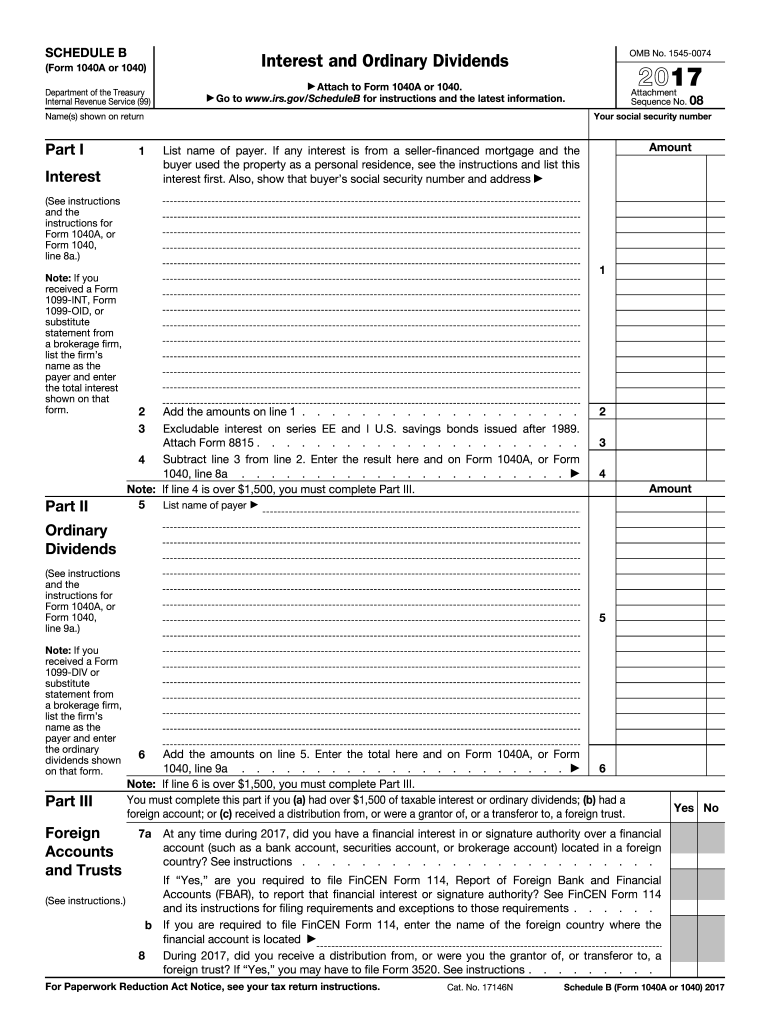







Definition and Purpose of Schedule B 2017 Form
Schedule B is a tax form used by the Internal Revenue Service (IRS) in the United States. It is specifically designated for individuals who need to report interest and ordinary dividends when filing their federal income tax returns using Form 1040 or 1040A for the year 2017. The form aids taxpayers in itemizing income earned from interest and dividends, ensuring accurate reporting and compliance with taxation requirements.
Key Functions
- Reporting Interest Income: Taxpayers list each payer of interest received during the year. This can include various financial institutions like banks or credit unions.
- Reporting Dividends: The form requires listing dividends received from investments, such as stocks or mutual funds.
- Foreign Accounts: Part III addresses foreign bank and financial accounts, requiring disclosure if specific thresholds are met.
- Total Calculations: Summarizes total interest and dividends to be transferred to the main 1040 form.
Steps to Completing Schedule B 2017 Form
Understanding the process of accurately filling out Schedule B is crucial. Below are detailed steps:
-
Gather Necessary Documents:
- Collect all 1099-INT and 1099-DIV forms received from banks, brokers, and other financial institutions.
- Obtain statements detailing foreign accounts if applicable.
-
List Interest and Dividend Income:
- Interest Income: Enter each payer's name and the amount of interest earned. Total these amounts.
- Ordinary Dividends: List each issuer of dividends and the amount received. Calculate the total dividends.
-
Foreign Accounts Section:
- Indicate any foreign accounts, the country, and balance details if you meet the filing threshold.
-
Total and Transfer:
- Sum up the totals from all sections and ensure transfer to the appropriate lines on your Form 1040.
Practical Example
Consider a taxpayer with interest from two bank accounts and dividends from three different stocks. Each income source should be listed individually, reflecting accurate amounts, ensuring the total calculations align with those transferred to the main tax form.
Obtaining the Schedule B 2017 Form
Taxpayers can acquire the Schedule B 2017 form through several channels:
- IRS Website: The form is available for download on the official IRS website, providing both printable and fillable PDF versions.
- Tax Preparation Software: Many programs include Schedule B, integrating it into the larger tax filing process for ease of use.
- Local IRS Office: Physical copies can be obtained from IRS offices if electronic access is limited.
Legal Use and Compliance
Schedule B carries legal significance, as it involves accurate reporting of financial details that can influence tax liabilities.
Importance of Compliance
- Accuracy: Errors or omissions can lead to penalties and interest charges.
- Disclosure: Ensures adherence to regulations regarding foreign accounts, as required under the Foreign Account Tax Compliance Act (FATCA).
IRS Guidelines for Schedule B 2017 Form
The IRS provides comprehensive guidelines for Schedule B, outlining when the form must be filed, specific thresholds, and applicable instructions for accurate completion.
Filing Requirements
- Interest and Dividend Thresholds: Schedule B is mandatory if your interest and ordinary dividends exceed $1,500, or if you have foreign accounts.
- Correct Filing: Ensure timely inclusion within your Form 1040 or 1040A submission to avoid compliance issues.
Examples of Using Schedule B 2017 Form
Schedule B is used by individuals with various financial activities:
- Retirees often rely on dividend income, making Schedule B critical for accurate reporting.
- Investors with diverse portfolios will commonly engage with the form to document interest and dividend income.
- Individuals with Foreign Accounts: Extended travel or expatriate life necessitates the disclosure part of Schedule B.
Penalties for Non-Compliance
Failure to correctly complete and submit Schedule B can result in significant penalties:
- Late Filing Penalties: Applicable if the Schedule is not filed within the tax due date.
- Accuracy-Related Penalties: Occur when significant discrepancies arise between reported and actual income.
Avoidance Strategies
- Double Verification: Thoroughly check all entries for correctness.
- Professional Assistance: Engage with tax professionals or accountants to ensure compliance.
Software Compatibility
For efficient document handling, Schedule B can be integrated with several tax preparation software solutions:
- TurboTax and H&R Block: These programs simplify form filling through guided, user-friendly interfaces.
- QuickBooks: Can assist in gathering necessary financial data to ease the filling process.
Advancements in Software
The incorporation of digital solutions has enhanced the efficiency and accuracy of tax filing, allowing for seamless electronic submission and integration with existing financial records.
Conclusion
Schedule B 2017 serves an essential function in the U.S. tax system, providing a structured format to declare specific income types. By understanding its requirements and meticulously following IRS guidelines, taxpayers can ensure compliance, avoid penalties, and contribute to a transparent tax reporting process.




