




01. Edit your form online
Type text, add images, blackout confidential details, add comments, highlights and more.

Type text, add images, blackout confidential details, add comments, highlights and more.

Draw your signature, type it, upload its image, or use your mobile device as a signature pad.

Send it via email, link, or fax. You can also download it, export it or print it out.
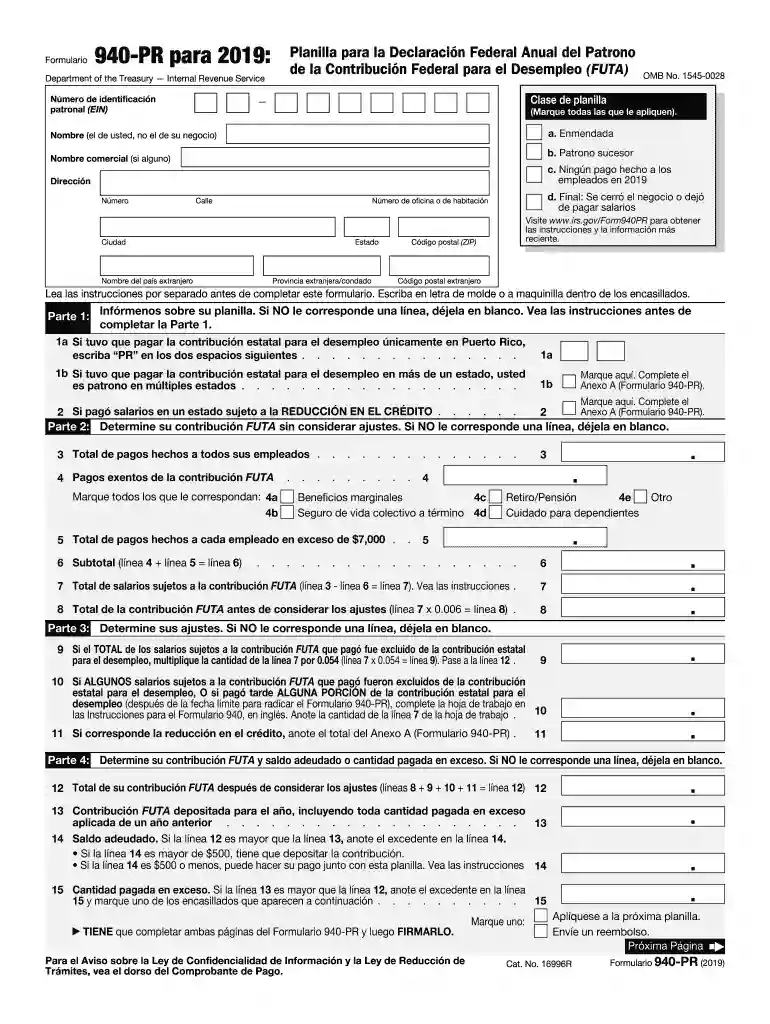
The 940-PR form is an essential document used for reporting annual federal unemployment taxes (FUTA) specifically by employers in Puerto Rico. This form allows businesses to report their FUTA tax, which is a federal tax that provides temporary funding for unemployed workers. Employers must ensure they correctly report their employee's wages and any state unemployment taxes paid, as it directly impacts FUTA tax calculations. The form acts not only as a financial report but also ensures compliance with both federal and Puerto Rican tax regulations.
Employers need to accurately fill out the 940-PR to report their FUTA tax liabilities. This includes gathering detailed information about their payroll and any compensation that falls under federal unemployment criteria. The form must be filled out with the employer's identification details, total wages paid, and any adjustments or credits related to state contributions. It is used to compute the tax due after accounting for applicable exemptions and payments, ensuring the employer meets their annual tax obligations under the FUTA.
The form is used by employers operating in Puerto Rico who must report and pay federal unemployment taxes on wages paid to employees. It's pertinent for businesses of various types, including corporations, partnerships, and sole proprietorships, that have employees subject to FUTA tax. Even small businesses with minimal staffing are required to comply if they meet the wage thresholds.


The 940-PR must be filed annually. The deadline for submission is typically January 31st following the year for which the tax is reported. If the employer has made timely FUTA tax deposits, the deadline extends to February 10th. Staying compliant with these deadlines helps avoid interest and penalties for late filing or uncompleted payments.
To accurately complete the 940-PR, gather supporting documentation including payroll records, prior state unemployment tax returns, and any receipts of state unemployment contributions paid. Accurate financial records throughout the tax year simplify the preparation and ensure all figures reported are verifiable, minimizing the risk of audits or discrepancies.
The IRS provides specific guidelines for completing the 940-PR, ensuring correct calculation and filing of the unemployment tax. Employers must follow these stipulations to determine who qualifies as an employee, what constitutes taxable wages, and how to apply tax credits. The IRS also outlines how to handle amendments and corrections to previously filed forms should errors be discovered after submission.
While the 940-PR pertains to federal unemployment taxes, it aligns closely with Puerto Rico's specific rules and requirements. Employers must take into account any state-specific stipulations regarding unemployment contributions which may affect the federal reporting. Understanding both federal and local regulations ensures appropriate compliance and accurate reporting.
Failing to file or inaccurately completing the form 940-PR can result in significant penalties. The IRS may impose fines for late submissions, incorrect payments, or inaccurate information. Non-compliance could also lead to interest on unpaid taxes and potential audits, which is why accurate, timely filing is crucial for employers.
Employers have the option to file the 940-PR electronically or via a paper form. Electronic filing is often more efficient and reduces errors associated with manual entries. Many employers prefer using digital platforms that offer direct integration with accounting software, making it easier to compile and submit essential data accurately and quickly.
We've got more versions of the 940 pr form. Select the right 940 pr version from the list and start editing it straight away!
| Versions | Form popularity | Fillable & printable |
|---|---|---|
| 2022 | 4.8 Satisfied (39 Votes) | |
| 2021 | 4.9 Satisfied (43 Votes) | |
| 2020 | 4.3 Satisfied (126 Votes) | |
| 2019 | 4.4 Satisfied (245 Votes) | |
| 2018 | 4.3 Satisfied (200 Votes) | |
| 2017 | 4.4 Satisfied (200 Votes) | |
| 2016 | 4.3 Satisfied (121 Votes) | |
| 2015 | 4.4 Satisfied (543 Votes) | |
| 2014 | 4.2 Satisfied (57 Votes) | |
| 2013 | 4.2 Satisfied (63 Votes) | |
| 2012 | 4.3 Satisfied (57 Votes) | |
| 2011 | 4.3 Satisfied (49 Votes) |
At DocHub, your data security is our priority. We follow HIPAA, SOC2, GDPR, and other standards, so you can work on your documents with confidence.
Use Form 940 to report your annual Federal Unemployment Tax Act (FUTA) tax. Together with state unemployment tax systems, the FUTA tax provides funds forRead more
Sep 3, 2011 940-941). In 1932, rates for advertising content were raised, while in 1934 they were lowered. [For further details on rates to 1956, seeRead more
File Form 940 to report your annual. Federal unemployment (FUTA) tax. You, as the employer, must pay this tax. Do not collect or deduct it from your employeesRead more


