
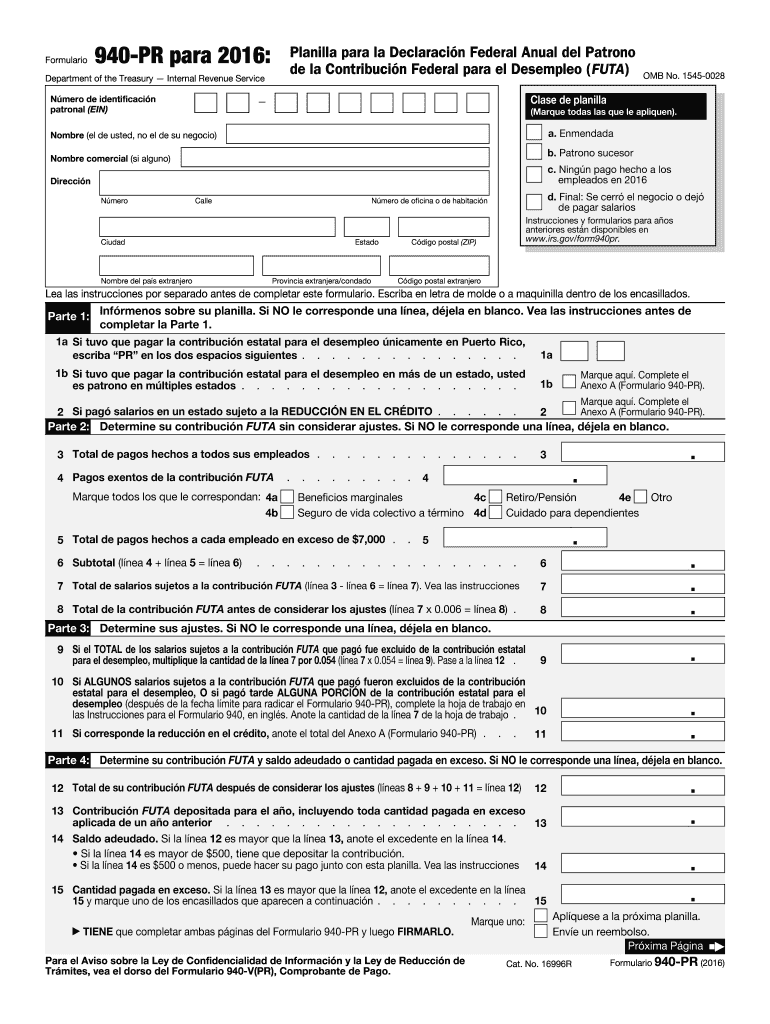







Definition and Meaning of the 2015 940-PR Form
The Form 940-PR for 2015 is designed for employers in Puerto Rico to report their Federal Unemployment Tax Act (FUTA) contributions. This form outlines the employer’s liability to provide unemployment compensation to workers who have lost their jobs. It requires detailed input on wages paid and adjustments, ensuring that businesses fulfill their fiscal responsibilities as mandated by the Internal Revenue Service (IRS).
Purpose and Structure
- Employer Identification: Includes sections for entering the Employer Identification Number (EIN) and verifying accurate employer details.
- Contribution Calculations: Guides on calculating the total FUTA tax owed, accounting for any adjustments or credits that apply.
- Payment Instructions: Provides directives for submitting payments electronically or by mail, ensuring compliance with IRS regulations.
How to Use the 2015 940-PR Form
Completing the Form 940-PR is crucial for businesses operating in Puerto Rico, as it ensures accurate reporting of unemployment taxes.
- Ensure Correct EIN Entry: Verify that the EIN entered on the form matches the one registered with the IRS.
- Accurate Wage Reporting: Carefully record all employee wages to avoid discrepancies in FUTA tax calculations.
- Calculate FUTA Tax Liability: Use the instructions to determine both gross and net FUTA liability, including any applicable credits.
- Review for Errors: Double-check for completeness and accuracy to prevent delays in processing.
Special Considerations
- Adjustments and Credits: Businesses might be eligible for reductions if they’ve paid state unemployment taxes within deadlines.
- Puerto Rico-Specific Guidelines: Recognize any unique provisions due to Puerto Rico’s territorial status affecting tax payments.
Steps to Complete the 2015 940-PR Form
Attention to detail is essential when filling out the form to avoid compliance issues.
- Input Basic Information:
- Enter business name, address, and EIN accurately.
- Report Employee Wages:
- Ensure all taxable wages are included.
- Calculate Tax Obligations:
- Subtract any applicable state unemployment tax credits from total taxes.
- Sign and Date the Form:
- Ensure the authorized individual signs the form, confirming all information is accurate.
Error Prevention Measures
- Conduct Regular Audits: Regular payroll audits help identify and correct discrepancies prior to form submission.
- Use Available Resources: Utilize IRS resources or consult a tax professional for guidance on complex scenarios.
Important IRS Guidelines for the 2015 940-PR Form
Compliance with IRS regulations is non-negotiable to avoid penalties.
- FUTA Tax Rates: Understand the current tax rate and any changes from previous years.
- Filing Instructions: Follow the step-by-step IRS instructions to ensure the form is completed accurately.
- Recordkeeping: Maintain records for at least four years after the due date of the form to support potential audits.
Filing Deadlines and Important Dates
Timely filing of the Form 940-PR is key to avoiding late fees and penalties.
- Annual Filing Deadline: The return is typically due by January 31 following the reporting year. If all taxes are paid by this date, a deadline extension to February 10 may be granted.
- Payment Deadlines: If taxes haven’t been deposited throughout the year, full payment is required when filing.
Late Filing Consequences
- Penalties and Interest: Late filing can result in significant penalties and accrued interest on unpaid taxes.
Required Documents for the 2015 940-PR Form
Gather supporting documents to ensure precision in form completion.
- Payroll Records: Detailing wages paid to employees throughout the year.
- Documented Adjustments: Evidence of any adjustments or credits claimed.
- EIN Confirmation: Official IRS correspondence confirming the business’s EIN.
Supporting Documentation
- State Unemployment Tax Filings: Have detailed state filings on hand to substantiate any claimed credits.
Penalties for Non-Compliance
Understanding potential penalties can motivate timely and accurate submissions.
- Filing Errors: Incorrect or incomplete submissions can result in penalties that vary based on the degree of the error.
- Late Payments: Interest accrues on late payments, increasing the total liability.
Prevention Strategies
- Utilize Tax Preparation Software: Tools like TurboTax or QuickBooks help minimize errors through guided form completion and automatic calculations.
- Timely Financial Reviews: Conduct regular reviews of financial operations to ensure ongoing compliance.
Digital vs. Paper Versions of the Form
Employers have options in how they choose to complete the Form 940-PR.
- Digital Submission: Benefit from faster processing times with electronic versions, reducing paperwork and storage needs.
- Manual Form Completion: Permits detailed review but requires adherence to postal submission deadlines.
Filing Method Decision Factors
- Accessibility and Convenience: Evaluate whether digital tools like DocHub improve efficiency and accuracy in your business operations.
- Recordkeeping Preferences: Decide based on whether digital or physical recordkeeping aligns with company policies.
This structured approach, with comprehensive exploration of the 2015 940-PR Form, aids businesses in ensuring compliance while optimizing operational efficiency.




