







Definition and Purpose of the 940 Formulario IRS
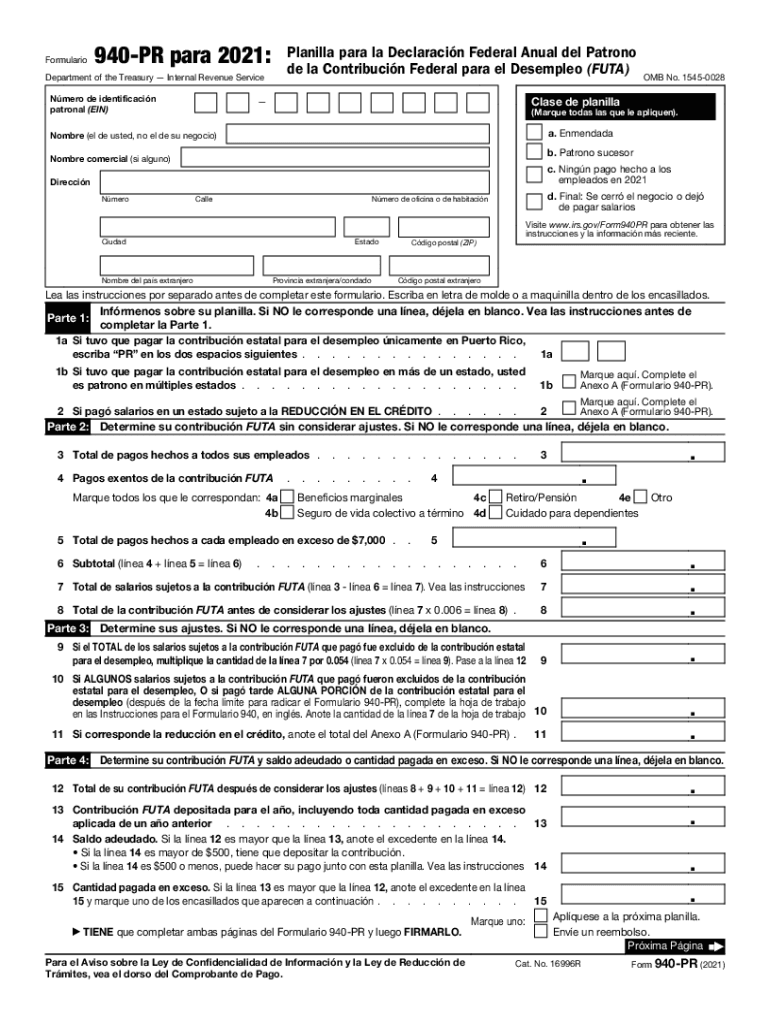
The 940 Formulario IRS, officially known as Form 940-PR, is used by employers in Puerto Rico to report their annual Federal Unemployment Tax Act (FUTA) tax obligations. This tax helps fund unemployment compensation for workers who have lost their jobs. Employers need to understand this form's role in ensuring compliance with federal tax regulations, particularly when employing staff in Puerto Rico.
Steps to Complete the 940 Formulario IRS
-
Gather Necessary Information: Collect wage information for all employees subject to FUTA tax, ensuring accuracy.
-
Enter Employer Identification Details: Fill in your Employer Identification Number (EIN), business name, and address as directed on the form.
-
Calculate Taxable Wages: Determine wages subject to FUTA by subtracting exempted wages, such as those paid to certain agricultural and household workers, from total wages.
-
Determine FUTA Tax Due: Apply the applicable FUTA tax rate to the taxable wage amount, taking into account any rate reductions available through timely state unemployment contributions.
-
Complete Adjustments: Account for any credits or adjustments, such as advance payments or overpayment carryovers from the previous year.
-
Finalize and Submit the Form: Verify all entered information, sign the form, and submit it by the prescribed deadline using one of the accepted submission methods.
Obtaining and Submitting the 940 Formulario IRS
-
Obtaining the Form: The 940 Formulario IRS can be obtained directly from the IRS website, where it is available for download in PDF format. This ensures employers always access the most current version.
-
Submission Methods: The form can be submitted online through the IRS e-file system, by mail, or in-person at an IRS office. Submissions ensure compliance with federal deadlines, which typically fall on January 31 for the previous calendar year.
Filing Deadlines and Important Dates
The IRS requires that the 940 Formulario IRS be filed by January 31 each year. However, deposits of FUTA taxes are due on a quarterly basis if the unpaid liability reaches or exceeds $500 at the end of any quarter. This system helps manage cash flow and ensures timely compliance.
Key Elements of the 940 Formulario IRS
-
Employer Identification Number (EIN): Critical for the form's identification and processing.
-
Taxable Wages: The focal point of the form, calculated by substantive rules and exemptions.
-
Adjustments for FUTA Tax: Includes credits and reductions from state unemployment contributions.
Who Typically Uses the 940 Formulario IRS
Employers in Puerto Rico who are subject to the Federal Unemployment Tax Act must utilize this form. This group includes private businesses of various sizes, non-profit organizations, and other entities that employ workers subject to this tax. Understanding who must file helps ensure that all responsible parties comply with tax obligations.


Penalties for Non-Compliance
Failure to file the 940 Formulario IRS or underpaying the FUTA tax can result in severe financial penalties and interest. Late filings are penalized at a rate of 5% per month, up to 25% of the total tax due. This underscores the importance of timely submission and accurate tax payments.
Important Terms Related to the 940 Formulario IRS
-
FUTA Tax: A federal employer tax used to fund unemployment benefits.
-
Taxable Wages: Total compensation to employees subject to FUTA tax.
-
Credit Reduction: A decrease in allowable credit for state unemployment taxes if a state has outstanding federal loans.
Versions or Alternatives to the 940 Formulario IRS
While Form 940-PR is specific to Puerto Rico, Form 940 is used by employers in the United States. Both serve similar purposes but are tailored to different jurisdictions. Understanding the differences is essential for accurate reporting and compliance.
These sections provide comprehensive coverage, detailing the steps, rules, and consequences associated with the 940 Formulario IRS, ensuring that employers complete and submit the form accurately and on time.




