




01. Edit your form 940 for 2016 online
Type text, add images, blackout confidential details, add comments, highlights and more.

Type text, add images, blackout confidential details, add comments, highlights and more.

Draw your signature, type it, upload its image, or use your mobile device as a signature pad.

Send it via email, link, or fax. You can also download it, export it or print it out.
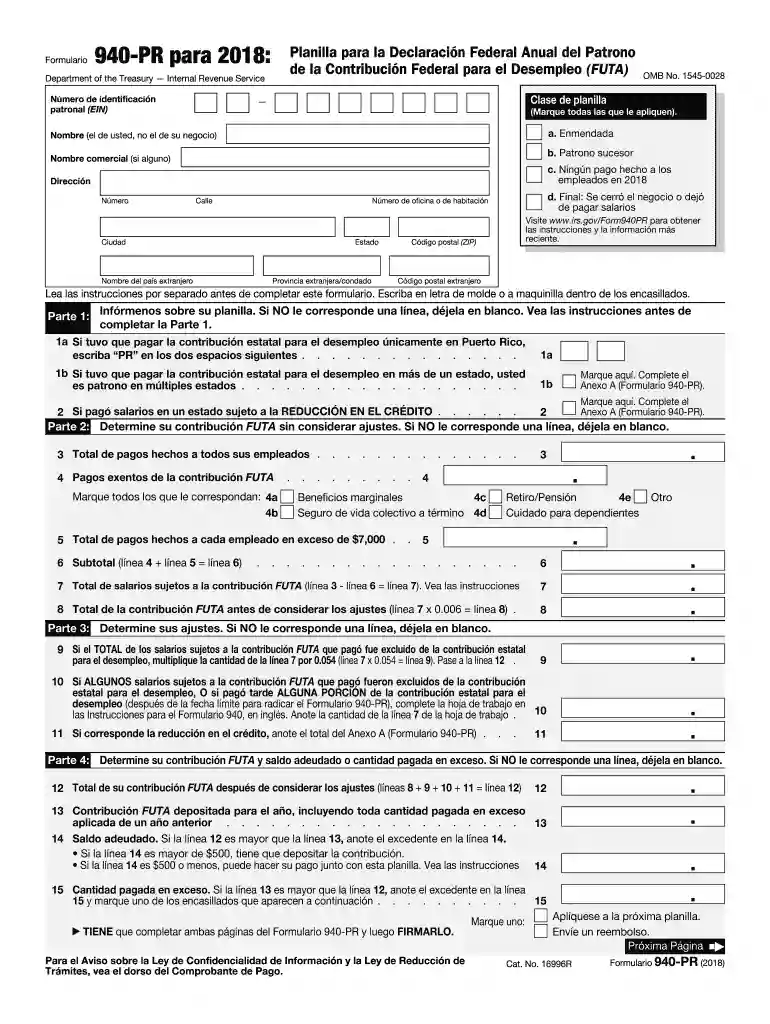
The 940-PR form, officially named the Employer's Annual Federal Unemployment (FUTA) Tax Return, is specifically designed for employers in Puerto Rico. This form is used to report and pay the Federal Unemployment Tax Act (FUTA) taxes. Employers in Puerto Rico use this form to report their unemployment taxes to the Internal Revenue Service (IRS), which helps fund unemployment benefits for workers who have lost their jobs. Comprehending the full meaning and purpose of this form is essential for businesses operating in Puerto Rico to ensure compliance with federal unemployment tax obligations.
Completing the 940-PR form involves a structured process to ensure all required information is provided accurately:
Employer's Information: Begin by entering the employer's name, address, EIN (Employer Identification Number), and the calendar year for reporting.
Determine Tax Liability: Calculate the total FUTA tax based on wages paid to employees, adjusting for any state unemployment tax credits applicable.
Report Payments: Indicate any payments made throughout the year and account for any previous year’s overpayments or adjustments.
Calculate Total Tax Due: Sum the total tax due after credits and previous payments, ensuring any discrepancies are addressed.
Sign and Date: Conclude the form with an authorized signature and a date to validate the submission.
Ensure to keep a copy of the completed form for records and for any potential audits by the IRS.
Employers can obtain the 940-PR form through several methods:
IRS Website: The form and its instructions are available as downloadable PDFs directly from the IRS official site. This ensures that the form is the updated version for the specific filing year.
IRS Office: Physical copies of the form can be picked up at local IRS offices in Puerto Rico.
Ensuring access to the latest version of the form is crucial for accurately adhering to submission requirements and deadlines.
The 940-PR form is generally used by:
Puerto Rico-Based Employers: Businesses that employ workers in Puerto Rico and are subject to FUTA taxes.
Corporations, Partnerships, and LLCs: These entities operating within Puerto Rico need to file this form to report their employment tax obligations.
The form is central to legally obligated reporting and contributes to the financial support system for unemployed workers in Puerto Rico.


The filing deadline for the 940-PR form is generally January 31st of the year following the reported tax year. For the 2017 form, it was due by January 31, 2018. Employers who have promptly deposited FUTA tax throughout the year may qualify for an extended deadline, providing additional time until February 10th.
Meeting these deadlines is essential to avoid penalties and ensure compliance with federal tax obligations.
The 940-PR form comprises several critical elements:
Tax Calculations: Detailed sections calculate the FUTA tax due, considering any credits for state unemployment taxes.
Employer Identification: Accurate employer identification details are crucial for IRS processing.
Signature and Acknowledgment: Finalizing the form with a signature acknowledges the information provided is accurate and complete.
Attention to these elements is necessary to avoid errors that could lead to audits or penalties.
Non-compliance with the 940-PR filing requirements can lead to severe penalties. Common issues include:
Late Filing: A penalty of up to 5% of the unpaid tax for each month the form is late, not exceeding 25% in total.
Underpayment of Taxes: Additional interest charges on any tax due that remains unpaid after the deadline.
These penalties emphasize the importance of timely and accurate filing to maintain good standing with the IRS.
The 940-PR form can be submitted in both digital and paper formats:
Digital Submission: Offers greater convenience, faster processing, and immediate electronic confirmation upon submission.
Paper Submission: Traditional method that may suit businesses less familiar with digital filing but typically results in longer processing times.
Choosing the appropriate submission method can influence the efficiency and speed of IRS processing and responses.
Understanding essential terms related to the 940-PR form can enhance comprehension and accurate completion:
FUTA Tax: Federal tax paid by employers to provide funds for unemployment benefits.
Credits: Deductions applied to the FUTA tax based on contributions made to state unemployment funds.
These terms are pivotal in grasping the mechanics of the form and ensuring correct calculations and submissions.
We've got more versions of the form 940 for 2016 form. Select the right form 940 for 2016 version from the list and start editing it straight away!
| Versions | Form popularity | Fillable & printable |
|---|---|---|
| 2022 | 4.8 Satisfied (39 Votes) | |
| 2021 | 4.9 Satisfied (43 Votes) | |
| 2020 | 4.3 Satisfied (126 Votes) | |
| 2019 | 4.4 Satisfied (245 Votes) | |
| 2018 | 4.3 Satisfied (200 Votes) | |
| 2017 | 4.4 Satisfied (200 Votes) | |
| 2016 | 4.3 Satisfied (121 Votes) | |
| 2015 | 4.4 Satisfied (543 Votes) | |
| 2014 | 4.2 Satisfied (57 Votes) | |
| 2013 | 4.2 Satisfied (63 Votes) | |
| 2012 | 4.3 Satisfied (57 Votes) | |
| 2011 | 4.3 Satisfied (49 Votes) |
At DocHub, your data security is our priority. We follow HIPAA, SOC2, GDPR, and other standards, so you can work on your documents with confidence.
2017; Chen et al., 2017). Figure 2-1: Photographs of the peeper design selected for the laboratory experiment and field demonstration (SiREM Laboratories)Read more
by C Cruz 2024 Form 941-X is available for correcting errors on previously filed employment tax returns, each corresponding to specific forms being corrected.Read more
Complete el. Anexo A (Formulario 940-PR). Determine su contribucin FUTA sin considerar ajustes. Si NO le corresponde una lnea, djela en blanco. Parte 2:.Read more


