




01. Edit your 940 form online
Type text, add images, blackout confidential details, add comments, highlights and more.

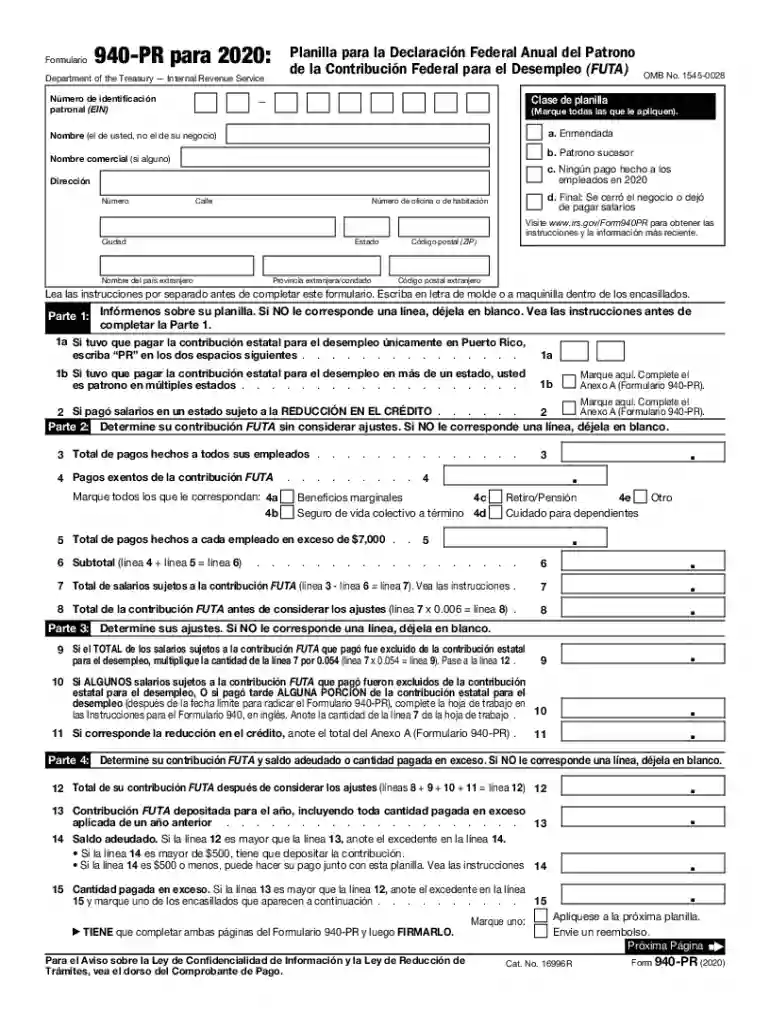
Type text, add images, blackout confidential details, add comments, highlights and more.

Draw your signature, type it, upload its image, or use your mobile device as a signature pad.

Send form 940 example via email, link, or fax. You can also download it, export it or print it out.
The "940 formulario" is commonly used by employers to report their annual Federal Unemployment Tax Act (FUTA) obligations. This form is essential for documenting and paying unemployment taxes to the Internal Revenue Service (IRS). It is also required to provide specific payroll information, which helps the federal government manage unemployment compensation programs. The form captures details such as wages, exemptions, and tax credit qualifications.
Completing the "940 formulario" is pivotal for compliance with federal tax regulations. It ensures employers contribute their fair share towards unemployment funds, supporting individuals who lose jobs through no fault of their own. The information provided on this form includes the number of employees and total wages paid out, which helps in calculating the FUTA tax due.
According to IRS guidelines, employers must adhere to prescribed rates for calculating FUTA taxes and filing requirements. Employers should maintain detailed payroll records to verify wage calculations, taking into account any applicable deductions or adjustments. The guidelines also emphasize the importance of understanding potential changes in tax rates and compliance procedures, as these can affect the amount of tax due.
Moreover, the IRS provides specific instructions for form completion to ensure adherence to federal reporting standards. Employers can refer to the IRS's website and publications for updated instructions and requirements related to the "940 formulario."
Employers need to pay FUTA taxes quarterly, with the "940 formulario" due annually by January 31. If a business has paid its FUTA taxes in full and on time throughout the year, it can qualify for an extended filing deadline of February 10. Missing these deadlines could incur penalties from the IRS, making timely submission and payment critical.
For accurate completion of the "940 formulario," employers should have the following documents on hand:
These documents ensure that all wage and tax figures are documented accurately, supporting valid tax calculations.
The "940 formulario" can be submitted in three ways:
Employers need to keep copies of submitted forms for their records, regardless of the method chosen.
Failure to file the "940 formulario" or inaccurately reporting tax obligations can result in significant penalties. Potential issues include underpayment fines, late filing fees, and interest on overdue taxes. The IRS bases penalties on the amount owed and the duration of non-compliance, emphasizing the necessity for employers to maintain accurate records and meet deadlines. Regularly reviewing IRS communications can help employers avoid misunderstandings and meet all requirements effectively.
Businesses with a large employee base or multi-state operations will greatly benefit from completing the "940 formulario." By accurately reporting FUTA obligations, these companies ensure compliance with federal tax laws and potentially reduce their FUTA liability through available credits. Companies in industries with high turnover rates, such as retail or hospitality, should pay close attention to the tax calculations captured in this form to manage costs effectively while supporting proper unemployment insurance funding.
We've got more versions of the 940 form form. Select the right 940 form version from the list and start editing it straight away!
| Versions | Form popularity | Fillable & printable |
|---|---|---|
| 2022 | 4.8 Satisfied (39 Votes) | |
| 2021 | 4.9 Satisfied (43 Votes) | |
| 2020 | 4.3 Satisfied (126 Votes) | |
| 2019 | 4.4 Satisfied (245 Votes) | |
| 2018 | 4.3 Satisfied (200 Votes) | |
| 2017 | 4.4 Satisfied (200 Votes) | |
| 2016 | 4.3 Satisfied (121 Votes) | |
| 2015 | 4.4 Satisfied (543 Votes) | |
| 2014 | 4.2 Satisfied (57 Votes) | |
| 2013 | 4.2 Satisfied (63 Votes) | |
| 2012 | 4.3 Satisfied (57 Votes) | |
| 2011 | 4.3 Satisfied (49 Votes) |
Sure, it is possible with DocHub. This reliable and compliant online solution features a phone-based signing option. Once you log in to your DocHub account and add your irs 940 form to our editor, complete all necessary fields and use the Sign feature on the upper barf. Click on Create your signature and select Phone from the available options. Here, you scan a QR code with your smartphone and draw your signature on your phone screen, as you normally do when signing physical papers. If you access DocHub right from your mobile device, you can eSign your paperwork by drawing your eSignature, uploading its image, or simply with a typed name.
If you edit your 940 forms with DocHub, you merely require a steady internet connection and virtually any browser installed on your device. No need to install any third-party applications or research guides. Just open a tab with DocHub, drag and drop your file, and modify it on the spot.
At DocHub, your data security is our priority. We follow HIPAA, SOC2, GDPR, and other standards, so you can work on your documents with confidence.
Jun 2, 2025 Complete Schedule A (Form 940). Part 2: Determine your FUTA tax before adjustments. If any line does NOT apply, leave it blank. 3Read more
May 2, 2017 railroad retirement taxes apply), and on Form 940,. Employers Annual Federal Unemployment (FUTA) Tax. Return. CAUTION ! You must report allRead more
You can request an IRS Tax Return Transcript, free of charge, from the IRS in one of three ways: Online; By Telephone; By PaperRead more


