Rct 132 b 2026

Get Form
rct 132 Preview on Page 1

Here's how it works

01. Edit your rct 132 online
Type text, add images, blackout confidential details, add comments, highlights and more.

02. Sign it in a few clicks
Draw your signature, type it, upload its image, or use your mobile device as a signature pad.

03. Share your form with others
Send it via email, link, or fax. You can also download it, export it or print it out.

How to use or fill out rct 132 b with DocHub

Form edit decoration
9.5
Ease of Setup
DocHub User Ratings on G2
9.0
Ease of Use
DocHub User Ratings on G2
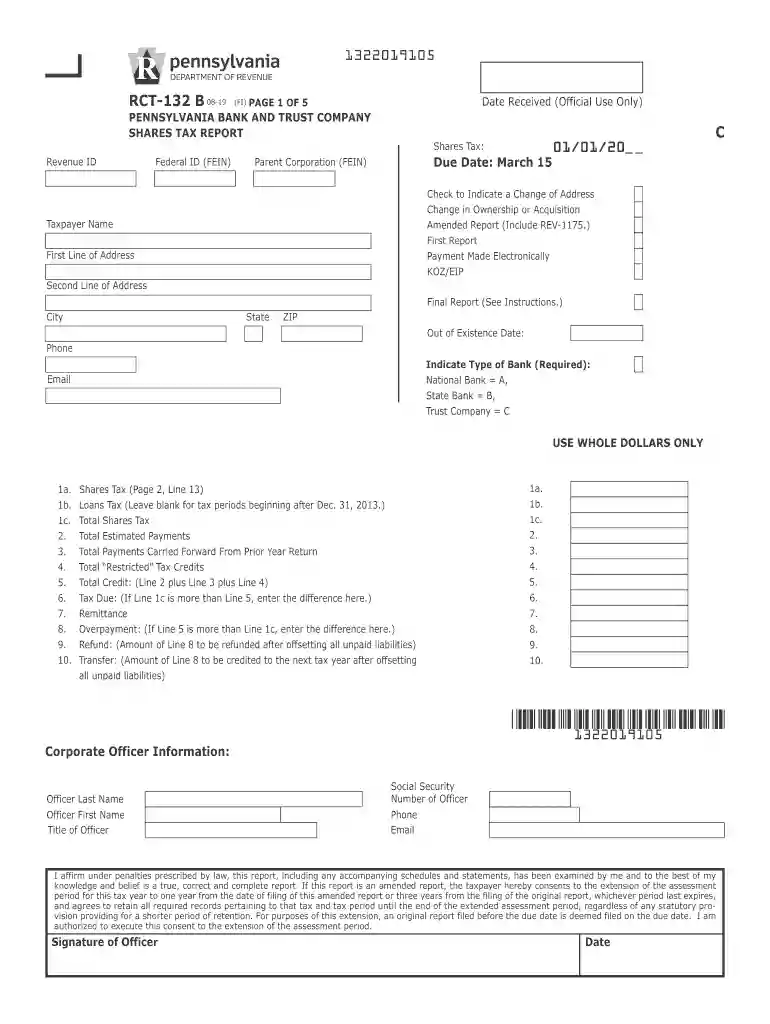
  1. Click ‘Get Form’ to open the rct 132 b in our editor.
  2. Begin by entering your Revenue ID and Federal Employer Identification Number (FEIN) at the top of the form. Ensure all fields are filled without dashes or slashes.
  3. Indicate the type of bank by selecting from the dropdown menu: National Bank, State Bank, or Trust Company.
  4. Complete the Taxpayer Name and Address sections accurately. Remember to check if there’s a change of address or ownership.
  5. Proceed to calculate your Shares Tax on Page 2. Fill in each line carefully, ensuring you use whole dollars only.
  6. For corporate officer information, provide names, titles, and contact details. Sign and date where indicated.
  7. Review all entries for accuracy before saving your completed form. Use our platform's features to print or share as needed.

Start filling out your rct 132 b today for free using our powerful editing tools!

See more rct 132 b versions

We've got more versions of the rct 132 b form. Select the right rct 132 b version from the list and start editing it straight away!
Versions Form popularity Fillable & printable
2024 4.7 Satisfied (33 Votes)
2022 4.8 Satisfied (31 Votes)
2021 4.8 Satisfied (24 Votes)
2019 4.8 Satisfied (95 Votes)
2017 4.3 Satisfied (81 Votes)
be ready to get more

Complete this form in 5 minutes or less

Get form

Got questions?

We have answers to the most popular questions from our customers. If you can't find an answer to your question, please contact us.
Contact us
The IRS treats interest earned on money in a savings account as taxable income. Your financial institution issues a 1099-INT form if you earned at least $10 in interest in the previous tax year.
Maximum Deduction Limit: A maximum deduction of ₹10,000 is allowed on the total interest earned across all eligible savings accounts. Tax Implications on Excess Interest: Any interest income exceeding ₹10,000 in a financial year is subject to taxation as per the individuals applicable income tax slab.
Section 132 of the Income-tax Act, 1961 (the Act) empowers income tax authorities to carry out a search and seizure of books of accounts, documents, cash, jewellery etc. Further, section 132A of the Act empowers certain income tax authorities to requisition books of accounts, documents etc.
Pennsylvania is a separate-company filing state for the Corporate Net Income Tax (CNI), meaning that each corporation doing business in Pennsylvania files their own returns and reports only its income or loss to the Department of Revenue to determine Pennsylvania tax liability.
Interest income is a gross taxable income class under Pennsylvania law. Consequently, Pennsylvania law does not permit the deduction of any expenses that a taxpayer incurs to realize ordinary interest income.

Security and compliance

At DocHub, your data security is our priority. We follow HIPAA, SOC2, GDPR, and other standards, so you can work on your documents with confidence.

Learn more
ccpa2
pci-dss
gdpr-compliance
hipaa
soc-compliance
be ready to get more

Complete this form in 5 minutes or less

Get form

People also ask

Key takeaways. The interest you earn on your savings account must be declared when lodging your tax return. Interest is considered income, so your standard income tax rate will be applied to it.
RCT-132 B is used to report Pennsylvania bank and trust company shares tax.
Retirement and pension income: Payments from retirement accounts, like 401(k)s and IRAs are fully exempt. Pension income for seniors age 60 or older are also exempt. Investment income: Taxed at 3.07%, including dividends and capital gains​. Social Security income: Exempt from Pennsylvania state taxes​.

Related links