




01. Edit your 2020 1041 online
Type text, add images, blackout confidential details, add comments, highlights and more.

Type text, add images, blackout confidential details, add comments, highlights and more.

Draw your signature, type it, upload its image, or use your mobile device as a signature pad.

Send 2020 irs 1041 via email, link, or fax. You can also download it, export it or print it out.
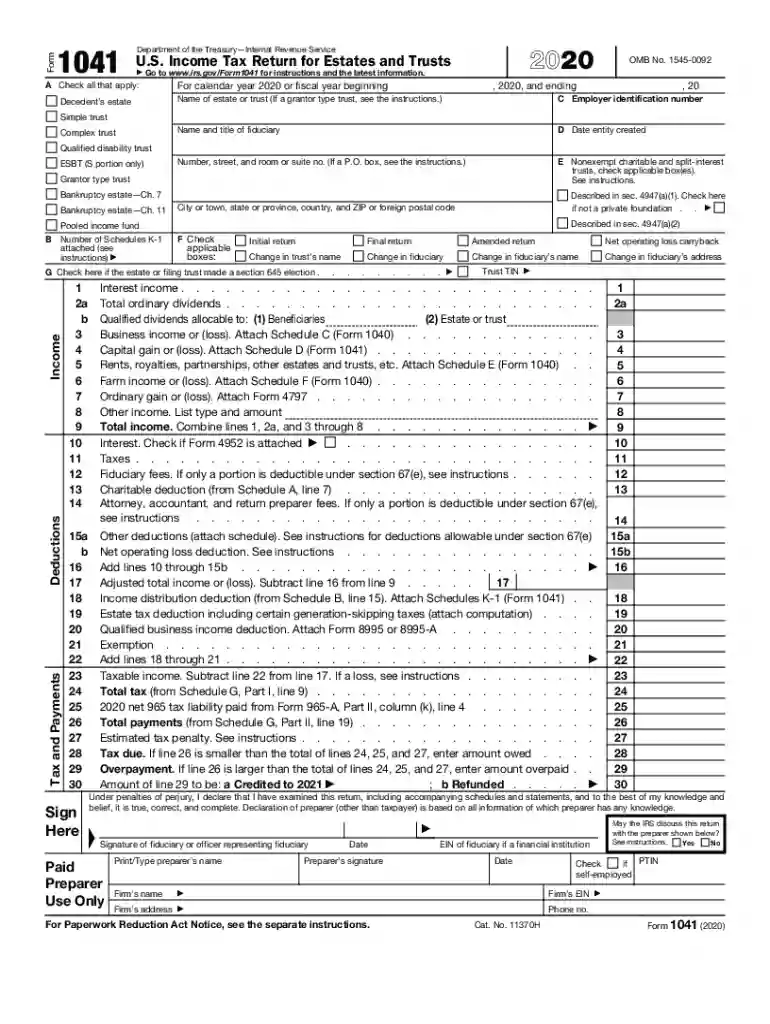
IRS Form 1041, officially titled "U.S. Income Tax Return for Estates and Trusts," is a crucial document used to report the income, deductions, and tax liabilities of an estate or trust. Issued by the Department of the Treasury—Internal Revenue Service, this form allows fiduciaries of estates and trusts to calculate and report income tax obligations in a standardized manner. By submitting Form 1041, estates and trusts fulfill their legal duty to disclose financial activities within a fiscal year to the IRS, helping ensure compliance with U.S. tax laws.
To obtain IRS Form 1041, you have several options available. This form can be downloaded directly from the official IRS website, ensuring you have the most up-to-date version. Alternatively, tax preparation software, such as TurboTax or QuickBooks, often includes Form 1041 within their suite of offerings, streamlining the process for users. If you prefer a physical copy, you can request forms by mail from the IRS or visit local IRS offices for assistance.
Completing IRS Form 1041 involves several steps:
Gather Required Information: Begin by assembling all necessary documentation, including the previously filed tax return, financial statements, and relevant expense records.
Identify Income Sources: Reportable income may include interest, dividends, rent, and capital gains. Accurately list these amounts in the income section of the form.
Calculate Deductions: Identify deductions applicable to the estate or trust, such as administration expenses, distributions, and charitable contributions.
Determine Tax Liability: Use the form's guidelines to calculate the estate or trust's taxable income and determine the corresponding tax owed.
Submit the Form: Ensure that the form is correctly filled out, and submit it by the filing deadline to avoid penalties. Electronic filing is available through authorized e-file providers for convenience and speed.
IRS Form 1041 is used by fiduciaries, which include executors, administrators, or trustees of estates and trusts. Estates of deceased individuals and trusts established for beneficiaries' benefit must report their income and pay any taxes owed. While individuals file Form 1040 for personal taxes, Form 1041 is specifically designed for entities, with the fiduciary acting as the responsible party for ensuring compliance.
Understanding specific terminology can make filling out Form 1041 more straightforward:
Form 1041 must be used to comply with U.S. federal tax laws as they pertain to estates and trusts. Fiduciaries are legally obligated to report the financial activities and income of these entities accurately. Misreporting or failure to file can result in significant penalties, including fines and interest. Ensuring accuracy and timeliness helps avoid legal repercussions and maintains compliance with tax regulations.
The deadline for filing Form 1041 typically falls on the 15th day of the fourth month after the end of the entity's tax year, often April 15 for calendar-year filers. If this date falls on a weekend or holiday, the deadline is extended to the next business day. Fiduciaries can also apply for a six-month extension using Form 7004. Timely filing is crucial to avoid late penalties and interest charges.
When filing Form 1041, adhere to the guidelines set forth by the IRS:
Review Instructions Carefully: The IRS provides detailed instructions for Form 1041 to assist in its completion. Familiarize yourself with these instructions to avoid common errors.
Maintain Accurate Records: Keep thorough records of all transactions, income sources, and deductions claimed to substantiate the information reported on the form.
Consult a Tax Professional: Due to the complexity of estate and trust taxation, consulting with a tax professional can ensure accuracy and adherence to current tax laws.
Fiduciaries can choose between digital and paper filing for submitting Form 1041. Electronic filing is faster and can be more secure, offering instant confirmation of receipt from the IRS. Many tax software solutions facilitate e-filing, simplifying the process. Meanwhile, paper filing remains an option for those who prefer traditional methods or lack access to e-filing resources. Always consider security and convenience when selecting a submission method.
We've got more versions of the 2020 1041 form. Select the right 2020 1041 version from the list and start editing it straight away!
| Versions | Form popularity | Fillable & printable |
|---|---|---|
| 2025 | 4.4 Satisfied (30 Votes) | |
| 2024 | 4.5 Satisfied (37 Votes) | |
| 2023 | 4.7 Satisfied (20 Votes) | |
| 2022 | 4.6 Satisfied (50 Votes) | |
| 2021 | 4.9 Satisfied (46 Votes) | |
| 2020 | 4.2 Satisfied (46 Votes) | |
| 2019 | 4.4 Satisfied (92 Votes) | |
| 2018 | 4.2 Satisfied (95 Votes) | |
| 2017 | 4.4 Satisfied (262 Votes) | |
| 2016 | 4.3 Satisfied (72 Votes) | |
| 2015 | 4.3 Satisfied (57 Votes) | |
| 2014 | 4 Satisfied (38 Votes) | |
| 2013 | 4.2 Satisfied (73 Votes) | |
| 2012 | 4 Satisfied (33 Votes) | |
| 2011 | 4.3 Satisfied (71 Votes) |
At DocHub, your data security is our priority. We follow HIPAA, SOC2, GDPR, and other standards, so you can work on your documents with confidence.
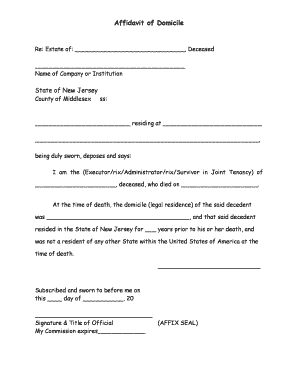





Under penalties of perjury, I declare that I have examined this application and accompanying schedules and statements, and to the best of my knowledge andRead more
Use Schedule D (Form 1041) to report gains and losses from the sale or exchange of capital assets by an estate or trust. Schedule D (From 1041) PDF.Read more
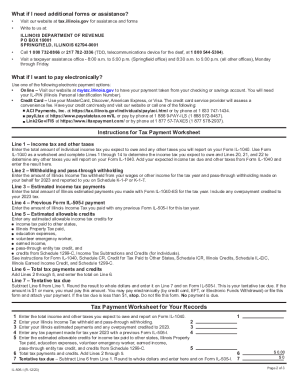
Total net gain from Schedule D (Form 1041), line 17, column (a). If a loss, enter -0-. 15. Capital gains for the tax year allocated to corpus and paid orRead more


