






Definition and Meaning of the 2015 Form 1041
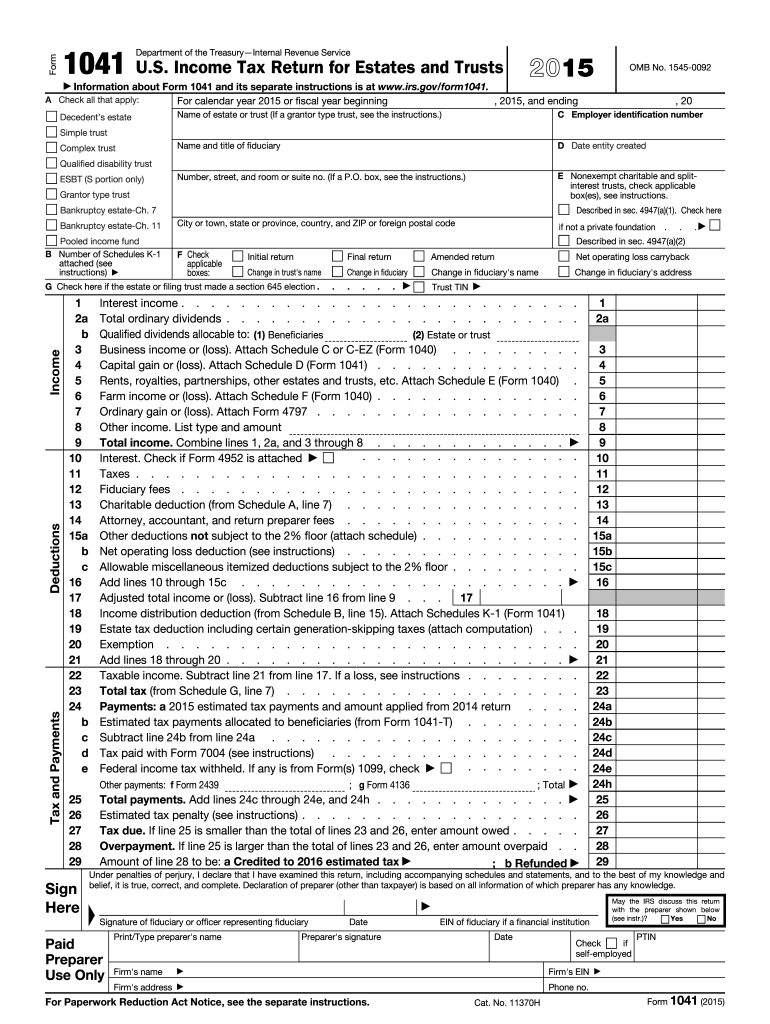
The 2015 Form 1041, formally known as the U.S. Income Tax Return for Estates and Trusts, is a critical document issued by the Internal Revenue Service (IRS) for fiduciaries. This form is primarily used by estates and trusts to report their income, deductions, tax liabilities, and other financial activities. It encompasses various sections dedicated to identifying the estate or trust, listing income sources, calculating taxable income, and detailing payments and credits. An important feature of the form is its schedules, which facilitate the reporting of charitable deductions and income distribution deductions.
Detailed Breakdown:
- Purpose: The form is designed to consolidate the financial information of estates and trusts that must fulfill federal tax obligations.
- Components: It includes a distinct set of sections and schedules to simplify the filing process for fiduciaries.
- Scope: Addresses both income earned by the estate or trust and the distribution of that income among beneficiaries.
Steps to Complete the 2015 Form 1041
Filing the 2015 Form 1041 requires meticulous attention to detail and adherence to IRS guidelines. Here are the steps to follow:
- Gather Information: Collect all necessary documentation such as previous tax returns, income statements, and records of deductions.
- Identify Income Sources: Accurately report all income generated by the estate or trust, including interest, dividends, and rental income.
- Complete Schedules: Fill out Schedule A for charitable deductions and Schedule B for income distribution deductions.
- Calculate Taxable Income: Use the information provided to compute the estate or trust's taxable income.
- Submit the Form: File the completed form with the IRS by the stipulated deadline, either electronically or via mail.
Practical Tips:
- Accuracy: Ensure all figures are accurate to prevent processing delays or penalties.
- Professional Assistance: Consider consulting a tax professional if the calculations are complex or if there are significant financial transactions involved.
Eligibility Criteria for the 2015 Form 1041
To determine whether the 2015 Form 1041 is applicable, assess if the estate or trust meets the following conditions:
- U.S. Based: The estate or trust must be located within the United States.
- Income Requirements: Must have income above the IRS threshold for filing.
- Fiduciary Responsibility: Managed by a fiduciary responsible for reporting the entity's financial activities.


Important Considerations:
- Beneficiaries: Involves organizations or individuals who receive income distributions.
- Tax Obligations: The fiduciary is responsible for meeting all tax obligations related to the estate or trust.
Key Elements of the 2015 Form 1041
Understanding the key elements of the 2015 Form 1041 is fundamental for proper completion:
- Fiduciary Information: Includes details about the fiduciary, such as name, address, and taxpayer identification number.
- Income and Deductions: Comprehensive sections for reporting all relevant financial activities.
- Schedules and Attachments: Necessary schedules for deductions and credits, which must be included with the primary form.
Examples:
- Schedule A: Reporting of charitable contributions made by the estate or trust.
- Schedule B: Details of income distributions to beneficiaries.
IRS Guidelines and Compliance
The IRS provides specific instructions for filling out and submitting the 2015 Form 1041. Compliance with these guidelines is crucial to avoid penalties:
- Filing Instructions: Detailed in the IRS's official instructions for the form.
- Compliance Requirements: Includes adhering to deadlines and accurately reporting all financial information.
Penalties:
- Late Filing: May result in fines and additional scrutiny from the IRS.
- Incorrect Information: Could lead to amendments and potential fines.
Filing Deadlines and Important Dates
Adhering to key deadlines is essential when dealing with the 2015 Form 1041 to meet legal requirements:
- Initial Filing Deadline: Generally due by April 15th of the year following the tax year.
- Extension Requests: Possible through the filing of Form 7004, which grants an automatic extension of up to six months.
Deadlines:
- Quarterly Payments: Estates or trusts may need to make estimated tax payments throughout the year depending on income levels.
- Revision Window: Amendments can be made if errors are found after filing, usually within three years from the original filing date.
How to Obtain the 2015 Form 1041
Accessing the 2015 Form 1041 is straightforward and can be done through several means:
- Online Resources: The IRS website offers downloadable PDFs of the form and instructions.
- Tax Software: Many platforms like TurboTax and QuickBooks provide access to tax forms, facilitating easy retrieval.
- Physical Copies: Can be requested from the IRS directly or obtained from authorized IRS distribution points.
Tips for Access:
- Digital Copies: Preferable for ease of filing and archiving.
- Check for Updates: Ensure you have the correct version by confirming the tax year on the form.
Required Documents for Filing
To complete the 2015 Form 1041 accurately, several documents are necessary:
- Prior Tax Returns: Helps in understanding past financial activity and ensures consistency.
- Income Records: Includes all forms of income earned by the estate or trust.
- Deductions Documentation: Any charitable contributions or expenses that qualify for deductions.
Document Checklist:
- 1099 Forms: For reporting dividends, interest, and other income.
- Receipts for Expenses: Proof of any expenditures that impact the reported taxable amount.