




01. Edit your 2011 1041 online
Type text, add images, blackout confidential details, add comments, highlights and more.

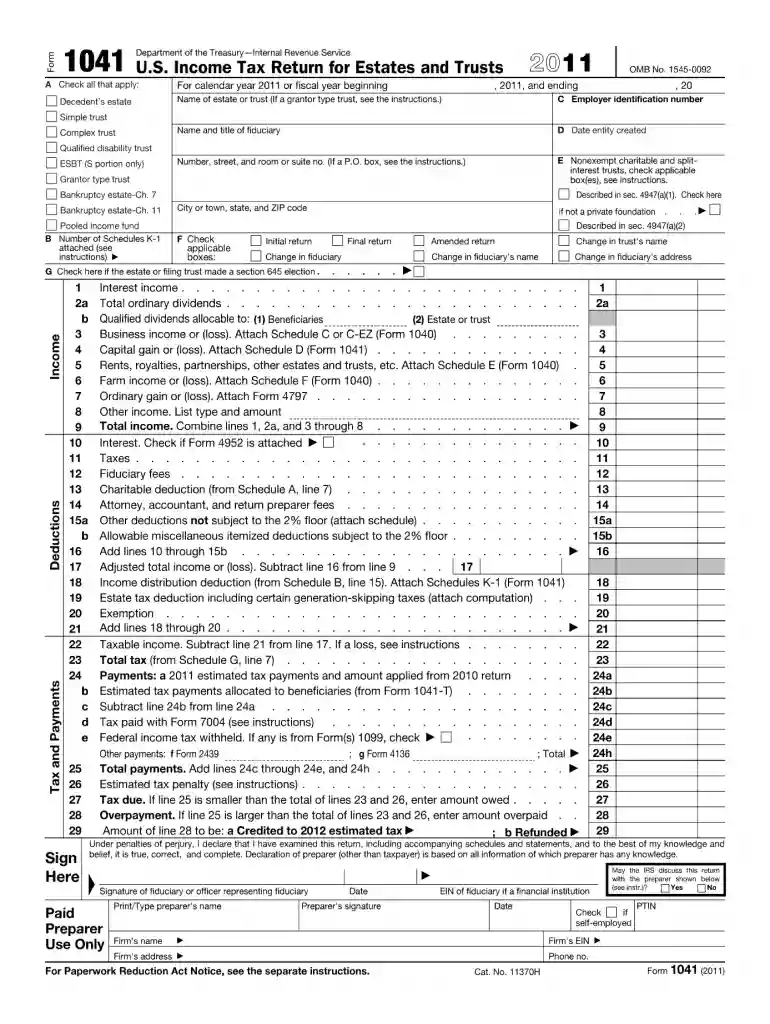
Type text, add images, blackout confidential details, add comments, highlights and more.

Draw your signature, type it, upload its image, or use your mobile device as a signature pad.

Send it via email, link, or fax. You can also download it, export it or print it out.
Form 1041, also known as U.S. Income Tax Return for Estates and Trusts, is a crucial document for fiduciaries handling the tax affairs of estates and trusts. For the year 2011, the form focuses on reporting the income, deductions, and tax liabilities of these entities. It captures various elements such as identifying the type of entity, listing income sources, and calculating taxable income. The 2011 form includes sections for fiduciary signatures, thereby ensuring accountability and authenticity of the information provided.
The primary purpose of the 2 Form is to comply with federal tax regulations for estates and trusts in the U.S. It helps fiduciaries in meeting legal obligations by reporting financial activities accurately. This form is necessary for avoiding penalties and ensuring the proper functioning of estates and trusts. By using this form, institutions can maintain transparency in their financial dealings, ultimately benefiting beneficiaries.
The 2 Form can be obtained directly from the IRS website or through authorized physical locations like tax preparation offices and community centers. However, downloading from the IRS website ensures you receive the most up-to-date version and access to comprehensive instructions tailored to that particular year.
Filing the 2 Form is a legal requirement under U.S. federal tax law for estates or trusts. Failure to file or incorrect filing can result in penalties. It’s important to ensure that all information is accurate and complete. The form's critical role in maintaining compliance highlights the necessity of understanding and adhering to its guidelines.
Fiduciaries, including executors of estates and trustees, are the primary users of the 2 Form. These individuals are responsible for managing the financial activities of the estate or trust and ensuring that all tax obligations are met. They must have a comprehensive understanding of the entity’s financial operations to complete the form accurately.


While the 2 Form is a federal tax document, states may have additional requirements. Some states require separate filings for state-specific tax obligations for estates and trusts. It's essential to consult with a tax professional familiar with state laws to ensure all aspects of compliance are covered.
For the 2011 tax year, the 1041 Form filing deadline was generally April 15, 2012. However, if extensions were required, they needed to be filed timely. It is crucial for fiduciaries to adhere to these deadlines to avoid late filing penalties. Understanding the timeline ensures compliance with tax obligations and minimizes risk.
We've got more versions of the 2011 1041 form. Select the right 2011 1041 version from the list and start editing it straight away!
| Versions | Form popularity | Fillable & printable |
|---|---|---|
| 2025 | 4.4 Satisfied (30 Votes) | |
| 2024 | 4.5 Satisfied (37 Votes) | |
| 2023 | 4.7 Satisfied (20 Votes) | |
| 2022 | 4.6 Satisfied (50 Votes) | |
| 2021 | 4.9 Satisfied (46 Votes) | |
| 2020 | 4.2 Satisfied (46 Votes) | |
| 2019 | 4.4 Satisfied (92 Votes) | |
| 2018 | 4.2 Satisfied (95 Votes) | |
| 2017 | 4.4 Satisfied (262 Votes) | |
| 2016 | 4.3 Satisfied (72 Votes) | |
| 2015 | 4.3 Satisfied (57 Votes) | |
| 2014 | 4 Satisfied (38 Votes) | |
| 2013 | 4.2 Satisfied (73 Votes) | |
| 2012 | 4 Satisfied (33 Votes) | |
| 2011 | 4.3 Satisfied (71 Votes) |
At DocHub, your data security is our priority. We follow HIPAA, SOC2, GDPR, and other standards, so you can work on your documents with confidence.
Form 990 (2011). Check if Schedule O contains a Is the organization filing Form 990 in lieu of Form 1041? Attach to Form 990, Form 990-EZ, or Form 990-PF.
Form 1041 (2011). Page 2. Schedule A. Charitable Deduction. Do not complete for a simple trust See instructions . . . . . . . . . . . . . Form 1041 (2011)Read more
A default under a contract for the sale and purchase of real estate in Florida must be material to be legally justified. If a material default occurs,Read more


