




01. Edit your 1041 2012 online
Type text, add images, blackout confidential details, add comments, highlights and more.

Type text, add images, blackout confidential details, add comments, highlights and more.

Draw your signature, type it, upload its image, or use your mobile device as a signature pad.

Send 2012 1041 form via email, link, or fax. You can also download it, export it or print it out.
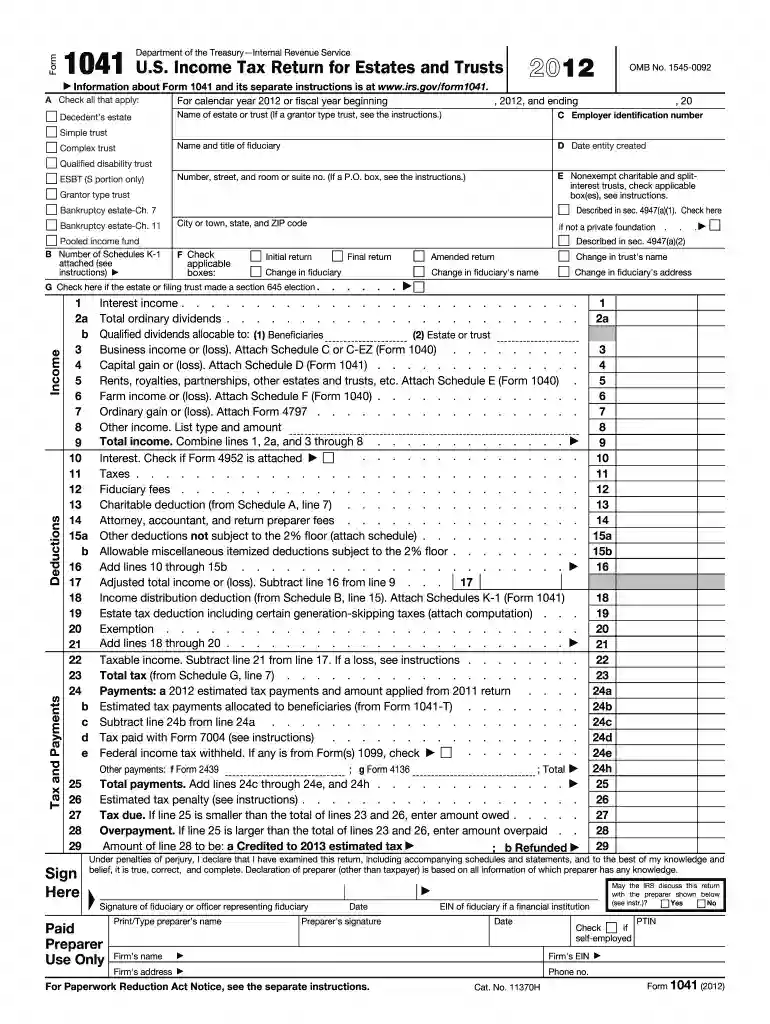
The 2012 IRS Form 1041, known as the U.S. Income Tax Return for Estates and Trusts, is essential for fiduciaries responsible for settling and managing the financial activities of estates and trusts. The form captures income, deductions, and tax liabilities specific to these entities, helping ensure accurate tax reporting and compliance with federal requirements. Estates and trusts use this form to report earnings from dividends, interests, and other income sources, as well as to declare applicable deductions. The form's design guides fiduciaries through the calculation of taxable income and tax owed, playing a key role in the tax reporting duties of estates and trusts.
Identify the Estate or Trust:
Report Income:
Account for Deductions:
Calculate Taxable Income:
Complete Additional Schedules:
Identifying Information:
Income Section:
Deductions:
Tax Computation:
To accurately complete and file the 2012 Form 1041, gather necessary documents like:
Fiduciaries of estates and trusts primarily use the 2012 Form 1041. These individuals are responsible for managing the assets of deceased individuals or entities funded for specific purposes, such as a trust. Fiduciaries must ensure taxes are reported correctly, meeting the legal obligations of managing estate or trust finances.


The 2012 IRS Form 1041 carries critical legal significance, as incorrect filings can lead to IRS scrutiny and penalties. Complying with the IRS guidelines is imperative to avoid potential legal complications. Fiduciaries should consult IRS instructions specific to Form 1041 to confirm all parts of the form align with legal requirements and accurately reflect the estate or trust's financial status.
For the 2012 tax year, Form 1041 was due by April 15, 2013. Fiduciaries could request an extension, changing the deadline to October 15, 2013. It's crucial for filers to keep abreast of IRS updates around deadlines and submit timely returns to avoid penalties.
Failure to comply with Form 1041 filing requirements can result in penalties, calculated based on the overdue duration. The IRS mandates timely and accurate submissions of tax forms to prevent interest accumulation on unpaid or erroneous tax filings. Fiduciaries who delay or submit incorrect information risk fines that can significantly impact estate or trust funds, underscoring the importance of compliance.
We've got more versions of the 1041 2012 form. Select the right 1041 2012 version from the list and start editing it straight away!
| Versions | Form popularity | Fillable & printable |
|---|---|---|
| 2025 | 4.4 Satisfied (30 Votes) | |
| 2024 | 4.5 Satisfied (37 Votes) | |
| 2023 | 4.7 Satisfied (20 Votes) | |
| 2022 | 4.6 Satisfied (50 Votes) | |
| 2021 | 4.9 Satisfied (46 Votes) | |
| 2020 | 4.2 Satisfied (46 Votes) | |
| 2019 | 4.4 Satisfied (92 Votes) | |
| 2018 | 4.2 Satisfied (95 Votes) | |
| 2017 | 4.4 Satisfied (262 Votes) | |
| 2016 | 4.3 Satisfied (72 Votes) | |
| 2015 | 4.3 Satisfied (57 Votes) | |
| 2014 | 4 Satisfied (38 Votes) | |
| 2013 | 4.2 Satisfied (73 Votes) | |
| 2012 | 4 Satisfied (33 Votes) | |
| 2011 | 4.3 Satisfied (71 Votes) |
At DocHub, your data security is our priority. We follow HIPAA, SOC2, GDPR, and other standards, so you can work on your documents with confidence.
May 15, 2014 FINALLY, THE FORM 990 WILL BE DISTRIBUTED. TO THE ENTIRE BOARD OF DIRECTORS BEFORE FILING WITH THE IRS. FORM 990, PART VI, SECTION B, LINE 12:Read more
Jan 22, 2013 Schedule K-1 (Form 1041) is used to notify the beneficiaries of the amounts to be included on their income tax returns. Before preparing FormRead more
Part I. Accumulation Distribution in 2012. Note: See the Form 4970 instructions for certain income that minors may exclude and special rules for multipleRead more


