




01. Edit your 2012 form 1120 online
Type text, add images, blackout confidential details, add comments, highlights and more.

Type text, add images, blackout confidential details, add comments, highlights and more.

Draw your signature, type it, upload its image, or use your mobile device as a signature pad.

Send 2012 1120 via email, link, or fax. You can also download it, export it or print it out.
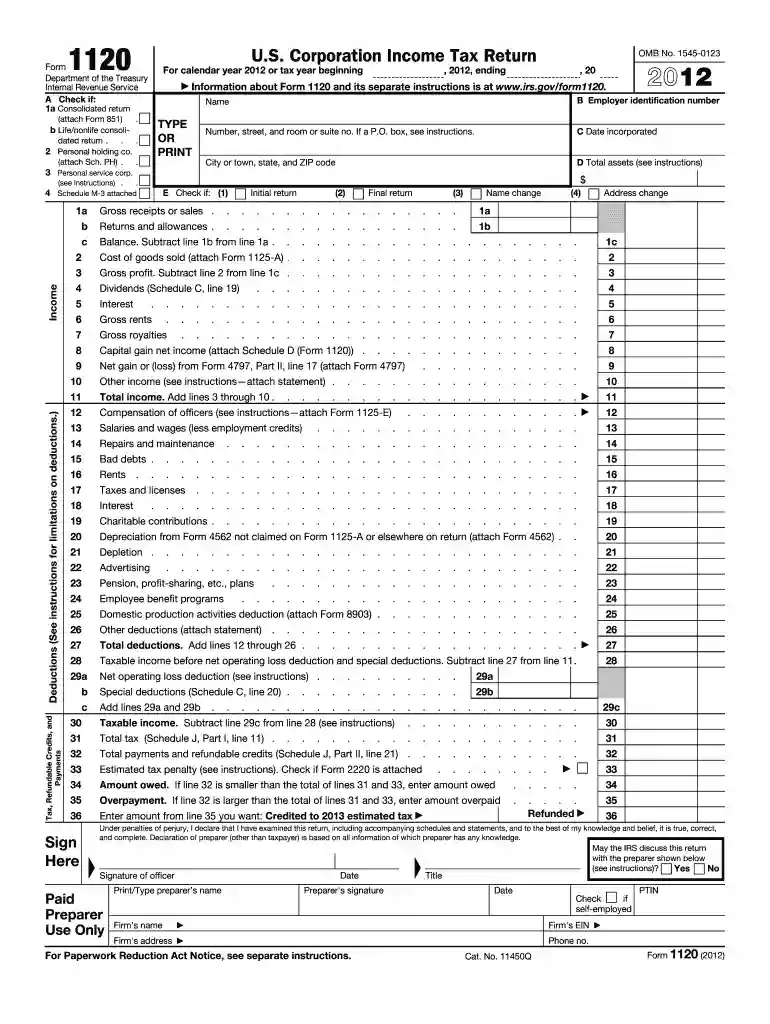
The 2012 Form 1120 is the U.S. Corporation Income Tax Return form used by corporations to report their income, deductions, and tax liabilities to the Internal Revenue Service (IRS). This form is essential for ensuring compliance with federal income tax obligations. The key sections of this form include corporate information, income calculations, deductions, and tax computation details.
Corporations must use Form 1120 to document their financial activities, which includes reporting their gross income, cost of goods sold, and allowable deductions. Proper completion of this form is critical for determining and fulfilling a corporation's fiscal responsibilities to the government.
Using the 2012 Form 1120 involves several steps. First, gather pertinent financial records, including income, expenses, and details of any deductions. This information is necessary for accurate reporting. Next, complete each section of the form methodically:
Ensure all calculations are precise, and review each entry for correctness to avoid errors that could lead to non-compliance penalties.
Completing the 2012 Form 1120 requires careful attention to detail:
Key terms relevant to the 2012 Form 1120 include:
Understanding these terms is crucial for accurately completing the form and ensuring compliance.
For the 2012 Form 1120, corporations are generally required to file by the 15th day of the third month after the end of their tax year. For most corporations operating on a calendar year, this means the deadline would be March 15, 2013. It is essential to adhere to this deadline to avoid penalties and interest charges.
Extensions are available if requested before the deadline, typically providing an additional six months for filing.
Before filing the 2012 Form 1120, ensure you have the following documents:
These documents support the entries on the form and are vital for resolving any inquiries from the IRS.
Corporations have the option to file the 2012 Form 1120 either electronically or by mail. Many corporations prefer electronic filing due to its convenience, speed, and the ability to receive quick confirmation of receipt. Some benefits of e-filing include:
However, some corporations may still choose paper filing due to comfort with traditional methods or lack of digital resources.
The primary users of the 2012 Form 1120 are U.S. corporations, both domestic and foreign, that generate income from U.S. sources. This includes entities such as:
Understanding the scope of entities required to file can ensure compliance with tax laws and avoid unnecessary complications.


We've got more versions of the 2012 form 1120 form. Select the right 2012 form 1120 version from the list and start editing it straight away!
| Versions | Form popularity | Fillable & printable |
|---|---|---|
| 2025 | 4.4 Satisfied (37 Votes) | |
| 2024 | 4.6 Satisfied (32 Votes) | |
| 2023 | 4.2 Satisfied (33 Votes) | |
| 2022 | 4.8 Satisfied (59 Votes) | |
| 2021 | 4.8 Satisfied (80 Votes) | |
| 2020 | 4.3 Satisfied (37 Votes) | |
| 2019 | 4.4 Satisfied (228 Votes) | |
| 2018 | 4.3 Satisfied (133 Votes) | |
| 2017 | 4.3 Satisfied (98 Votes) | |
| 2016 | 4.4 Satisfied (267 Votes) | |
| 2015 | 4.3 Satisfied (34 Votes) | |
| 2014 | 4.2 Satisfied (35 Votes) | |
| 2014 | 4 Satisfied (59 Votes) | |
| 2013 | 4 Satisfied (42 Votes) | |
| 2013 | 4.8 Satisfied (25 Votes) |
At DocHub, your data security is our priority. We follow HIPAA, SOC2, GDPR, and other standards, so you can work on your documents with confidence.



For Paperwork Reduction Act Notice, see separate instructions. Cat. No. 11450Q. Form 1120 (2012). Page 2. Form 1120 (2012). Page 2. Schedule C. Dividends andRead more
Dec 21, 2011 Paying by authorizing an electronic funds withdrawal ceived one credit, up to a maximum of four credits, for each. $1,120 ($1,130 for 2012) ofRead more


