




01. Edit your form 1120 2011 online
Type text, add images, blackout confidential details, add comments, highlights and more.

Type text, add images, blackout confidential details, add comments, highlights and more.

Draw your signature, type it, upload its image, or use your mobile device as a signature pad.

Send it via email, link, or fax. You can also download it, export it or print it out.
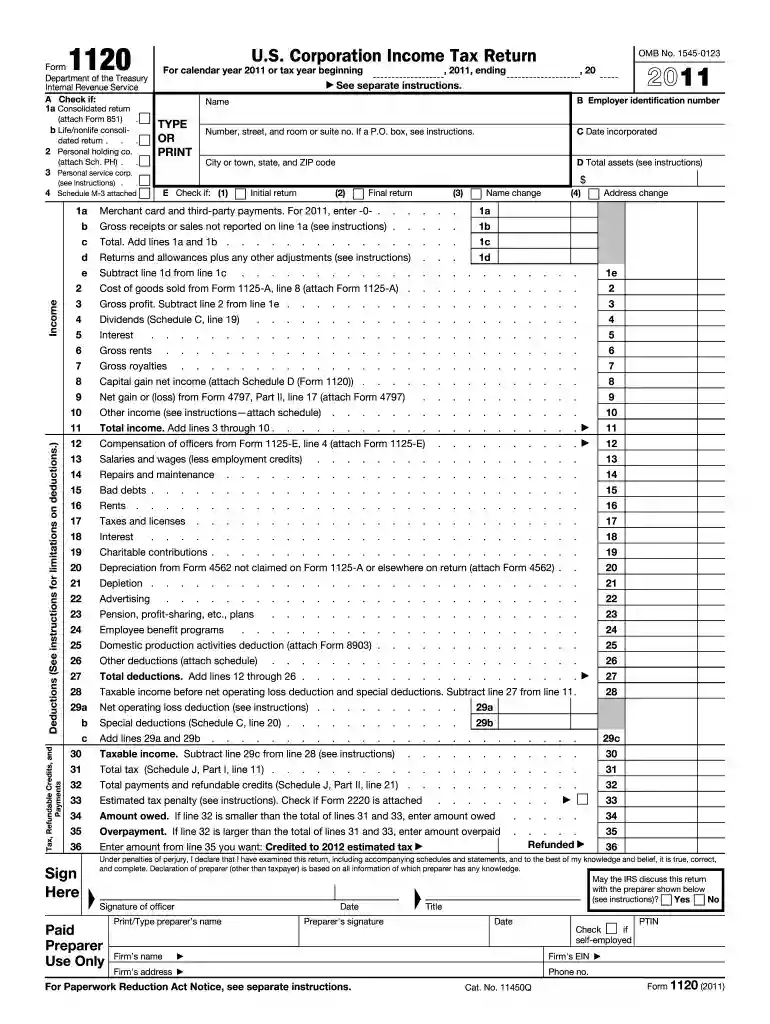
The 2011 Form 1120 is the U.S. Corporation Income Tax Return required for corporations to report their income, deductions, and tax liabilities to the IRS for the tax year 2011. This form is essential for determining the tax burden of corporations under U.S. tax laws. It includes sections detailing corporate identification, income, deductions, tax computations, and other relevant financial information. Being thorough and accurate in filling out this form helps ensure compliance with federal tax obligations.
Corporate Information Section: Begin by filling out the corporation's name, address, and Employer Identification Number (EIN). This section also requires information on the date of incorporation and the type of corporation.
Income Reporting: Accurately report all sources of income, including gross receipts, cost of goods sold, and any other pertinent income.
Deductions and Credits: Complete the deductions section meticulously, including ordinary and necessary business expenses. Analyze tax credits that the corporation is eligible for, as these can significantly reduce tax liabilities.
Tax Calculation: Use the information from prior sections to determine the total tax liability. This involves calculating the taxable income and applying the appropriate tax rate.
Sign and Date: The form must be signed and dated by an authorized corporate officer, affirming the accuracy of the information.
Corporations operating within the United States typically utilize the 2011 Form 1120 to fulfill their tax reporting obligations. This includes:


Adhering to IRS guidelines is crucial when completing the 2011 Form 1120. The IRS provides detailed instructions outlining the procedures for filling out the form, acceptable deduction claims, and tax computation methods. The guidelines emphasize accuracy and compliance to avoid potential audits or penalties.
The filing deadline for the 2011 Form 1120 was March 15, 2012, for calendar-year corporations. Extensions could be requested, providing up to an additional six months, but required submission of IRS Form 7004 by the original deadline. Failure to adhere to these timelines could result in penalties.
Corporations failing to file the 2011 Form 1120 by the deadline may incur significant penalties. These can include:
The 2011 Form 1120 is compatible with various tax preparation software, such as TurboTax and QuickBooks. These programs can facilitate accurate completion by automating calculations and ensuring that all required fields are filled. Software solutions often include e-filing options, streamlining the submission process.
Corporations have the option to file the 2011 Form 1120 either digitally or on paper. Digital filing through the IRS e-file system can be quicker and provide immediate confirmation of receipt. Conversely, the paper version might be preferred by corporations that maintain traditional record-keeping practices. Both methods require meticulous record-keeping and compliance with IRS requirements.
While primarily used by C Corporations, the form can also be applicable to LLCs and partnerships electing to be taxed as corporations. In such cases, these entities must follow the same processes and requirements as traditional C Corporations when completing and submitting the form. Understanding the specific tax obligations for their designated business entity type helps ensure compliance.
We've got more versions of the form 1120 2011 form. Select the right form 1120 2011 version from the list and start editing it straight away!
| Versions | Form popularity | Fillable & printable |
|---|---|---|
| 2025 | 4.4 Satisfied (37 Votes) | |
| 2024 | 4.6 Satisfied (32 Votes) | |
| 2023 | 4.2 Satisfied (33 Votes) | |
| 2022 | 4.8 Satisfied (59 Votes) | |
| 2021 | 4.8 Satisfied (80 Votes) | |
| 2020 | 4.3 Satisfied (37 Votes) | |
| 2019 | 4.4 Satisfied (228 Votes) | |
| 2018 | 4.3 Satisfied (133 Votes) | |
| 2017 | 4.3 Satisfied (98 Votes) | |
| 2016 | 4.4 Satisfied (267 Votes) | |
| 2015 | 4.3 Satisfied (34 Votes) | |
| 2014 | 4.2 Satisfied (35 Votes) | |
| 2014 | 4 Satisfied (59 Votes) | |
| 2013 | 4 Satisfied (42 Votes) | |
| 2013 | 4.8 Satisfied (25 Votes) |
At DocHub, your data security is our priority. We follow HIPAA, SOC2, GDPR, and other standards, so you can work on your documents with confidence.

Under penalties of perjury, I declare that I have examined this return, including accompanying schedules and statements, and to the best of my knowledge andRead more
For Paperwork Reduction Act Notice, see separate instructions. Cat. No. 11450Q. Form 1120 (2011). Page 2. Form 1120 (2011). Page 2. Schedule C. Dividends andRead more
Dec 21, 2011 Instructions for. Form 1120S. The following are some of the tax changes for 2011. For information on other changes, go to IRS.gov. What youRead more


