




01. Edit your 1120 2013 online
Type text, add images, blackout confidential details, add comments, highlights and more.

Type text, add images, blackout confidential details, add comments, highlights and more.

Draw your signature, type it, upload its image, or use your mobile device as a signature pad.

Send 2013 form 1120 via email, link, or fax. You can also download it, export it or print it out.
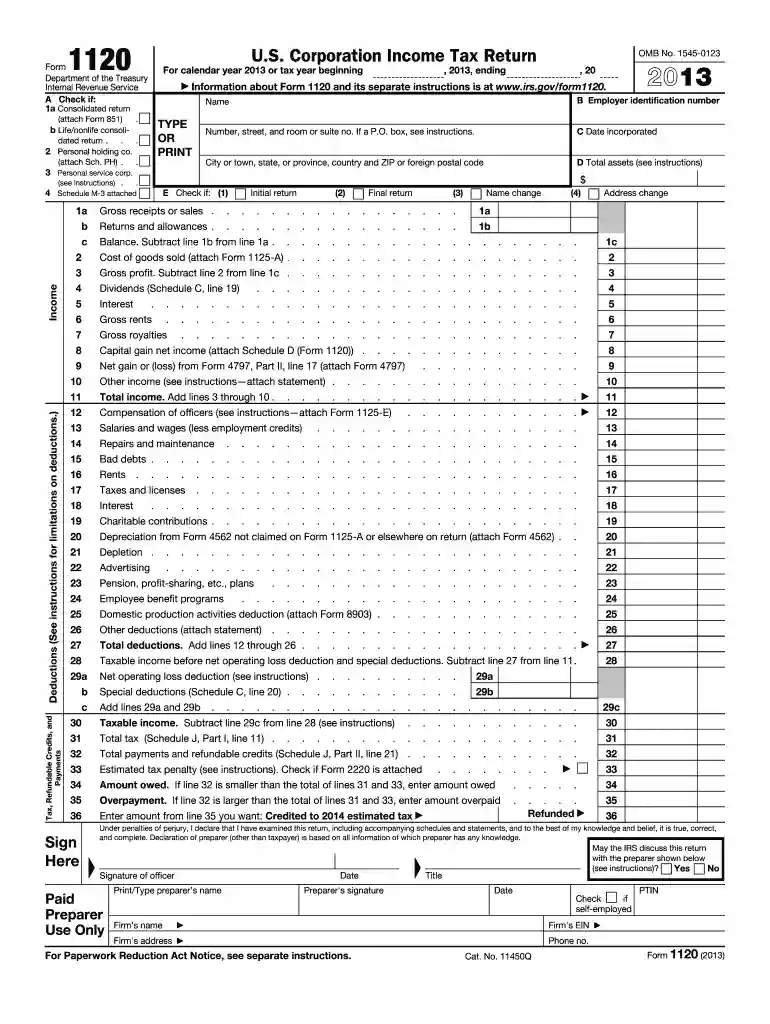
Form 1120 for the 2013 tax year is the U.S. Corporation Income Tax Return. Corporations use this form to report income, deductions, and tax liabilities to the Internal Revenue Service (IRS). It includes sections for various financial components and declarations, ensuring compliance with federal tax regulations. The form helps the IRS assess the corporation's annual income tax and ensure accurate reporting of business activities.
Acquiring Form 1120 for the 2013 tax year involves several methods to ensure corporations adhere to tax obligations. The IRS provides this form through various accessible channels.
Direct Download:
Mail Request:
Tax Software Platforms:
Completing Form 1120 involves understanding its sections and detailed requirements. Follow these structured steps for an accurate submission:
Gather Required Information:
Fill Out Corporate Information:
Report Income and Deductions:
Calculate Tax Liability:
Review and File:
Form 1120 is primarily utilized by U.S. corporations that must report income and expenses for tax purposes:
Form 1120 encompasses crucial financial and business components:
Adhering to IRS deadlines is crucial for smooth submission:
Understanding penalties aids in avoiding unnecessary charges:
Corporations can choose between digital or paper submissions:
Digital Filing:
Paper Filing:
Leveraging software programs can streamline the filing process:
Understanding these key aspects of Form ensures businesses fulfill legal tax obligations comprehensively, safeguarding against potential penalties and maintaining fiscal responsibility.
We've got more versions of the 1120 2013 form. Select the right 1120 2013 version from the list and start editing it straight away!
| Versions | Form popularity | Fillable & printable |
|---|---|---|
| 2025 | 4.4 Satisfied (37 Votes) | |
| 2024 | 4.6 Satisfied (32 Votes) | |
| 2023 | 4.2 Satisfied (33 Votes) | |
| 2022 | 4.8 Satisfied (59 Votes) | |
| 2021 | 4.8 Satisfied (80 Votes) | |
| 2020 | 4.3 Satisfied (37 Votes) | |
| 2019 | 4.4 Satisfied (228 Votes) | |
| 2018 | 4.3 Satisfied (133 Votes) | |
| 2017 | 4.3 Satisfied (98 Votes) | |
| 2016 | 4.4 Satisfied (267 Votes) | |
| 2015 | 4.3 Satisfied (34 Votes) | |
| 2014 | 4.2 Satisfied (35 Votes) | |
| 2014 | 4 Satisfied (59 Votes) | |
| 2013 | 4 Satisfied (42 Votes) | |
| 2013 | 4.8 Satisfied (25 Votes) |
At DocHub, your data security is our priority. We follow HIPAA, SOC2, GDPR, and other standards, so you can work on your documents with confidence.



Filing Status 6. Single Dependent taxpayers, regardless of whether income is earned or unearned, are not required to file a Maryland income tax return unlessRead more
Check the box for the return for which you are using this Form 8879-EO and enter the applicable amount, if any, from the return. If you check the box on line 1aRead more
When preparing your 2013 tax return, you may complete the forms as if these contributions were made on. December 31, 2013, instead of in 2014. The contributionRead more


