




01. Edit your 1120 2019 tax online
Type text, add images, blackout confidential details, add comments, highlights and more.

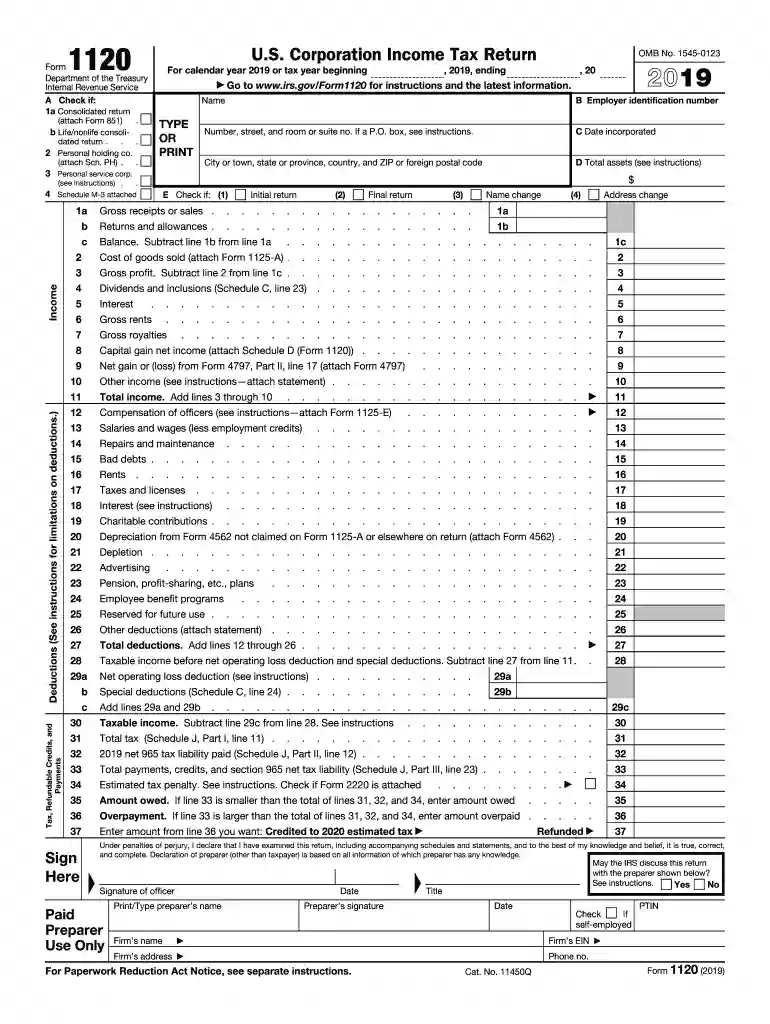
Type text, add images, blackout confidential details, add comments, highlights and more.

Draw your signature, type it, upload its image, or use your mobile device as a signature pad.

Send form 1120 2019 via email, link, or fax. You can also download it, export it or print it out.
Form 1120 is the U.S. Corporation Income Tax Return used by corporations to report their income, gains, losses, deductions, and credits to the Internal Revenue Service (IRS) for federal taxation purposes. This form is essential for determining a corporation’s federal income tax liability. The 2018 form 1120 specifically pertains to the tax obligations for the tax year 2018, adhering to the tax regulations and requirements in effect for that year. Corporations must complete this form to ensure compliance with federal tax laws and the accurate reporting of their financial activities.
Corporations operating in the United States, including C corporations and those electing to be taxed as such, utilize Form 1120. This includes various business entity types, such as:


The IRS provides comprehensive instructions for completing Form 1120, detailing each section and line item to ensure accuracy. The guidelines also define the filing requirements, eligible deductions, available tax credits, and applicable rates. Corporations must adhere to these guidelines to avoid penalties and ensure compliance. The IRS specifically outlines the proper documentation required to support the entries on the form, emphasizing the importance of maintaining accurate records.
For the 2018 tax year, corporations were generally required to file Form 1120 by April 15, 2019. Corporations can request a six-month extension, extending the deadline to October 15, 2019. It is important for corporations to be aware of these deadlines to avoid late filing penalties. If a corporation operates on a fiscal year rather than the calendar year, the due date for filing Form 1120 is the fifteenth day of the fourth month following the end of its fiscal year.
Failure to file Form 1120 by the specified deadline can result in significant penalties. The IRS typically imposes a penalty of 5% of the unpaid tax for each month or part of a month the return is late, up to a maximum of 25%. Additionally, there are penalties for underpayment of taxes or inaccuracies in the tax return. Corporations must exercise diligence in filing and accurately completing Form 1120 to avoid costly penalties and interest charges.
Various tax software solutions are compatible with Form 1120, aiding corporations in preparing and filing their returns electronically. Programs like TurboTax Business, QuickBooks, and others provide guidance and tools for accurately completing the form. These software options streamline the filing process by offering step-by-step instructions, error checking, and direct submission to the IRS. Compatibility with accounting software can facilitate the transfer of financial data, reducing the risk of errors and ensuring a smooth filing experience.
Corporations have the option to file Form 1120 either electronically or on paper. Electronic filing (e-filing) is encouraged by the IRS as it typically results in faster processing times, reduced chances of errors, and confirmation of receipt. The digital version of Form 1120 also often integrates seamlessly with tax preparation software. However, some corporations may choose to file a paper version, typically due to preferences for manual record-keeping or technological constraints. E-filing is considered more efficient, especially for larger corporations with complex tax situations.
We've got more versions of the 1120 2019 tax form. Select the right 1120 2019 tax version from the list and start editing it straight away!
| Versions | Form popularity | Fillable & printable |
|---|---|---|
| 2025 | 4.4 Satisfied (37 Votes) | |
| 2024 | 4.6 Satisfied (32 Votes) | |
| 2023 | 4.2 Satisfied (33 Votes) | |
| 2022 | 4.8 Satisfied (59 Votes) | |
| 2021 | 4.8 Satisfied (80 Votes) | |
| 2020 | 4.3 Satisfied (37 Votes) | |
| 2019 | 4.4 Satisfied (228 Votes) | |
| 2018 | 4.3 Satisfied (133 Votes) | |
| 2017 | 4.3 Satisfied (98 Votes) | |
| 2016 | 4.4 Satisfied (267 Votes) | |
| 2015 | 4.3 Satisfied (34 Votes) | |
| 2014 | 4.2 Satisfied (35 Votes) | |
| 2014 | 4 Satisfied (59 Votes) | |
| 2013 | 4 Satisfied (42 Votes) | |
| 2013 | 4.8 Satisfied (25 Votes) |
At DocHub, your data security is our priority. We follow HIPAA, SOC2, GDPR, and other standards, so you can work on your documents with confidence.


Ordinary business income (loss). Determine whether the income (loss) is passive or nonpassive and enter on your return as follows: Report on. Passive loss.Read more
Enter the total tax from Form 1120, Schedule J, or the total tax from your applicable tax return. See the instructions for your applicable tax return. Line 8.Read more
4. At the end of the tax year: a Did any foreign or domestic corporation, partnership (including any entity treated as a partnership), trust, or tax-exempt.Read more


