







Definition & Meaning
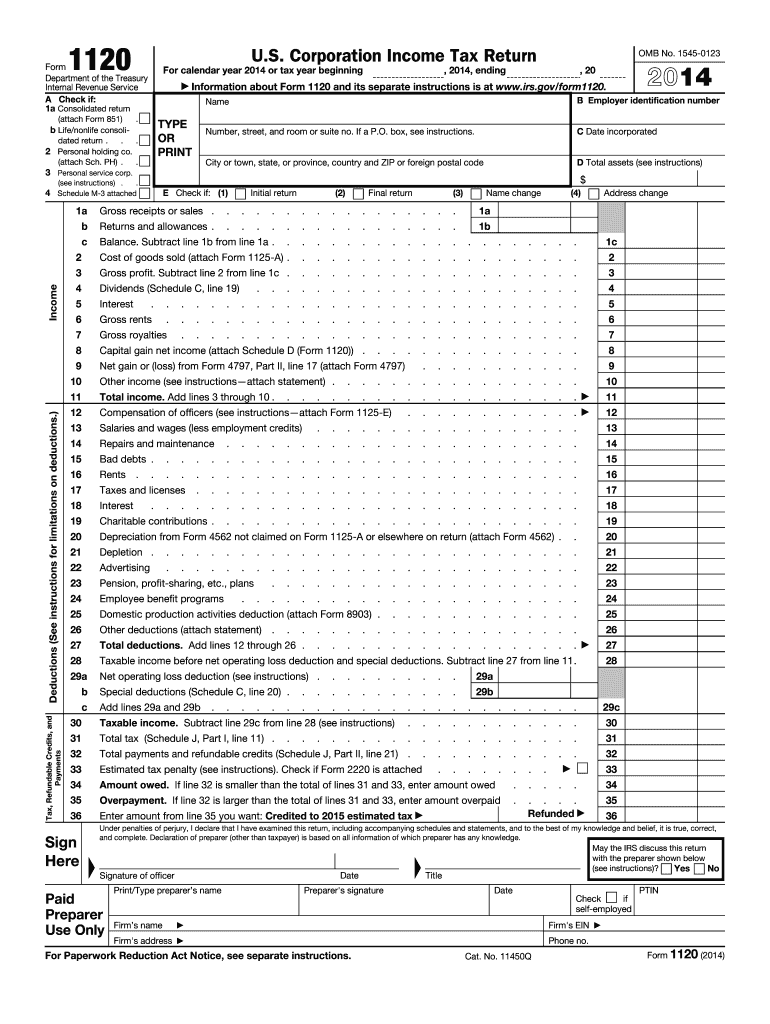
The 1120 form for 2014, officially known as the U.S. Corporation Income Tax Return, is a document that corporations in the United States use to report their income, gains, losses, deductions, and credits. This form is essential for calculating the corporation's federal tax liability for that particular tax year. It consists of various schedules and sections where corporations disclose financial and operational details comprehensively to comply with IRS regulations.
Key Sections of the Form
- Corporate Information: Information about the corporation's legal name, address, employer identification number (EIN), and date of incorporation.
- Income: Details on total income, including gross receipts, sales returns, allowances, and cost of goods sold.
- Deductions: A breakdown of ordinary business expenses, such as wages, salaries, rents, and other deductions that reduce taxable income.
- Tax and Payments: Calculations for total tax liability, credits applied, and payments already made for estimated taxes.
How to Use the 1120 Form 2014
Using the 1120 form involves several steps to ensure accurate and compliant tax reporting. The form is primarily utilized by corporations to compute and file their annual income tax return with the IRS. It requires detailed financial information and a thorough understanding of corporate tax laws.
Steps to Use the Form
- Gather Financial Statements: Collect all necessary financial documentation, including income statements, balance sheets, and cash flow statements.
- Complete Each Section: Fill out the income, deductions, and other relevant sections, ensuring all calculations align with existing records.
- Attach Required Schedules: Depending on specific financial activities, attach schedules for additional income, deductions, and credits.
- Sign and Date: Ensure an authorized corporate officer signs and dates the form before submission.
Important Considerations
- Accurate entries avoid potential audits or penalizations.
- Review the IRS's instructions specific to the 2014 tax year to account for any unique rules or exceptions.
Filing Deadlines / Important Dates
For the 2014 tax year, the 1120 form was due on March 16, 2015, for calendar-year corporations. Corporations operating on a fiscal year basis must file by the 15th day of the third month following the close of their fiscal year. It is critical for corporations to meet these deadlines to prevent late filing penalties and interest on any unpaid taxes.
Extensions
- Automatic Six-Month Extension: Filing Form 7004 can provide an automatic six-month extension, but it is crucial to submit it before the original due date.
- Payment of Taxes: An extension to file does not extend the deadline for paying any taxes due by the original deadline.
Steps to Complete the 1120 Form 2014
Filling out the 1120 form involves detailed input of financial data from a corporation's records. Adhering to a step-by-step approach ensures completeness and accuracy.
Step-by-Step Process
- Prepare Financial Data: Collect all relevant documentation, including revenue, expenses, and all forms of income.
- Income Section: Carefully input gross receipts, deductions for returns and allowances, and cost of goods sold to ascertain gross profit.
- Deductions Section: Enter all allowable business expenses including salaries, rent, taxes, and interest expenses.
- Tax Computation: Calculate the tax owing by applying applicable credits and prepayments.
- Review and Attach Schedules: Verify that all supplemental schedules are correct and attached.
- Submit the Form: File the completed return with the IRS either electronically or by mail before the deadline.
Who Typically Uses the 1120 Form 2014
The 1120 form is specifically used by C corporations in the United States, which are separate taxpaying entities from their owners. This form is also applicable to some other tax entities that require corporate taxation treatment.


Eligible Business Entities
- Domestic C Corporations: These corporations are separate from their shareholders for tax purposes and use this form to declare their federal income tax.
- Foreign Corporations Operating in the U.S.: Must file if they conduct business or derive income effectively connected with the U.S.
Exclusions
- S corporations and certain nonprofit entities have different tax filing obligations and typically do not use Form 1120.
Required Documents
Corporations will need several documents ready to correctly fill out the 1120 form. These documents help verify entries and ensure compliance with IRS regulations.
Essential Documents
- Financial Statements: Income statement, balance sheet, and cash flow statement to input correct data.
- Previous Tax Returns: Previous filings to maintain consistency in reporting and understand carryovers or unused credits.
- Supporting Schedules: Required for distinct types of income or deductions, depending on the corporation's activities.
Gathering Documentation
- Ensure all documents are up-to-date and reconcile discrepancies before beginning the filing process.
Penalties for Non-Compliance
Failure to comply with the IRS filing requirements for the 1120 form can result in significant penalties, affecting a corporation's financial standing and credibility.
Types of Penalties
- Late Filing Penalty: A penalty generally calculated as 5% of the unpaid tax for each month (or part of a month) that the return is late, up to a maximum of 25% of the unpaid taxes.
- Late Payment Penalty: Accrued at 0.5% of the unpaid taxes per month or part of a month until the taxes are paid, not exceeding a total of 25%.
- Accuracy-Related Penalty: Imposed for underpayment due to negligence or substantial understatement of income, typically 20% of the underpaid tax.
Avoiding Penalties
- Timely filing and payment, accompanied by accurate reporting, minimize the risk of penalties.
Software Compatibility for Filing
Numerous software solutions facilitate filing the 1120 form, ensuring accuracy and efficiency for corporations managing complex tax returns. Many are IRS-approved and offer additional features to simplify form completion.
Popular Software Options
- TurboTax Business: Offers guided assistance through the 1120 form with built-in checks for errors.
- QuickBooks: Integrates accounting data to pre-fill and streamline the filing process.
- TaxAct: Provides calculations and supports filing for multiple states.
Benefits of Using Software
- Saves time with automated calculations and e-filing.
- Reduces errors through data import features from existing accounting software.
- Facilitate compliance with real-time updates on tax law changes.




