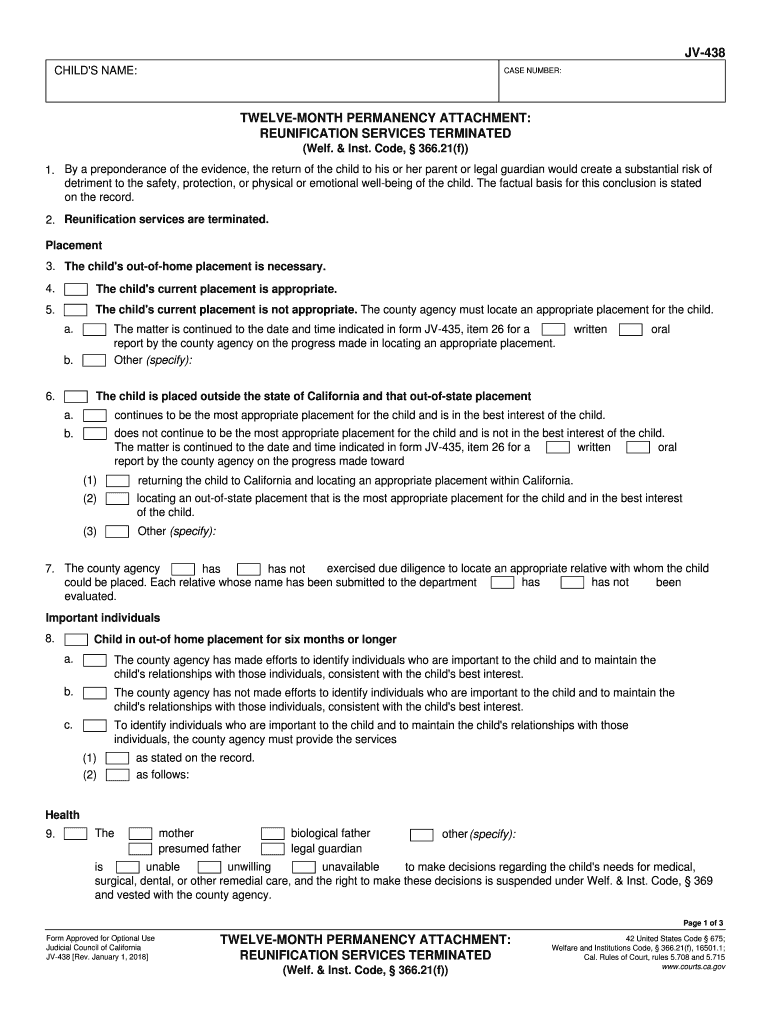
Twelve permanency reunification online 2026

Get Form
twelve permanency reunification online Preview on Page 1

Here's how it works

01. Edit your form online
Type text, add images, blackout confidential details, add comments, highlights and more.
02. Sign it in a few clicks
Draw your signature, type it, upload its image, or use your mobile device as a signature pad.
03. Share your form with others
Send it via email, link, or fax. You can also download it, export it or print it out.

How to use or fill out twelve permanency reunification online

Form edit decoration
9.5
Ease of Setup
DocHub User Ratings on G2
9.0
Ease of Use
DocHub User Ratings on G2
  1. Click ‘Get Form’ to open it in the editor.
  2. Begin by entering the child's name and case number at the top of the form. This information is crucial for identifying the specific case.
  3. In the 'Twelve-Month Permanency Attachment' section, carefully review each statement regarding reunification services and select the appropriate options based on your situation.
  4. For placement details, indicate whether the current placement is appropriate. If not, provide necessary information about locating a suitable alternative.
  5. Address health decision-making rights by selecting who is unable or unwilling to make decisions regarding the child's care.
  6. In the 'Selection of Permanent Plan' section, choose from options like adoption or legal guardianship, and specify any relevant dates for achieving these plans.
  7. Finally, ensure all sections are completed accurately before saving your work. Utilize our platform's features to print or share your finalized document as needed.

Start filling out your twelve permanency reunification form today for free using our editor!

See more twelve permanency reunification online versions

We've got more versions of the twelve permanency reunification online form. Select the right twelve permanency reunification online version from the list and start editing it straight away!
Versions Form popularity Fillable & printable
2021 4.3 Satisfied (31 Votes)
2020 4.8 Satisfied (40 Votes)
2018 4.3 Satisfied (102 Votes)
2011 4.3 Satisfied (228 Votes)
be ready to get more

Complete this form in 5 minutes or less

Get form

Got questions?

We have answers to the most popular questions from our customers. If you can't find an answer to your question, please contact us.
Contact us
Among the permanency outcomes for children and youth in foster care (CYFC) are adoption by their foster carers, relatives, or strangers; emancipation, also called aging out, from out-of-home care; long-term foster care; and reunification with their family.
Family reunification is used to reunite children with verified and authorized family members after a critical and often highly stressful incident (e.g., fire, natural disaster, a situation involving weapons or violence at school, a school bus accident, etc.)
Whenever it is safe and possible, reunification is the preferred outcome for children who have been removed from their homes. It represents healing, growth, and the restoration of a family unit. While the path to reunification is rarely easy, it is often the most rewarding and beneficial for families and children.
Reunification therapy is an intervention that aims to improve or reestablish the relationship between members of a family, usually parents and children. Therapy may focus on attachment, improving communication, and building trust between parents and children.
Identifying the safety issue that brought the family to the attention of the child welfare system, assessing family strengths and needs, and bringing together a team of partners to include the family, caregivers, and legal and community providers are all strategies that can positively impact reunification and support

Security and compliance

At DocHub, your data security is our priority. We follow HIPAA, SOC2, GDPR, and other standards, so you can work on your documents with confidence.

Learn more
ccpa2
pci-dss
gdpr-compliance
hipaa
soc-compliance
be ready to get more

Complete this form in 5 minutes or less

Get form

People also ask

Agencies should consider factors such as your childs racial, ethnic, and cultural background; the caregivers ability to care for your child; how close the caregivers home is to your childs school; and whether your child will be able to keep a connection to their community.
Reunification is the return of a child to the care of their birth family. Reunification decisions are made by the relevant childrens court following consideration for the childs safety, wellbeing and best interests by all the stakeholders involved.
Permanency planning begins when a child comes to the attention of the child welfare system. It is most often achieved when a child is reunified with their family of origin, but it may also occur when another court mandated permanency goal, such as guardianship or adoption, is obtained.

Related links