







Definition & Meaning
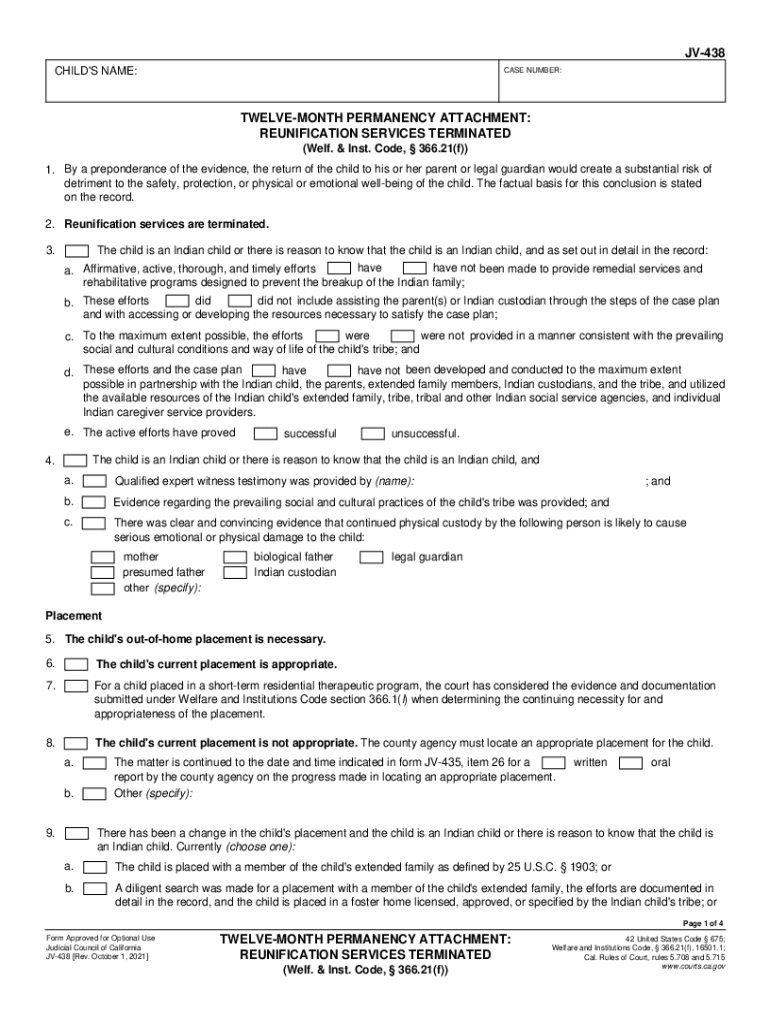
The Form JV-438, known as the Twelve-Month Permanency Attachment, serves as a critical document in child welfare proceedings. This form is utilized within the juvenile court system to document the termination or continuation of reunification services for a child. The primary focus of Form JV-438 is to evaluate whether a child's return to their parent or legal guardian would pose a substantial risk to their well-being. It also outlines the current placement and offers recommendations for the child's permanent plan, such as adoption, guardianship, or placement with relatives.
How to Use the Form JV-438 "Twelve-Month Permanency Attachment"
To use the Form JV-438 effectively, legal professionals must assess the child's situation thoroughly. The form requires detailed information about the child's current circumstances, including their living arrangements and any services provided to their family. It's vital to document efforts made to engage the child's family and community resources. When completing the form, practitioners should ensure clarity and precision in describing the child's best interests and potential permanency plans. This comprehensive approach helps the court make informed decisions regarding the child's future.
Steps to Complete the Form JV-438 "Twelve-Month Permanency Attachment"
- Gather Required Information: Collect data regarding the child's placement, service efforts, and any risk factors.
- Evaluate Child's Situation: Analyze if returning to the parent or guardian is in the child's best interest or if it poses risks.
- Document Efforts and Services: Note all services provided to the child and family, highlighting those specific to an Indian child if applicable.
- Propose a Permanent Plan: Recommend a long-term placement plan, taking into account adoption, guardianship, or relative placement.
- Submit for Review: Ensure completion of all sections before submitting to the juvenile court for evaluation.
Key Elements of the Form JV-438 "Twelve-Month Permanency Attachment"
- Child's Placement Details: Information about the child's current living situation and caregivers.
- Service Efforts: Documentation of services offered to support the child and family.
- Risk Assessment: Evaluation of the risk associated with returning the child to their parent or guardian.
- Permanency Planning: Recommendations for the most suitable permanent option for the child's welfare.
- Compliance with the Indian Child Welfare Act: If applicable, verify that efforts are consistent with the needs of an Indian child.
State-Specific Rules for the Form JV-438 "Twelve-Month Permanency Attachment"
Different states may have unique requirements or additional sections to be completed on the Form JV-438. It is crucial for practitioners to understand state-specific guidelines, which could dictate the timing of submission, additional required documentation, and specific language that must be included. For instance, California might have specific mandates for documenting services and the involvement of child welfare agencies in permanency planning.
Who Typically Uses the Form JV-438 "Twelve-Month Permanency Attachment"
The Form JV-438 is predominantly used by child welfare professionals, including social workers, attorneys representing children and parents, and court-appointed advocates. The juvenile court judges reviewing child welfare cases also rely on this form to gain understanding and make decisions regarding the child's permanency plan.


Examples of Using the Form JV-438 "Twelve-Month Permanency Attachment"
In practice, consider a scenario where a child has been placed temporarily with a foster family due to safety concerns at home. A social worker would use Form JV-438 to document whether it's feasible for the child to return home or if a permanent plan such as adoption is more suitable. Through thorough assessments documented on the form, the court can make a decision that prioritizes the child's long-term safety and stability.
Legal Use of the Form JV-438 "Twelve-Month Permanency Attachment"
The Form JV-438 holds significant legal weight in juvenile dependency hearings. It serves as evidence for the court's decision regarding a child’s permanent placement when reunification is not a viable option. The form ensures that all legal considerations are accounted for, and it provides a detailed record of the parties involved and the recommended course of action, supporting the court's commitment to acting in the best interest of the child.
Important Terms Related to Form JV-438 "Twelve-Month Permanency Attachment"
- Reunification Services: Services aimed at reuniting the child with their biological family.
- Permanency Plan: A long-term plan for a child's living arrangements, focused on stability.
- Indian Child Welfare Act (ICWA): A federal law applying to Native American children in welfare cases.
- Risk Assessment: Analysis of potential harm if a child is returned to their original home environment.
- Guardian Ad Litem: A court-appointed advocate for the child’s best interests during legal proceedings.




