California emergency protective order form 2026

Get Form
california emergency protective order form Preview on Page 1

Here's how it works

01. Edit your form online
Type text, add images, blackout confidential details, add comments, highlights and more.

02. Sign it in a few clicks
Draw your signature, type it, upload its image, or use your mobile device as a signature pad.

03. Share your form with others
Send it via email, link, or fax. You can also download it, export it or print it out.

How to use or fill out California Emergency Protective Order Form

Form edit decoration
9.5
Ease of Setup
DocHub User Ratings on G2
9.0
Ease of Use
DocHub User Ratings on G2
  1. Click ‘Get Form’ to open the California Emergency Protective Order form in our editor.
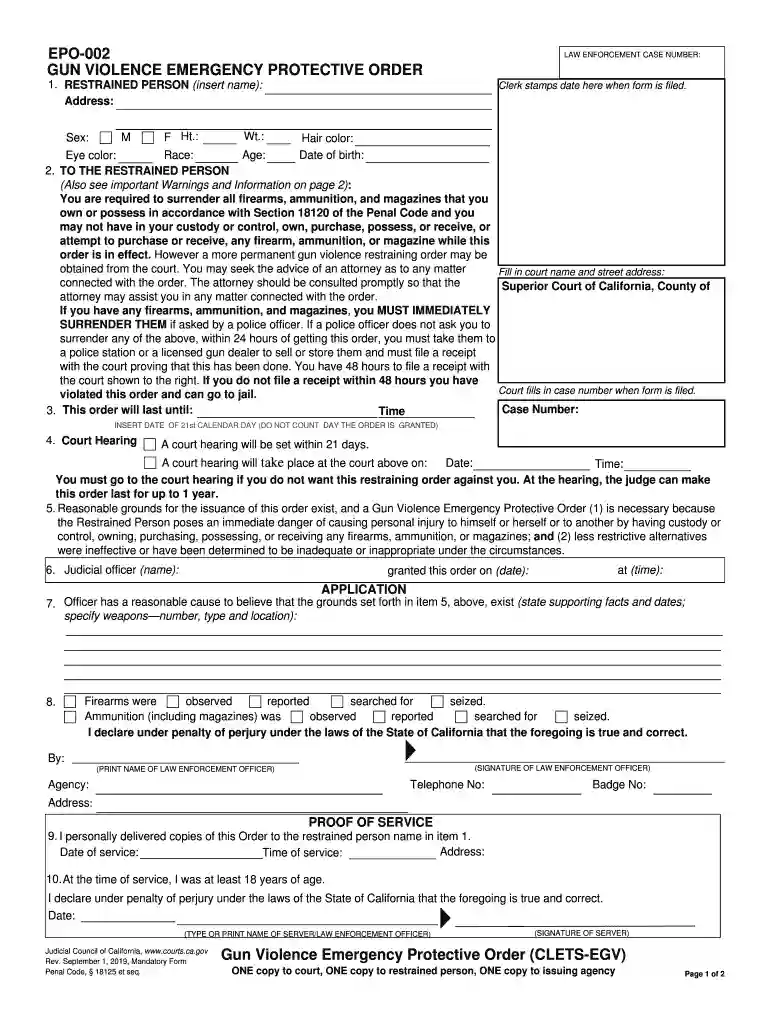
  2. Begin by filling in the 'Restrained Person' section with the individual's name and address. Ensure accuracy as this information is crucial for enforcement.
  3. Complete the personal details of the restrained person, including weight, height, sex, hair color, race, age, date of birth, and eye color. This helps law enforcement identify the individual.
  4. In the 'Court Hearing' section, specify the date and time for the hearing. This is essential for both parties to know when they must appear in court.
  5. Provide a detailed explanation in item 7 regarding the grounds for issuing this order. Include any relevant facts and dates that support your case.
  6. Finally, ensure that all signatures are completed where required. This includes signatures from law enforcement officers involved in serving or processing this order.

Start using our platform today to fill out your California Emergency Protective Order form quickly and efficiently!

See more california emergency protective order form versions

We've got more versions of the california emergency protective order form form. Select the right california emergency protective order form version from the list and start editing it straight away!
Versions Form popularity Fillable & printable
2024 4.9 Satisfied (39 Votes)
2021 4.8 Satisfied (221 Votes)
2019 4.3 Satisfied (110 Votes)
2019 4.2 Satisfied (24 Votes)
2017 4.3 Satisfied (60 Votes)
2016 4.3 Satisfied (188 Votes)
be ready to get more

Complete this form in 5 minutes or less

Get form

Got questions?

We have answers to the most popular questions from our customers. If you can't find an answer to your question, please contact us.
Contact us
There are a handful of reasons why a judge could decide to deny a petition for a protective order, including: The petitioner does not have sufficient evidence of abuse or harassment. The petitioner fails to complete their petition accurately and completely. The petitioner fails to attend their protective order hearing.
A DVO is a final order by the court, but its not the first order that someone gets. The process actually begins when someone takes out an Emergency Protective Order (EPO). An EPO may or may not become a DVO. A domestic violence order involves a familial relationship.
(California Family Code Section 6250.3.) The Emergency Protective Order goes into effect immediately and is good for seven (7) calendar days or five (5) business days, whichever is shorter.
The Emergency Protective Order goes into effect immediately and is good for seven (7) calendar days or five (5) business days, whichever is shorter. The Emergency Protective Order is intended to provide protection long enough for the requestor to file an application for a Domestic Violence Restraining Order in court.
Overall, no, California does not make an important or official distinction between protective orders and restraining orders. The two terms are often used interchangeably in legal contexts.

Security and compliance

At DocHub, your data security is our priority. We follow HIPAA, SOC2, GDPR, and other standards, so you can work on your documents with confidence.

Learn more
ccpa2
pci-dss
gdpr-compliance
hipaa
soc-compliance
be ready to get more

Complete this form in 5 minutes or less

Get form

People also ask

A protective order (EPO/TIPO) is effective until the court hearing is held, usually within 14 days. If the respondent has not been served with the EPO/ TIPO, the order will be continued until service is made (up to six months) or until the order is withdrawn by the court.
The victim who is asking for an EPO is referred to as a protected person and their family members are known as protected people in the order. Unlike other temporary restraining orders (TRO) or permanent restraining orders, an EPO can be requested by any law enforcement officer responding to the call.

Related links