






Overview of Pedigree Fillable Forms
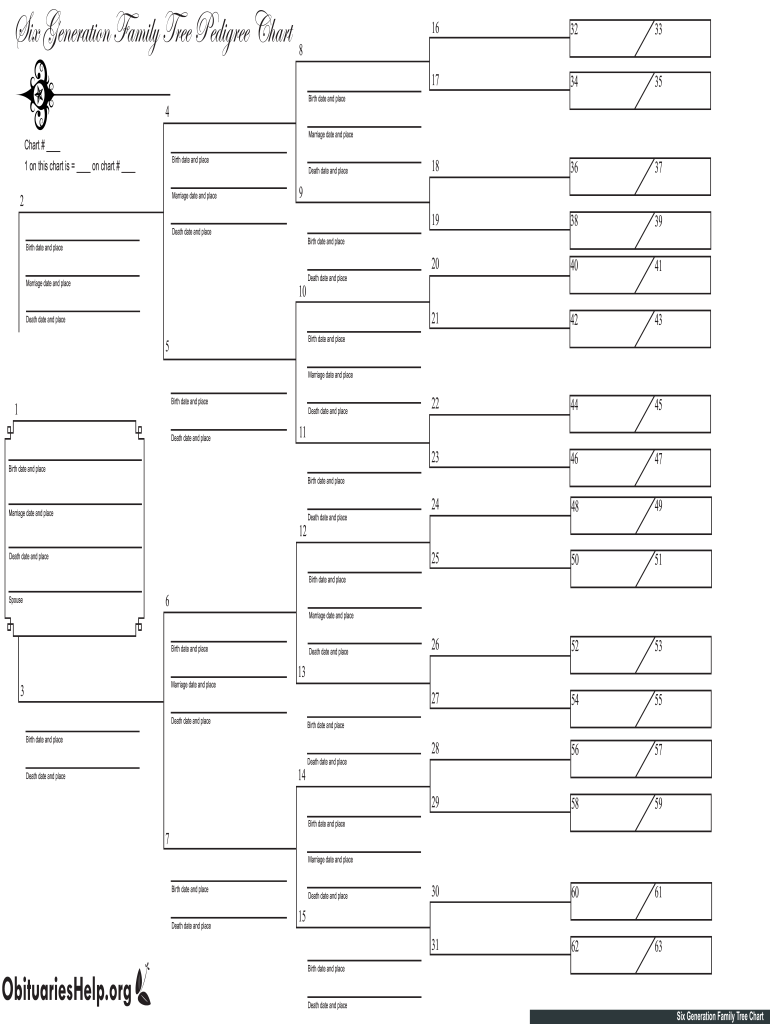
Pedigree fillable forms serve an essential role in genealogical research and family history documentation. These forms allow individuals to organize detailed information about their ancestry, showcasing relationships across generations. Typically, one such form is the Six Generation Family Tree Pedigree Chart, which tracks birth, marriage, and death dates and places for ancestors across six generations. This structured format assists researchers in visualizing family connections and lineage in an organized manner, facilitating comprehensible historical documentation.
Features of Fillable Pedigree Charts
Fillable pedigree charts come with a range of functionalities that enhance their usability:
- Interactive Fields: These charts feature fillable fields where users input names, dates, and relationships, resulting in neat and organized data presentation.
- Customizable Layouts: Users can often modify structures—adding or removing fields according to their research needs.
- Download Options: Many platforms offer free pedigree chart downloads in various formats, such as PDF, which allow for easy printing and offline storage.
This enhanced interactivity enables individuals to create a personalized family history record that meets their specific requirements.
Steps for Using a Fillable Pedigree Chart
Using a fillable pedigree chart involves several straightforward steps:
- Select the Family Tree Template: Choose a pedigree form that fits your research focus, such as a vertical or horizontal chart layout.
- Input Family Information: Enter details for each ancestor, including full names, birth dates, marriage dates, and death dates. Ensure accuracy for genealogical integrity.
- Save and Edit: Save your progress periodically. Many platforms allow for real-time edits, enabling the addition of new information as research evolves.
- Export and Share: Once the chart is complete, export it in your desired format (PDF, DOCX, etc.) for sharing with family members or archival purposes.
This systematic approach ensures that all relevant data is captured accurately while allowing for flexibility in documentation.
Advantages of Digital vs. Paper Pedigree Charts
When considering how to document family history, it's vital to weigh the benefits of digital fillable forms against traditional paper formats:
-
Digital Pedigree Charts:
- Accessibility: Accessible from any device, enabling you to update information easily.
- Storage: Occupies no physical space and can be backed up in various cloud storage services.
- Collaboration: Easily shared with family members or collaborative researchers.
-
Paper Pedigree Charts:
- Tangible Records: Physical copies can be more visually satisfying and beneficial for in-person genealogical meetings.
- Archival Integrity: Paper records can be stored and preserved when properly handled.
Considering personal preferences and research needs will help determine the most suitable format for documenting family lineage.
Enhancing Fillable Forms with Genealogical Tools
There are several tools and resources available to enrich the pedigree fillable experience:
- Genealogy Software: Many programs offer additional functionalities that integrate seamlessly with fillable forms, helping track changes and preserve historical accuracy.
- Online Genealogical Databases: Access to extensive databases can deepen research, providing critical dates and name variations that might not be immediately available from personal records.
- Collaboration Platforms: Use tools that enable multiple users to contribute to the family tree, ensuring a comprehensive capture of collective family history.
These enhancements empower users to create thorough and accurate genealogical records, bolstering their family history research.
Legal Considerations and Privacy in Using Pedigree Fillable Forms
When documenting family history, users should be mindful of legal and privacy considerations, especially regarding sensitive information:
- Data Sensitivity: Be cautious when documenting living individuals. Avoid sharing private details such as social security numbers or address information without consent.
- Historical Records Usage: When incorporating publicly available information, ensure its proper use complies with relevant privacy laws and regulations.
Understanding these legal aspects nurtures responsible genealogical practices while protecting personal and familial relationships throughout the research process.