Form 21 686c 2009-2026

Get Form
form 21 686c 2009 Preview on Page 1

Here's how it works

01. Edit your form online
Type text, add images, blackout confidential details, add comments, highlights and more.

02. Sign it in a few clicks
Draw your signature, type it, upload its image, or use your mobile device as a signature pad.

03. Share your form with others
Send it via email, link, or fax. You can also download it, export it or print it out.

Definition & Meaning of VA Form 21-686c

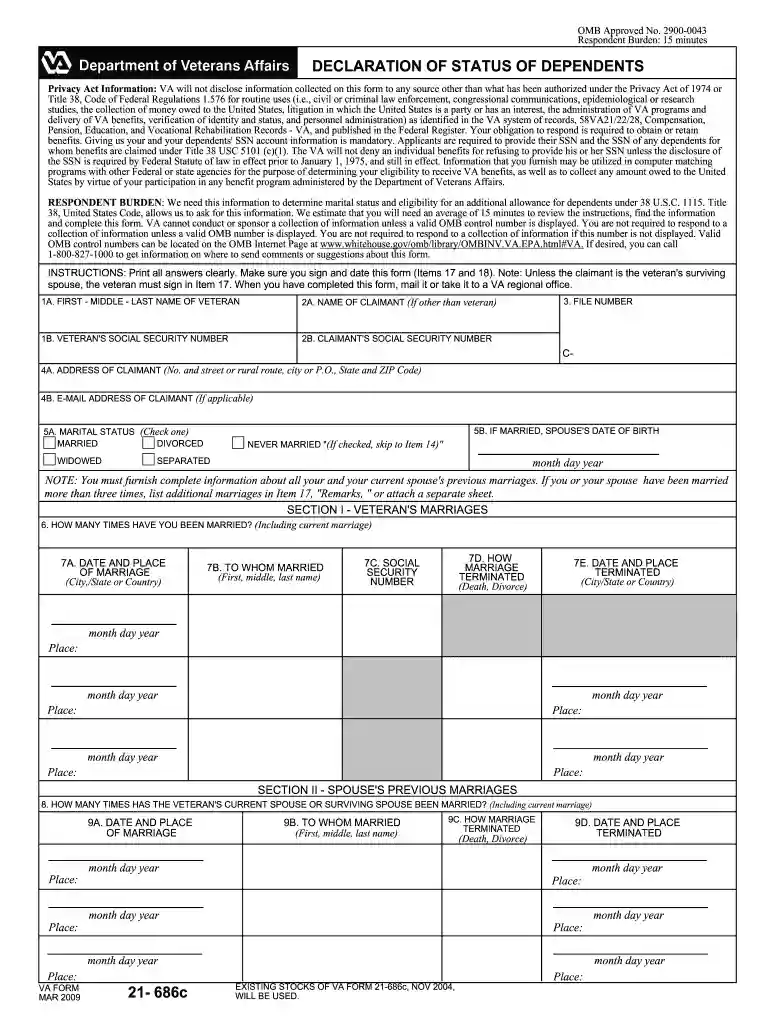
VA Form 21-686c, known as the "Declaration of Status of Dependents," is used by veterans to declare their dependents for the purpose of determining eligibility for additional benefits. This form collects information on the marital status and dependent children of the veteran, which affects the benefits they can receive under Title 38 of the United States Code. It’s a critical document for veterans seeking to maximize their entitlement by accurately reflecting their family situation.

How to Use VA Form 21-686c

To use VA Form 21-686c, veterans must fill out the form with detailed information about their dependents, including spouses and children. This process involves listing personal details like names, birth dates, and Social Security numbers. The form serves to update the Department of Veterans Affairs on the precise family composition, ensuring veterans receive the correct benefits. Accurate completion and submission of this form are necessary to avoid any disruption in receiving dependent-related benefits.

Steps to Complete VA Form 21-686c

Completing VA Form 21-686c involves a series of steps:

  1. Gather Information: Collect all necessary information about dependents, including Social Security numbers, birth dates, and marriage certificates if applicable.
  2. Fill Out Personal Details: Provide your own name, Social Security number, and veteran ID if available.
  3. List Dependents: Input the complete information of each dependent, ensuring accuracy.
  4. Review and Sign: Double-check all entries for any errors or omissions, then sign the form to confirm the information is correct.

Detailed instructions are provided within the form itself, guiding veterans through each section.

Who Typically Uses VA Form 21-686c

VA Form 21-686c is primarily used by veterans who have served and are eligible for benefits, particularly those with dependents. This includes veterans currently receiving VA compensation or pension benefits who have undergone a change in their family status, such as marriage or the birth of a child. Veterans seeking to claim dependent-related benefits must use this form to update their dependency status with the VA.

Key Elements of VA Form 21-686c

Several key elements must be included in VA Form 21-686c:

  • Veteran's Personal Information: Includes full name, address, and Social Security number.
  • Dependent Information: Detailed data on each claimed dependent.
  • Marital Status: Information regarding any spouses, including marriage dates and locations.
  • Signatures and Dates: It must be signed and dated by the veteran to validate the provided information.

Each section must be meticulously filled out to ensure that the VA processes the form correctly and efficiently.

Important Terms Related to VA Form 21-686c

Several terms are critical when dealing with VA Form 21-686c:

  • Dependent: Typically refers to the veteran's spouse, child, or dependent parent who can be claimed for additional VA benefits.
  • Title 38 U.S.C.: The section of the United States Code that sets out the laws relating to veterans’ benefits.
  • ESIGN Act: Refers to legislation that makes electronic signatures valid and legally binding, relevant for digital submissions of the form.

Understanding these terms aids in correctly completing and submitting the form.

Eligibility Criteria for VA Form 21-686c

Eligibility for additional benefits through VA Form 21-686c hinges on fulfilling specific criteria:

  • Confirmed Veteran Status: Must be a verified U.S. veteran eligible for VA benefits.
  • Qualifying Dependents: Dependents must meet criteria under VA rules, including age limits for children unless permanently disabled.

Meeting these criteria is crucial for qualifying for the dependency-related benefits.

decoration image ratings of Dochub

Form Submission Methods for VA Form 21-686c

Submission of the VA Form 21-686c can occur through several channels:

  • Online Submission: Use the VA’s eBenefits portal for a faster, digital process.
  • Mail: Send a completed form via traditional postal service to the designated VA claims intake center.
  • In-Person: Visit a local VA office for direct submission and potential assistance with form completion.

Each method has its own advantages, depending on the veteran’s preference for speed and convenience.

See more form 21 686c 2009 versions

We've got more versions of the form 21 686c 2009 form. Select the right form 21 686c 2009 version from the list and start editing it straight away!
Versions Form popularity Fillable & printable
2022 4.3 Satisfied (56 Votes)
2018 4.8 Satisfied (162 Votes)
2014 4.4 Satisfied (62 Votes)
2009 4.1 Satisfied (65 Votes)
2004 4.2 Satisfied (35 Votes)
1998 4 Satisfied (48 Votes)
be ready to get more

Complete this form in 5 minutes or less

Get form

Got questions?

We have answers to the most popular questions from our customers. If you can't find an answer to your question, please contact us.
Contact us
Use VA Form 21-686c to submit a claim for additional benefits for a dependent, or to request to remove a dependent from your benefits.Dec 18, 2025
A widow of a 100% disabled veteran generally receives tax-free Dependency and Indemnity Compensation (DIC), starting at the base rate (around $1,653.07 in 2025), with increased amounts possible for dependent children, a housebound or disabled surviving spouse needing Aid Attendance, or if the veteran had a 100% rating for 8+ years while married. Other potential benefits include CHAMPVA healthcare and Survivors Pension if income/assets are low, plus possible SBP if the veteran had military retirement. Key VA Survivor Benefit: Dependency Indemnity Compensation (DIC) This is the primary monthly payment for surviving spouses, paid if the veteran died from a service-connected condition or was 100% disabled (or had a 100% rating for 10+ years). Base Rate (2025): Approximately $1,653.07 per month, tax-free. Additional Amounts (Examples for 2025/2026): Veteran had 100% rating for 8+ years: Extra $351.02/month (if married for full 8 years). Disabled surviving spouse needing Aid Attendance: Extra $409.53/month (for regular help). Housebound surviving spouse: Extra $191.85/month. For each minor child (under 18): Extra $409.53/month (plus potential for children 18-23 in school). Transitional Benefit: $350/month for the first two years after death if there are dependent children. Other Potential Benefits CHAMPVA: Medical coverage for spouses and dependents. Survivors Pension: For low-income survivors, an income-based pension (not disability-related). Survivor Benefit Plan (SBP): If the veteran was a military retiree who paid for this annuity, the spouse receives up to 55% of their retired pay. How to Check Eligibility Get More Info Visit VA.gov Home (VA.gov) for official rates and applications. Contact Disabled American Veterans (DAV) (DAV) or other veteran service organizations for assistance. AI can make mistakes, so double-check responsesDo Spouses of 100% Disabled Veterans Get Benefits?A monthly stipend. CHAMPVA medical coverage. Respite care for the veteran. Benefits for the Surviving Spouse of a 100% Disabled VeDisabledVets.comVeteran Survivor Benefits: VA Death Benefits Explained - DAVSurvivors of military retirees may be eligible to receive a monthly payment or annuity if the deceased veteran opted in and continDAV : Disabled American Veterans
There are multiple ways veterans can submit VA Form 21-686c: Mail Veterans can mail their filled-out VA Form 21-686c to VAs Evidence Intake Center (PO Box 4444 in Janesville, WI 53547-4444) Online Veterans may also submit their form online through VA.gov.Dec 23, 2022
The holy grail for VA disability is achieving Permanent and Total (PT) status, which means the VA recognizes your service-connected disabilities are severe, wont improve, and youre protected from future reductions, unlocking benefits like free Space-A travel, state discounts, and often no more CP exams. While a 100% rating provides maximum compensation, PT adds DocHub quality-of-life perks and stability, making it the ultimate goal for many veterans with lifelong conditions. Key aspects of PT status: Not automatic: A standard 100% rating doesnt guarantee PT; PT means permanent, not just high-paying. Lifelong conditions: Awarded for disabilities with little to no chance of improvement, like losing both legs. Benefit Enhancements: Free military air travel: Space-Available (Space-A) flights. State benefits: Access to state-specific discounts and programs. Reduced scrutiny: VA usually stops requiring future medical exams for PT conditions. Other Grails (depending on veteran goals): High Combined Rating: Achieving 100% through combined ratings for multiple conditions, though its harder to get from 80% to 100% schedular. PACT Act Claims: For those exposed to toxins, the PACT Act has become a DocHub pathway to new benefits, sometimes called a holy grail for related conditions. Special Monthly Compensation (SMC): For extremely severe, single-impairment losses, SMC offers higher pay, but pursuing it can risk review of other ratings. AI can make mistakes, so double-check responsesIs there any difference to be weary of when getting a rating of 100% thats Nov 21, 2024 Risk of Reduction: When a veteran has a 100% PT rating, particularly based on a single condition, pursuing additionalRReddit r/VeteransBenefitsWhy The PACT Act is the Holy Grail of VA Benefits: A whopping 74.9% Aug 15, 2024 Why The PACT Act is the Holy Grail of VA Benefits: A whopping 74.9% | pact act explained | TikTok. Global video TikTok VA Claims Insider
The hardest VA claims to get often involve subjective conditions or proving a strong link (nexus) to service, with PTSD (especially from Military Sexual Trauma - MST), sleep apnea, chronic pain, tinnitus/hearing loss, and claims for aggravation of pre-existing conditions (like flat feet) being notoriously difficult due to lack of objective proof, poor in-service documentation, or proving the worsening went beyond natural progression. Exposure-related illnesses and secondary conditions also present DocHub challenges. Why These Claims Are Hard: PTSD/MST: Requires a verified stressor (hard for MST) and subjective symptoms, often lacking in-service records. Sleep Apnea: Needs a sleep study and proving service connection if not diagnosed in service, often linked to obesity or other issues. Tinnitus Hearing Loss: Common but require specific, calibrated audiograms and functional impact documentation, with tinnitus having a low maximum rating. Chronic Pain/Invisible Injuries: Difficult to objectively measure and often require detailed functional limitation descriptions. Aggravation of Pre-existing Conditions: Requires showing service worsened it beyond normal progression, needing strong before/after evidence and expert opinions. Toxic Exposures (Non-Presumptive): Proving exposure, latency, and nexus without robust scientific evidence is tough. Key Challenges Across Difficult Claims: Lack of In-Service Records: Missing documentation of events or symptoms at the time. Subjective Symptoms: Conditions like pain or mental health struggles are hard to objectively measure. Nexus (Link) Requirement: Proving the military event directly caused or aggravated the condition. How to Improve Your Chances: Gather Extensive Evidence: Buddy statements, personal journals, private medical records, and detailed timelines. Get Expert Opinions: Nexus letters from specialists are crucial. Document Functional Impact: Show how the condition affects your daily life and work. Build a Consistent Record: Show a clear story over time. AI can make mistakes, so double-check responsesWhat is the Hardest VA Claim to Get?Coskrey LawTop 10 Hardest VA Claims to Get Approved!Jan 27, 2026 doesnt meet the VAs cut offs above 0% you may only receive 0% service connected rating. and as long as the evidence YouTube VA Claims Insider

Security and compliance

At DocHub, your data security is our priority. We follow HIPAA, SOC2, GDPR, and other standards, so you can work on your documents with confidence.

Learn more
ccpa2
pci-dss
gdpr-compliance
hipaa
soc-compliance

People also ask

Filling Out VA Form 21-686c Full name, birthdate, and Social Security number. Marriage details (e.g., date, place, type of ceremony) Any prior marriages for you or your spouse (dates, reasons for termination, supporting documents like divorce decrees or death certificates) Jul 10, 2023

Related links