
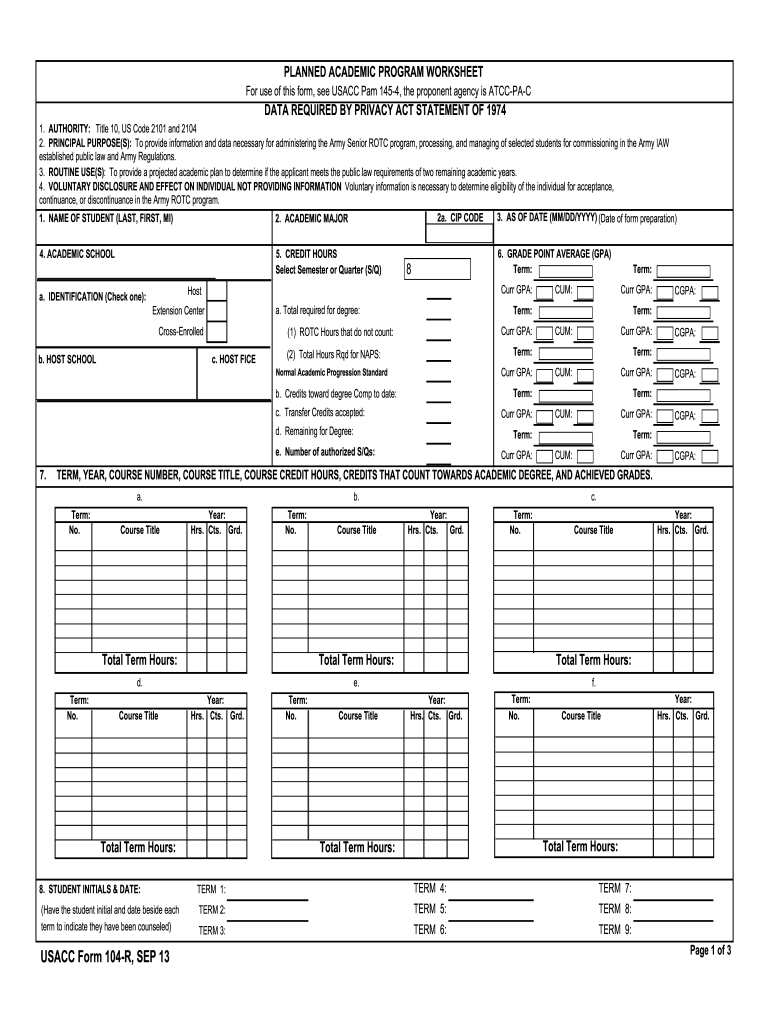







Definition and Purpose of the 104-R
The 104-R is a Planned Academic Program Worksheet specifically used in the Army Senior ROTC program. It is a structured form intended to collect essential data about an ROTC cadet's academic schedule, helping to oversee and ensure the student's progression aligns with the requirements for commissioning into the Army. This document is critical, as it verifies the cadet's coursework meets specific public law requirements concerning academic standards and timelines for the ROTC curriculum.
How to Obtain and Use the 104-R Form
To obtain the 104-R form, ROTC cadets typically receive it through their unit or campus ROTC office, ensuring it's distributed by official channels and aligned with specific program needs. The form can be either digital or printed, depending on the requirements of the particular ROTC program and the cadet’s preferences. Using the form involves the detailed input of academic and personal information, including major, semester schedule, and credits, to provide a comprehensive academic plan.
Steps to Complete the 104-R Form
-
Gather Information: Begin by collecting all pertinent information, including personal details, academic major, and planned courses.
-
Enter Personal Details: Fill in your name, ROTC battalion, and contact information at the top of the form.
-
Detail Academic Program: Itemize your academic program by listing your major, current GPA, and the total number of credit hours completed to date.
-
Outline Course Schedule: Include a detailed list of your planned courses for each upcoming semester until graduation, ensuring you meet program requirements.
-
Review with Advisor: Ensure accuracy by reviewing the completed form with your ROTC advisor or academic counselor to verify all program requirements are listed.
-
Submit for Approval: Once completed and reviewed, submit the form to your ROTC unit for approval and processing.
Who Typically Uses the 104-R
The 104-R form is primarily utilized by ROTC cadets who are pursuing a commission in the U.S. Army through the Senior ROTC program. The form helps ensure these cadets are on track to meet the educational requirements necessary for commissioning. Academic advisors and ROTC instructors also use the form to plan and verify cadet schedules and progress.


Key Elements of the 104-R
- Personal Information: Includes cadet's name and contact details.
- Academic Major and GPA: Lists major concentration and current academic standing.
- Credit Hours and Course Schedule: Details completed credits and proposed semester plans.
- Approval Signatures: Requires signatures from ROTC and academic officials to validate the form.
Important Terms Related to the 104-R
- Commissioning Requirements: These refer to the academic and training criteria that ROTC cadets must meet to become commissioned officers in the Army.
- Academic Progression: The set trajectory of a student’s course load and grades through their college career that meets the ROTC requirements.
- Senior ROTC Program: A college-based program designed to educate and train students for commissions as officers in the U.S. Army, Army Reserves, or Army National Guard.
Legal Use of the 104-R
The 104-R form is legally upheld within the constraints of its use for ensuring compliance with training and commissioning standards set forth by Army regulations and public law. It must be managed with integrity, ensuring all information is accurate and verified by designated officials to maintain the credibility of a cadet’s academic certification.
Digital vs. Paper Version
The 104-R form can be processed in either digital or paper format. A digital version allows for easier modifications and updates, while the paper version is often used for instances where digital access is limited. Both mediums require the same level of accuracy and verification, but the digital version offers advantages in terms of accessibility and ease of use, especially with tools like DocHub that provide seamless editing and form management capabilities.
Examples of Using the 104-R
Consider a cadet at a university majoring in engineering who plans a four-year schedule. Utilizing the 104-R, the cadet can outline prospective ROTC and academic courses for each semester, ensuring all necessary credits and requirements are satisfied by anticipated graduation. This planning tool becomes essential in managing both the civilian academic obligations and military training commitments integral to becoming an effective commissioned officer.




