




01. Edit your form online
Type text, add images, blackout confidential details, add comments, highlights and more.

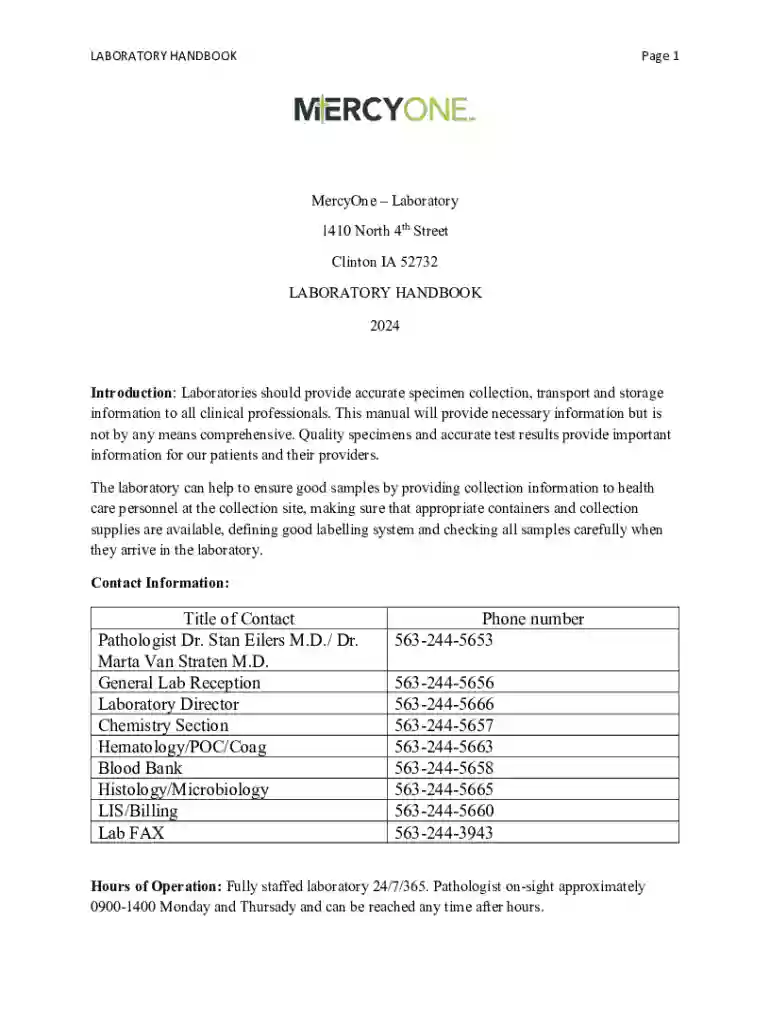
Type text, add images, blackout confidential details, add comments, highlights and more.

Draw your signature, type it, upload its image, or use your mobile device as a signature pad.

Send it via email, link, or fax. You can also download it, export it or print it out.
The "Department of Laboratory Medicine: Services and Specimen" form is a critical document used within medical facilities to facilitate the testing and analysis of various biological specimens. It outlines the necessary procedures and protocols for specimen collection, handling, and transportation. This ensures each sample is maintained in optimal condition for accurate testing and diagnosis. Precise data collection and adherence to the mentioned guidelines are vital to achieve reliable laboratory outcomes.
The form comprises several core components essential for processing laboratory specimens correctly. Key elements include:
To accurately complete the "Department of Laboratory Medicine: Services and Specimen" form, follow these steps:
Understanding the terminology associated with the form helps clarify its use:
The form is primarily utilized by healthcare providers in medical settings for diagnostic purposes. It delineates all necessary instructions to ensure compliance with medical standards. Proper use of the form supports the efficient functioning of laboratory medicine services, guaranteeing quality patient care by delivering precise and timely diagnostic information.
Regulated by healthcare laws and standards, this form must be used in compliance with federal and state regulations concerning medical testing. It ensures that laboratories operate under strict guidelines to protect patient confidentiality and produce valid test results. Legal adherence is integral, as any deviation can result in repercussions for medical facilities, impacting patient care and institutional accreditation.
The form is routinely used by:


While general procedures are standardized, specific state regulations may influence how the form is completed and processed:
The submission of specimens can vary based on the facility's capabilities and the particular requirements of the test:
When submitting the form, additional documents typically accompany it:
Each aspect of the form and accompanying steps works collectively to guarantee high-quality laboratory services, benefiting healthcare providers and patients alike.
We've got more versions of the Department of Laboratory Medicine: Services and Specimen form. Select the right Department of Laboratory Medicine: Services and Specimen version from the list and start editing it straight away!
At DocHub, your data security is our priority. We follow HIPAA, SOC2, GDPR, and other standards, so you can work on your documents with confidence.
SHS Laboratory Tests and Specimen. Annually, we test more than 1 million samples for infectious and food-borne diseases, biological and chemical compounds, and
Phone Support, 24/7: 206.520.4600 / 800.713.5198 Fax: Office Hours: seven days a week, M-F 0600-2330; Sat and Sun 0700-2130 Email: commserv@uw.edu


