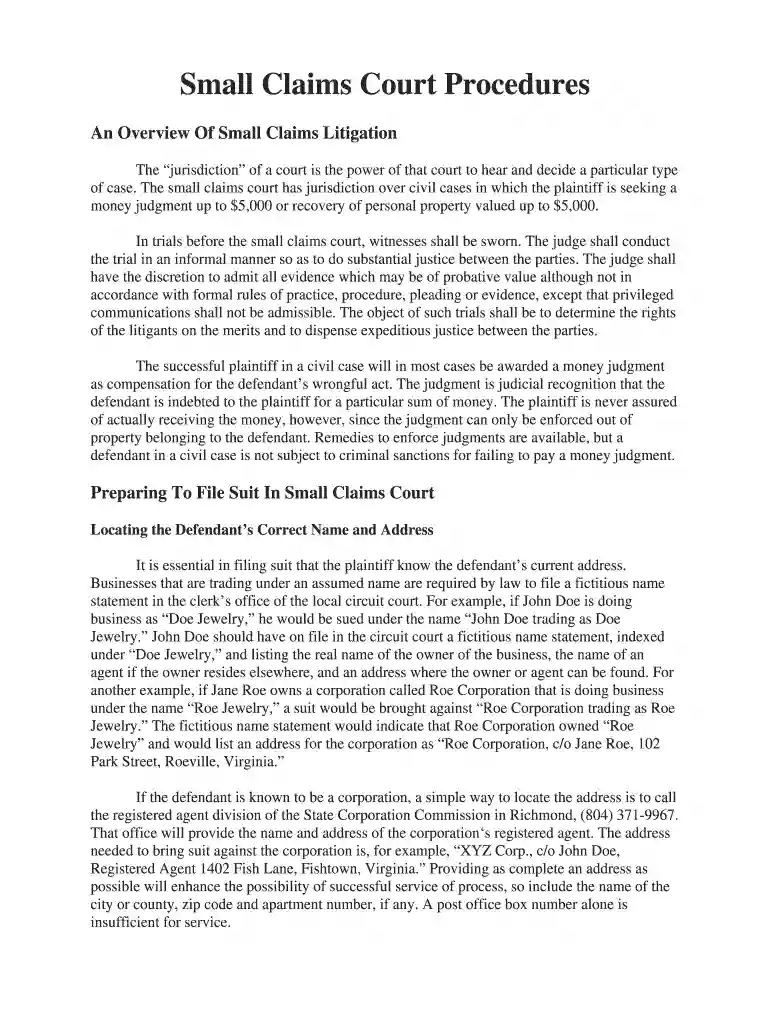
Virginia court procedures 2026

Get Form
virginia civil procedure outline Preview on Page 1

Here's how it works

01. Edit your virginia civil procedure outline online
Type text, add images, blackout confidential details, add comments, highlights and more.

02. Sign it in a few clicks
Draw your signature, type it, upload its image, or use your mobile device as a signature pad.

03. Share your form with others
Send york mega max 3001 price via email, link, or fax. You can also download it, export it or print it out.

How to use or fill out Virginia Court Procedures with our platform

Form edit decoration
9.5
Ease of Setup
DocHub User Ratings on G2
9.0
Ease of Use
DocHub User Ratings on G2
  1. Click ‘Get Form’ to open the Small Claims Court Procedures document in the editor.
  2. Begin by entering the defendant's correct name and address in the designated fields. Ensure accuracy to facilitate service of process.
  3. Select whether you are filing a warrant in debt or a warrant in detinue based on your claim. Fill out the corresponding sections with the amount and basis of your claim.
  4. Attach any necessary documentation that supports your claim, such as evidence of communication or agreements related to the dispute.
  5. Review all entered information for completeness and accuracy before submitting. Make sure to include sufficient funds for filing fees.
  6. Once completed, save your document and follow up with any required mailing or additional steps as outlined in the procedures.

Start using our platform today to streamline your court procedures for free!

See more virginia court procedures versions

We've got more versions of the virginia court procedures form. Select the right virginia court procedures version from the list and start editing it straight away!
Versions Form popularity Fillable & printable
2020 4.8 Satisfied (30 Votes)
2010 4.4 Satisfied (241 Votes)
be ready to get more

Complete this form in 5 minutes or less

Get form

Got questions?

We have answers to the most popular questions from our customers. If you can't find an answer to your question, please contact us.
Contact us
Rule 1 is amended to emphasize that just as the court should construe and administer these rules to secure the just, speedy, and inexpensive determination of every action, so the parties share the responsibility to employ the rules in the same way. Most lawyers and parties cooperate to achieve these ends.
Rules of procedure are a set of established guidelines or instructions that govern the way certain processes, events, or activities are conducted. These rules are designed to ensure fairness, consistency, and efficiency in how actions are carried out.
The CPR aim to speed up the judicial process, to reduce costs and to put the management of each case in the hands of the judge, not the warring parties. The parties include beneficiaries of estates, not just the claimant and executors.
The procedure comprises of the manner for collection of evidence, interrogation of accused, arrest, the examination of witnesses, safeguards and procedure to be implemented by Police and Courts, method of conviction, bail, the procedure for the criminal trial, and the accused rights of a fair trial.
Virginia civil procedure is the body of law that sets out the rules and standards that Virginia courts follow when adjudicating civil lawsuits (as opposed to procedures in criminal law matters).

Security and compliance

At DocHub, your data security is our priority. We follow HIPAA, SOC2, GDPR, and other standards, so you can work on your documents with confidence.

Learn more
ccpa2
pci-dss
gdpr-compliance
hipaa
soc-compliance

People also ask

The present system consists of four levels of courts: the Supreme Court, the Court of Appeals, the circuit courts, and the district courts. In addition, magistrates serve as judicial officers with authority to issue various types of processes.
Rules of court are a set of procedural regulations adopted by courts which must be followed by parties and their lawyers on matters within the courts jurisdiction. These rules are often classified into different categories, such as criminal procedure, civil procedure, evidence rules, and appellate procedure.

Related links