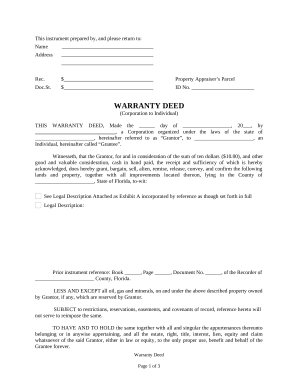
Get and manage Corporation to Individual Deed Transfer online

Accelerate your document managing with our Corporation to Individual Deed Transfer collection with ready-made templates that meet your needs. Get the document, modify it, fill it, and share it with your contributors without breaking a sweat. Start working more effectively with the forms.

How to use our Corporation to Individual Deed Transfer:

  1. Open our Corporation to Individual Deed Transfer and search for the form you need.
  2. Preview your form to ensure it’s what you want, and click Get Form to start working on it.
  3. Modify, include new text, or highlight important information with DocHub features.
  4. Complete your form and preserve the changes.
  5. Download or share your form template with other people.

Discover all the possibilities for your online document management with the Corporation to Individual Deed Transfer. Get a totally free DocHub account right now!

Video Guide on Corporation to Individual Deed Transfer management

video background

Commonly Asked Questions about Corporation to Individual Deed Transfer

When you sell your home or when you are considered to have sold it, usually you do not have to pay tax on any gain from the sale because of the principal residence exemption. This is the case if the property was solely your principal residence for every year you owned it.
A person or corporation defined as non-Canadian cant buy property, either directly or through trusts, partnerships or similar entities.
In Canada, it isnt advisable to transfer ownership of real estate to family members for anything other than the fair market value. However, an alternative would be to give the person cash they can then use to purchase the property at the fair market value.
Generally, property is transferred from an individual to a corporation based on the propertys fair market value (FMV) at the time of the transfer. This would typically result in an accrued gain being realized and you being responsible for tax.
A Section 85 election is a special election filed with the CRA after incorporating a sole proprietorship. It allows sole proprietors to transfer assets of the sole proprietorship into the newly incorporated business on a tax-deferred basis.
For example, a transfer of stock between an individual and a wholly-owned corporation, Page 2 although constituting a change in beneficial ownership, does not constitute a change in economic ownership and therefore must be done off-marketplace.
Yes, you can lease your properties or your assets to your limited liability company (LLC) in Canada.
The lenders and partners must consent and will require amendments and new documents to add the shareholder as a party or to substitute the shareholder to replace the corporation. If legal title to real estate assets is to be transferred, property transfer tax will be payable on the fair market value.