




01. Edit your form online
Type text, add images, blackout confidential details, add comments, highlights and more.

Type text, add images, blackout confidential details, add comments, highlights and more.

Draw your signature, type it, upload its image, or use your mobile device as a signature pad.

Send it via email, link, or fax. You can also download it, export it or print it out.
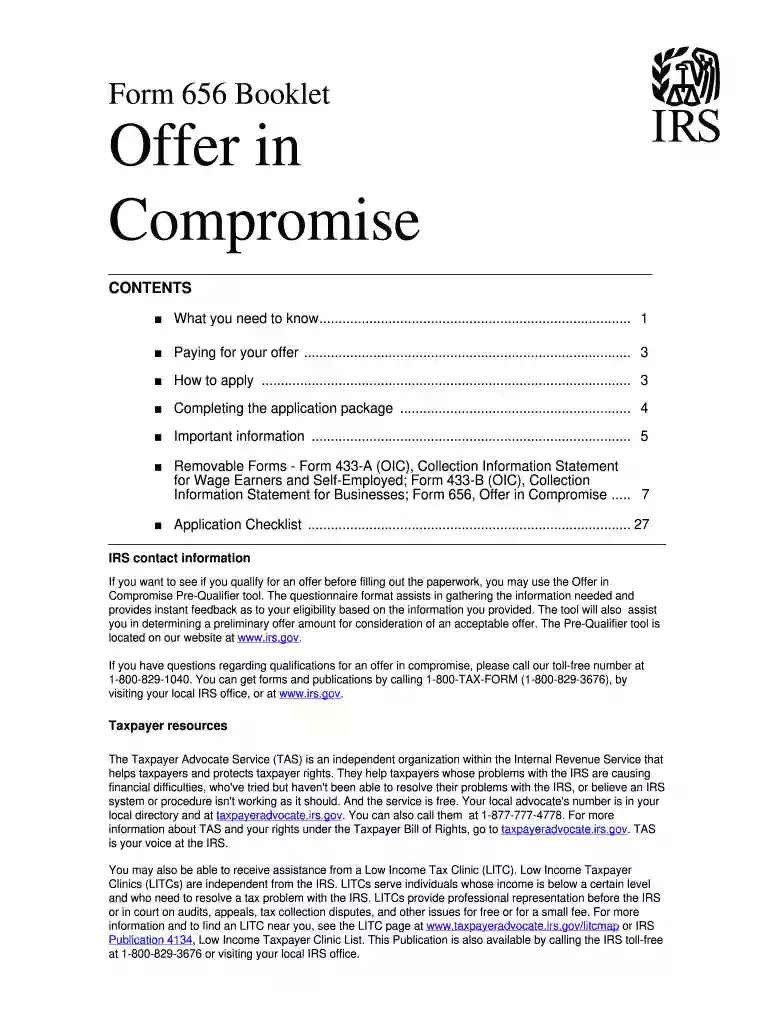
Form 656 is primarily used for submitting an Offer in Compromise (OIC) to the Internal Revenue Service (IRS). This form allows taxpayers to propose settling their tax liabilities for less than the full amount owed. The purpose of the OIC is to provide eligible individuals or businesses with financial relief, especially when paying the full amount would create an undue economic burden.
Gather Financial Information: Collect all relevant financial documents, such as pay stubs, bank statements, and expense reports. This will help accurately report financial details required by the IRS.
Fill Out Form 656: Begin by entering your personal information, detailing your financial situation, and proposing an amount you can pay. It's crucial to be truthful and thorough to avoid rejection.
Calculate Offer: Use IRS guidelines to determine an acceptable offer amount based on your income and asset valuation.
Attach Required Documentation: Include all supporting documentation about your financial status. This typically involves forms like 433-A or 433-B for individual or business financial disclosures.
Sign and Submit: Double-check the form for accuracy, sign it, and submit with the required initial payment or application fee to the IRS.
To be eligible for submitting Form 656, you must meet specific criteria:


The IRS considers your:
The IRS evaluates Offers in Compromise using a strict set of guidelines to ensure the program is accessible to those genuinely unable to pay their tax debts.
The completion and submission of Form 656 must adhere to legal protocols set by the IRS.
Failing to comply with OIC terms can lead to:
Non-compliance might also impact your future eligibility for an OIC or similar relief programs.
We've got more versions of the form 656 2015 form. Select the right form 656 2015 version from the list and start editing it straight away!
| Versions | Form popularity | Fillable & printable |
|---|---|---|
| 2024 | 4.3 Satisfied (48 Votes) | |
| 2023 | 4.8 Satisfied (55 Votes) | |
| 2022 | 4.5 Satisfied (54 Votes) | |
| 2021 | 4.9 Satisfied (52 Votes) | |
| 2020 | 4.4 Satisfied (190 Votes) | |
| 2019 | 4.4 Satisfied (141 Votes) | |
| 2018 | 4.3 Satisfied (207 Votes) | |
| 2017 | 4.1 Satisfied (50 Votes) | |
| 2016 | 4.4 Satisfied (703 Votes) | |
| 2015 | 4 Satisfied (44 Votes) | |
| 2014 | 4 Satisfied (43 Votes) | |
| 2012 | 4.1 Satisfied (61 Votes) | |
| 2011 | 4.2 Satisfied (69 Votes) |
At DocHub, your data security is our priority. We follow HIPAA, SOC2, GDPR, and other standards, so you can work on your documents with confidence.
In December 2016, Lumina Foundation issued a grant to NORC at the University of Chicago to further assess levels of education of attainment of adults in theRead more
Jul 1, 2014 This is also published in a booklet format, with accompanying information similar to that found with Form 656. Filing Fee. In addition to theRead more
The January 2015 revision of IRS Form 656-B, Offer in Compromise Booklet, is now available for download and use. This booklet contains all the current formsRead more


