
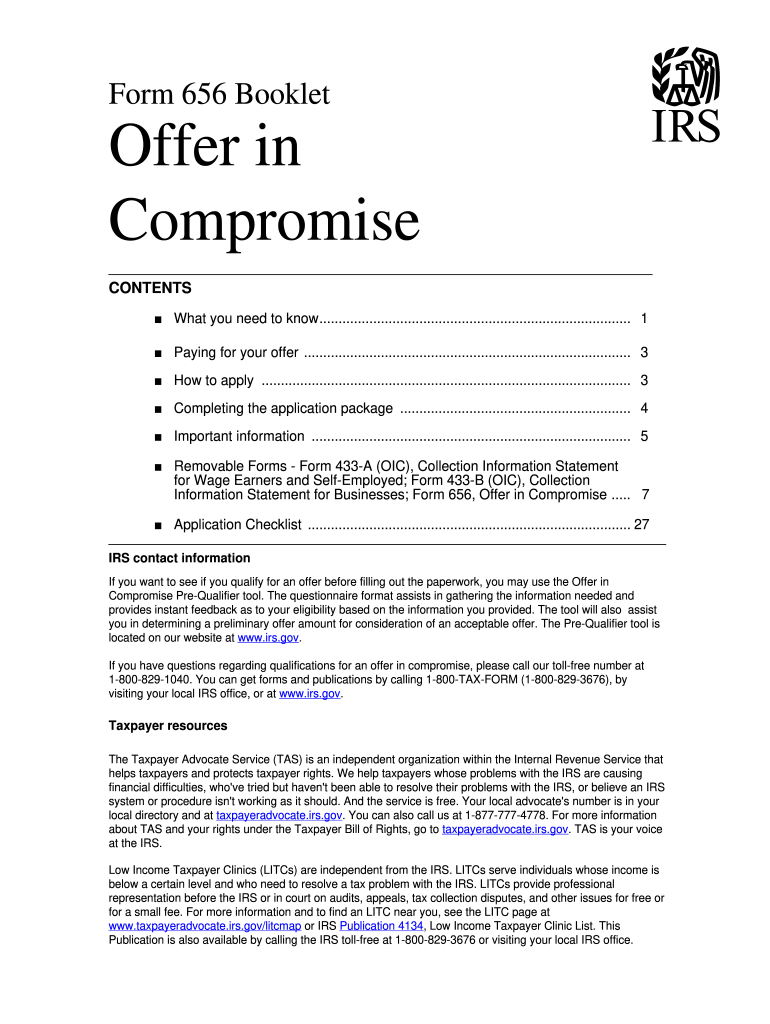







Definition and Purpose of Form 656
Form 656 is an essential document used in the IRS Offer in Compromise (OIC) program. This form lets taxpayers propose a reduced settlement of their tax debts, enabling them to offer less than the full amount owed. It is particularly advantageous for taxpayers facing financial hardship who are unable to pay their full tax liabilities. The OIC program, facilitated through Form 656, aims to provide a feasible resolution that reflects a taxpayer's financial situation.
Importance of Form 656 in the OIC Program
- Debt Settlement: It serves as a tool for settling tax debts at a reduced rate, which can significantly ease taxpayers' financial burdens.
- Eligibility: Filing the form correctly is crucial to qualify for the OIC. Taxpayers need to demonstrate that their financial situation justifies a compromise.
- Legal Binding: Once the IRS accepts an offer, the agreement is legally binding, ensuring that the taxpayer cannot be pursued for the settled amount.
Steps to Complete Form 656
- Gather Financial Information: Before completing Form 656, compile all relevant financial documentation, including income, expenses, assets, and liabilities.
- Fill Out Personal Information: Include your name, address, Social Security number, and other required personal details in the designated fields.
- Provide Financial Details: Accurately disclose your financial situation, detailing your expenses, assets, and liabilities to substantiate the compromise offer.
- Determine Offer Amount: Based on your financial analysis, propose a reasonable offer amount that reflects your ability to pay.
- Include Additional Forms: When necessary, include Form 433-A (for individuals) or Form 433-B (for businesses) to support your offer with detailed financial disclosures.
- Sign and Date: Ensure that both the taxpayer and legal representative (if applicable) sign and date the form.
- Submit the Form: Send the completed form and supporting documents to the IRS using your preferred submission method: online, mail, or in-person.
Eligible Criteria
Eligibility for filing Form 656 requires that taxpayers meet specific conditions set by the IRS. Candidates must demonstrate that:
- Inability to Pay: Full tax payment is infeasible based on their financial resources.
- Compliance: They have filed all required tax returns.
- Estimated Tax Payments: They have made all necessary estimated tax payments for the current tax year.
- Federal Tax Deposits: For business owners, all current year federal tax deposits must be paid.
Submission Methods for Form 656
Online Submission
- E-Payment Options: Use the IRS Online Payment Agreement application to submit your offer digitally.
- Document Upload: Attach all necessary documents as electronic files within the online application.
Mail-In Options
- Standard Mail: Print and mail the completed form along with all required documentation to the IRS office responsible for OIC submissions.
- Certified Mail: Use this service for tracking and confirmation of receipt.
In-Person Submission
- IRS Office: Visit a local IRS office to submit the form directly to ensure immediate handling.
Required Documents for Submission
- Current Financial Statements: Include up-to-date financial statements reflecting your current economic status.
- Supplementary Forms: Form 433-A or Form 433-B, depending on whether you are an individual or business applicant.
- Supporting Documentation: Evidence of income, assets, and expenses, such as pay stubs, bank statements, and mortgage statements.
Legal Use and Implications
Proper execution and submission of Form 656 result in a legally binding agreement between the taxpayer and the IRS. This agreement can include stipulations like:
- Tax Forgiveness: Consent to settle tax debts for less than the full amount, conditional upon accurate and truthful disclosure of financial status.
- Future Compliance: An obligation to comply with tax requirements for the years following the acceptance of the OIC.
- Rescinding Offers: The IRS reserves the right to rescind offers if fraud or discrepancies are discovered.
Penalties for Non-Compliance
Failure to comply with Form 656 requirements or providing false information can result in:
- Rejection of Offer: The IRS may decline the proposed settlement.
- Full Amount Due: Taxpayers might be liable for the entire original tax liability if the compromise is invalidated.
- Fines and Penalties: Additional financial penalties may be imposed for non-compliance, fraud, or misstatement.
Examples of Using Form 656
Self-Employed Individuals
- Scenario: An individual with fluctuating income proposes a new offer based on cyclical changes in revenue.
- Outcome: The IRS accepts if the financial hardship is convincingly presented.
Retired Taxpayers
- Scenario: Limited fixed income may qualify elderly taxpayers for an OIC.
- Outcome: A well-documented offer might result in significant tax reduction.
By understanding these aspects of Form 656, taxpayers can effectively navigate the OIC process, ensuring proper compliance and maximizing the chances of an accepted compromise offer.


