




2012 form 8829-2026

Get Form
2012 form 8829 Preview on Page 1

Here's how it works

01. Edit your form online
Type text, add images, blackout confidential details, add comments, highlights and more.
02. Sign it in a few clicks
Draw your signature, type it, upload its image, or use your mobile device as a signature pad.
03. Share your form with others
Send it via email, link, or fax. You can also download it, export it or print it out.

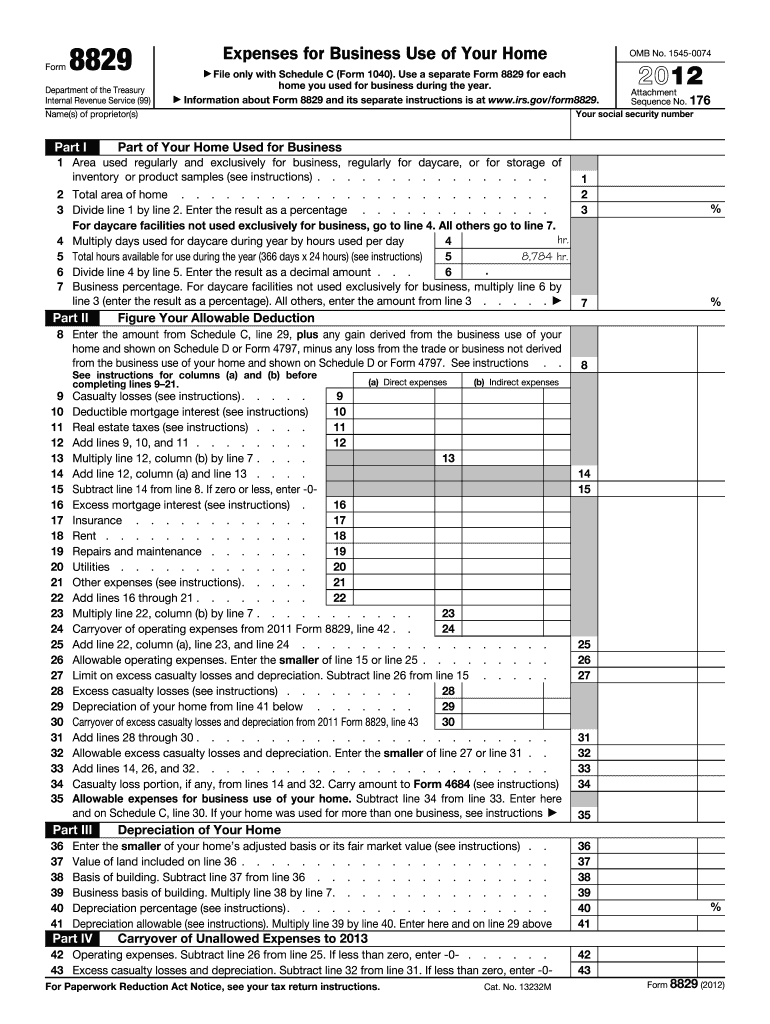
Definition and Purpose of the 2012 Form 8829

Form 8829, officially titled "Expenses for Business Use of Your Home," is a vital document utilized by self-employed individuals to detail and report the expenses associated with their home office. This form enables taxpayers to calculate the allowable business-use-of-home expenses when filing their taxes with Schedule C (Form 1040). By completing this form accurately, taxpayers can ensure they maximize their deductions related to the percentage of their home dedicated to business activities.

This form is specifically designed for those who use a portion of their home exclusively and regularly for business purposes. By distinguishing between direct and indirect expenses, taxpayers can well articulate the financial implications of operating a business from their residence. Understanding the nuances of this form can significantly affect the net taxable income of self-employed individuals.

Steps to Complete the 2012 Form 8829

Completing Form 8829 involves several steps, each designed to help taxpayers calculate their eligible home office deductions accurately.

  1. Determine Business Percentage: Calculate the portion of your home used for business. This often involves measuring the square footage of your home office compared to the total area of your home.

  2. Identify Direct Expenses: List all direct expenses related to your home office. These may include costs like repairs and maintenance that apply exclusively to the office space.

  3. Calculate Indirect Expenses: Indirect expenses, such as utilities and mortgage interest, should be apportioned based on the business-use percentage you've calculated. For example, if your home office constitutes 10% of your home's total space, you can claim 10% of those indirect expenses.

  4. Depreciation: In cases where taxpayers own the home, calculate the depreciation expense corresponding to the business use of the home. This usually involves determining your home's adjusted basis and useful life.

  5. Complete the Form Sections: Fill out the relevant sections, including the calculations for each category of expenses. Ensure accuracy to avoid issues with the IRS.

  6. Attach to Tax Return: Finally, submit Form 8829 with your Schedule C of Form 1040 when you file your annual tax return.

By following these steps methodically, taxpayers can streamline the process of reporting expenses related to their home office on the 2012 Form 8829.

Important Terms Related to the 2012 Form 8829

Understanding key terminology associated with Form 8829 can facilitate better comprehension of the form and the reporting requirements. Some essential terms include:

  • Exclusively Used: A requirement indicating that the space must be used solely for business purposes to qualify for deductions.
  • Direct Expenses: Costs that pertain specifically to the home office area, such as repairs or maintenance on that space alone.
  • Indirect Expenses: Costs like utilities and property taxes that are shared among both personal and business use, requiring a prorated calculation.
  • Depreciation: The allocation of the cost of your home office over its useful life, which can also affect tax planning.
  • Business-Use Percentage: The ratio calculated by dividing the space used for business by the total space of the home, critical in determining the apportionment of expenses.

Having an understanding of these terms is crucial for accurately completing Form 8829 and effectively navigating the tax implications associated with a home office.

Examples of Using the 2012 Form 8829

Practical examples significantly enhance understanding and application of Form 8829. Consider the following scenarios:

  • Freelance Graphic Designer: A graphic designer operates from a dedicated 200-square-foot office in a 2,000-square-foot home. The business-use percentage is ten percent. They total an annual utility bill of $2,400, which translates to $240 claimed as a business expense.

  • Consultant Working from Home: A consultant uses a spare bedroom for their activities. The room is 150 square feet, while the total area of the home is 1,500 square feet. The individual can claim 10% of their mortgage interest and insurance costs, along with direct expenses such as paint purchased specifically for the office.

These examples illustrate the routine application of Form 8829, empowering taxpayers to calculate and claim the appropriate deductions associated with their home office accurately.

Filing Deadlines and Important Dates for the 2012 Form 8829

Understanding the key deadlines for filing Form 8829 is critical to ensuring compliance with IRS requirements. Form 8829 must be filed by the due date of your tax return, generally April 15 for most individual taxpayers.

  • Extension: If a taxpayer applies for a tax extension, they can also extend the deadline for submitting Form 8829.

  • Estimated Tax Payments: Taxpayers making estimated quarterly tax payments need to consider the impact that the deductions calculated on Form 8829 will have on these payments.

Timely submission of Form 8829 allows taxpayers to effectively claim allowable deductions that can lower their tax liabilities for the year.

Eligibility Criteria for Using the 2012 Form 8829

Form 8829 is specifically designed for taxpayers who meet certain eligibility criteria. To qualify for using this form, individuals typically must:

  • Self-Employed Status: Be in a trade or business for themselves or have income reported on Schedule C.

  • Exclusive Use Requirement: Utilize part of their home exclusively and regularly for business purposes.

  • Proper Documentation: Maintain proper records of related expenses incurred for the home office.

  • Ownership or Lease: Either own the home or have the right to use the residential unit as a home office.

Understanding these eligibility criteria helps ensure that taxpayers apply Form 8829 correctly and avoid complications with the IRS due to ineligibility.

decoration image ratings of Dochub

See more 2012 form 8829 versions

We've got more versions of the 2012 form 8829 form. Select the right 2012 form 8829 version from the list and start editing it straight away!
Versions Form popularity Fillable & printable
2023 4.6 Satisfied (39 Votes)
2022 4.5 Satisfied (50 Votes)
2021 4.8 Satisfied (155 Votes)
2020 4.4 Satisfied (131 Votes)
2019 4.1 Satisfied (44 Votes)
2018 4.3 Satisfied (96 Votes)
2017 4.3 Satisfied (124 Votes)
2016 4.3 Satisfied (51 Votes)
2015 4 Satisfied (53 Votes)
2014 4 Satisfied (47 Votes)
2013 4.4 Satisfied (51 Votes)
2012 4 Satisfied (30 Votes)
2011 4.1 Satisfied (65 Votes)
2006 4 Satisfied (41 Votes)
2004 3.9 Satisfied (43 Votes)
be ready to get more

Complete this form in 5 minutes or less

Get form

Got questions?

We have answers to the most popular questions from our customers. If you can't find an answer to your question, please contact us.
Contact us
The simplified method allows you to figure the tax-free part of each annuity payment. If you made some after-tax contributions, divide your cost by the total number of monthly payments youre anticipating. For an annuity not payable for life, is the number of monthly annuity payments under the contract.
Use Form 8829 to figure the allowable expenses for business use of your home on Schedule C (Form 1040) and any carryover to next year of amounts not deductible this year.
Where in Turbotax is Form 8829 Business Use of Home Open your return and click on Pick up where you left off. In the left menu, click on Wages Income. In the list of Your income and expenses, click Edit/Add next to Self-employment income and expenses. Under your business, click Edit at the bottom of the box.
The IRS offers a simplified home office deduction for those who prefer a simplified approach. Instead of calculating actual expenses, you can use a standard deduction based on the square footage of your home office. As of the last update in 2022, the rate is $5 per square foot, up to a maximum of 300 square feet.
If you use the Simplified Method, you can do so within your account by clicking the link beside box 2 on your 1099-R entry screen. The Simplified Method Worksheet can be found in Form 1040/1040-SR Instructions if you prefer to do it by hand.
be ready to get more

Complete this form in 5 minutes or less

Get form

People also ask

The simplified method allows a standard deduction of $5 per square foot of home used for business, with a maximum of 300 square feet. Allowable home-related itemized deductions, such as mortgage interest and real estate taxes, are claimed in full on Schedule A.
Filling Out the 8829 Form Line 1: First, enter the square footage of your home office that you use exclusively for business purposes. Line 2: Then enter your homes total square footage. Line 3: Divide Line 1 by Line 2 and multiply by 100 to find the percentage of your home that you consider to be your home office.
Form 8829, Expenses for Business Use of Your Home is the tax form that businesses use to itemize, calculate and claim their home office expenses. You file it at the same time you file your personal tax return, and report the deduction you calculate on it on line 30 of Schedule C of Form 1040.

Related links