Type text, add images, blackout confidential details, add comments, highlights and more.

02. Sign it in a few clicks
Draw your signature, type it, upload its image, or use your mobile device as a signature pad.

03. Share your form with others
Send cra certificate of compliance processing time via email, link, or fax. You can also download it, export it or print it out.

How to use or fill out form t2062 with our platform
Ease of Setup
DocHub User Ratings on G2
Ease of Use
DocHub User Ratings on G2
Click ‘Get Form’ to open it in the editor.
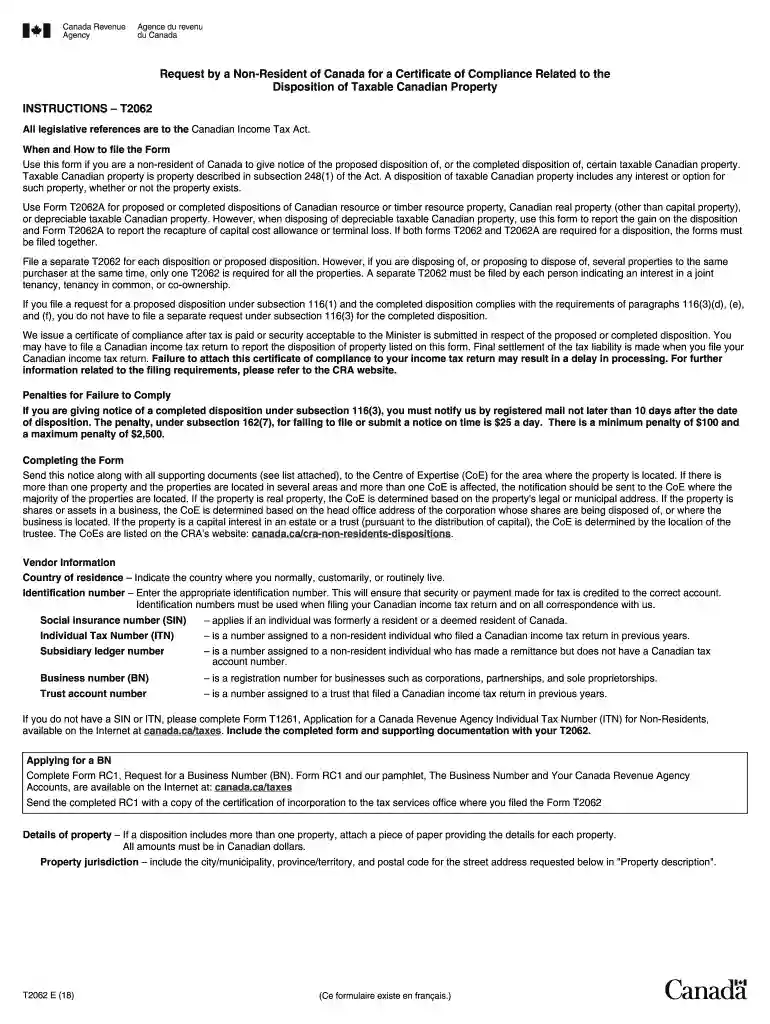
Begin by filling in the Vendor Information section. Provide your country of residence and identification number, ensuring accuracy for proper tax crediting.
In the Details of Property section, include all relevant information about the property being disposed of, such as address, type, and jurisdiction.
Enter the Gross Proceeds of Disposition and any exemptions you are claiming in their respective columns. Ensure that all amounts are in Canadian dollars.
Complete the Certification section by authorizing a representative if needed. Sign and date the form to validate your submission.
Attach any required supporting documents as listed in the instructions before submitting your completed form through our platform.
Start using our platform today for free to streamline your form completion process!
Residential Status of Indian Citizens Leaving India for Employment. In case you are an Indian citizen, and you leave India for employment outside of India, or as a member of the crew on an Indian ship, your status will be a Non-Resident Indian (NRI) if you stay in India in the previous year for less than 182 days.
What is the 90% rule for non-residents?
The 90% rule refers to at least 90% of a non-residents income from the tax year being sourced in Canada. If you have earned at least 90% of your net income in the tax year in Canada you will be entitled to claim non-refundable tax credits, allowing you to earn up to $15,705 tax-free income in Canada.
How are non-resident US citizens taxed?
Tax treatment of nonresident alien If you are not engaged in a trade or business, the payment of U.S. source income that is fixed, determinable, annual, or periodical is taxed at a flat 30 percent (or lower treaty rate) and no deductions are allowed against such income.
What is the tax on the sale of Canadian property by non-residents?
35% of the sale price of non-depreciable property (e.g. land) and 50% of depreciable property (e.g. a rental building) is required to be withheld on the sale of Canadian real estate owned by a non-resident of Canada. In practice, you may find 35% is commonly withheld on the total sales price of residential real estate.
What qualifies you as a non-resident?
If you are not a U.S. citizen, you are considered a nonresident of the United States for U.S. tax purposes unless you meet one of two tests. You are a resident of the United States for tax purposes if you meet either the green card test or the substantial presence test for the calendar year (January 1 December 31).
form t2062
Form t2062 templateForm t2062 instructionsForm t2062 pdfForm t2062 downloadForm T2064Form T2062CT2062 processing timeWhere to send T2062 form
Security and compliance
At DocHub, your data security is our priority. We follow HIPAA, SOC2, GDPR, and other standards, so you can work on your documents with confidence.
How do I report sale of Canadian property on a US tax return?
Tax forms associated with selling a foreign property Form 8949 Sales and Other Dispositions of Capital Assets Anyone who sells a house, gifted or not, must file Form 8949 (2) and report any capital gains. Schedule D (3)
Do foreigners pay tax on Canadian dividends?
A non-residents Canadian-source dividends are subject to WHT of 25%. That income is not subject to graduated rates. The 25% WHT, which is deducted at source, may be reduced under an income tax treaty to rates ranging from 5% to 20%.
t2062
(PDF) Canadian Tax Structuring for Gaming Ventures
Canada Revenue Agency, Form T2062 (Request by a Non- Resident of Canada for a Certificate of Compliance Related to the Disposition of Taxable Canadian Property)
Cookie consent notice
This site uses cookies to enhance site navigation and personalize your experience.
By using this site you agree to our use of cookies as described in our Privacy Notice.
You can modify your selections by visiting our Cookie and Advertising Notice.