




01. Edit your form 8829 worksheet online
Type text, add images, blackout confidential details, add comments, highlights and more.

Type text, add images, blackout confidential details, add comments, highlights and more.

Draw your signature, type it, upload its image, or use your mobile device as a signature pad.

Send it via email, link, or fax. You can also download it, export it or print it out.
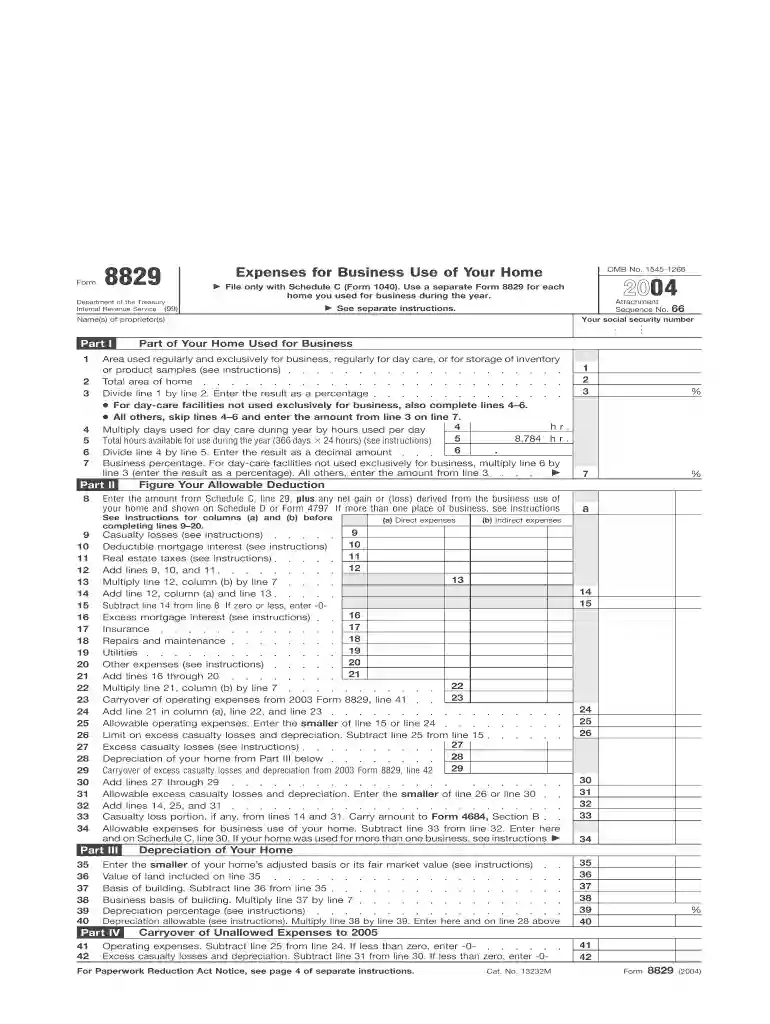
The 2004 Form 8829, titled "Expenses for Business Use of Your Home," is an IRS form used by U.S. taxpayers to calculate and report eligible expenses related to using their home for business purposes. It is primarily used by self-employed individuals or small business owners who operate from a part of their residence. The form allows taxpayers to determine the deduction amount they can claim for a proportionate share of their home expenses, such as mortgage interest, utilities, and depreciation.
Part I - Calculate Your Home's Business Use:
Part II - Figure Your Allowable Deduction:
Part III - Depreciation of Your Home:
Part IV - Carryover of Unallowed Expenses:
The form enables business owners to take advantage of the home office deduction, thus potentially reducing taxable income significantly. Claimed correctly, these deductions can lead to substantial tax savings by accurately attributing home expenses to business activities.



An independent accountant uses her basement exclusively for business activities. Her total home is 2,000 square feet, with a 200 square foot office. She will claim 10% of indirect home expenses and direct office supplies as deductions, precisely calculated using Form 8829.
We've got more versions of the form 8829 worksheet form. Select the right form 8829 worksheet version from the list and start editing it straight away!
| Versions | Form popularity | Fillable & printable |
|---|---|---|
| 2025 | 4.4 Satisfied (44 Votes) | |
| 2024 | 4.8 Satisfied (59 Votes) | |
| 2023 | 4.6 Satisfied (39 Votes) | |
| 2022 | 4.5 Satisfied (50 Votes) | |
| 2021 | 4.8 Satisfied (155 Votes) | |
| 2020 | 4.4 Satisfied (131 Votes) | |
| 2019 | 4.1 Satisfied (44 Votes) | |
| 2018 | 4.3 Satisfied (96 Votes) | |
| 2017 | 4.3 Satisfied (124 Votes) | |
| 2016 | 4.3 Satisfied (51 Votes) | |
| 2015 | 4 Satisfied (53 Votes) | |
| 2014 | 4 Satisfied (47 Votes) | |
| 2013 | 4.4 Satisfied (51 Votes) | |
| 2012 | 4 Satisfied (30 Votes) | |
| 2011 | 4.1 Satisfied (65 Votes) |
At DocHub, your data security is our priority. We follow HIPAA, SOC2, GDPR, and other standards, so you can work on your documents with confidence.
Kent and KCs completed 2004 Schedule C and Form 8829 follow. Income. Tax-exempt. Taxable. Payments from state. $ 96,000. $96,000. Private payments. 48,000.Read more
Apr 15, 1976 Increased section 179 deduction dollar limits. The maximum amount you can elect to deduct for most sec- tion 179 property you placed inRead more
Part of Your Home Used for Business. 1. Area used regularly and exclusively for business, regularly for day care, or for storage of inventory.Read more


