Default judgment form oregon 2013-2026

Get Form
default judgment form oregon 2013 Preview on Page 1

Here's how it works

01. Edit your form online
Type text, add images, blackout confidential details, add comments, highlights and more.

02. Sign it in a few clicks
Draw your signature, type it, upload its image, or use your mobile device as a signature pad.

03. Share your form with others
Send it via email, link, or fax. You can also download it, export it or print it out.

How to use or fill out default judgment form oregon 2013 with our platform

Form edit decoration
9.5
Ease of Setup
DocHub User Ratings on G2
9.0
Ease of Use
DocHub User Ratings on G2
  1. Click ‘Get Form’ to open the default judgment form in the editor.
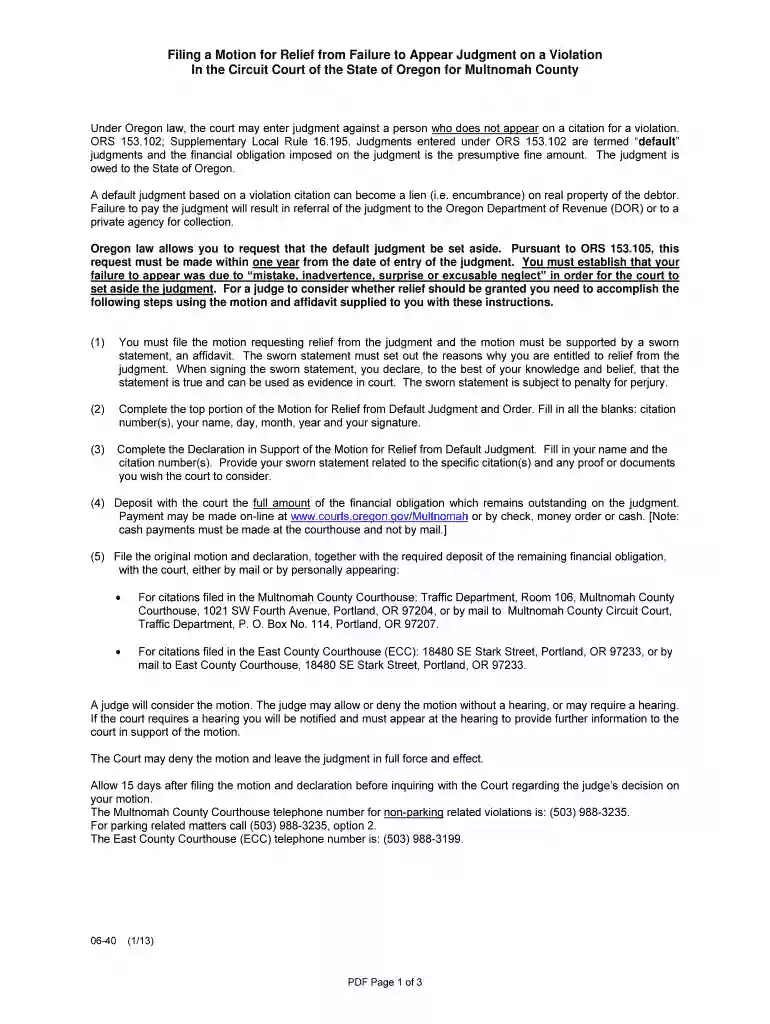
  2. Begin by completing the top portion of the Motion for Relief from Default Judgment. Fill in all required fields, including citation number(s), your name, date, and signature.
  3. Next, move to the Declaration in Support of the Motion. Here, provide your name and citation number(s). Write a detailed sworn statement explaining why you are entitled to relief from the judgment.
  4. Ensure you deposit the full amount of any outstanding financial obligation related to the judgment. Payments can be made online or via check, money order, or cash at the courthouse.
  5. Finally, file both the original motion and declaration along with your payment at the appropriate court location, either in person or by mail.

Start using our platform today for free to streamline your document editing and filing process!

See more default judgment form oregon 2013 versions

We've got more versions of the default judgment form oregon 2013 form. Select the right default judgment form oregon 2013 version from the list and start editing it straight away!
Versions Form popularity Fillable & printable
2016 4.9 Satisfied (273 Votes)
2013 4.3 Satisfied (55 Votes)
be ready to get more

Complete this form in 5 minutes or less

Get form

Got questions?

We have answers to the most popular questions from our customers. If you can't find an answer to your question, please contact us.
Contact us
You cant go to jail for debt, but once the creditor has a judgement against you, they can ask to review your financial situation to determine how the best way to collect. If you do not cooperate, they could ask the court to issue a bench warrant for. This happens very rarely, but it can happen.
Default Judgment is a judgment entered against a party who has failed to defend an action which has been brought against them.
After a default judgment, the Plaintiff will try to collect the money you owe. The Plaintiff may be able to take money from your paycheck or bank account and put a lien on your property. If you dont have any assets to pay the debt, you can let the Plaintiff. They may give up or try to collect in the future.
The judgment is owed to the State of Oregon. A default judgment based on a violation citation can become a lien (i.e. encumbrance) on real property of the debtor. Failure to pay the judgment will result in referral of the judgment to the Oregon Department of Revenue (DOR) or to a private agency for collection.
Although you may believe that you can check for a judgment by pulling your credit report, this is not the case. To see this, you would need to run a judgment search through a title company or go through the county recorders office. This may show a debt, but it will not show a judgment.

Security and compliance

At DocHub, your data security is our priority. We follow HIPAA, SOC2, GDPR, and other standards, so you can work on your documents with confidence.

Learn more
ccpa2
pci-dss
gdpr-compliance
hipaa
soc-compliance
be ready to get more

Complete this form in 5 minutes or less

Get form

People also ask

If you failed to appear on your parking violation and the court entered a judgment against you, this judgment is considered a Default Judgment. Oregon allows you to request that the Default Judgment be set aside. The way to do this is by filing a Motion for Relief from Default Judgment (see links below).
In a default judgment hearing, the judge may consider several types of evidence: documents, photographs, sworn statements, testimonies, and more. For example, if the claim involves debt that hasnt been paid, the plaintiff may present the original contract, a ledger of payments, or a record of payment requests.

Related links