




01. Edit your 2000 massachusetts online
Type text, add images, blackout confidential details, add comments, highlights and more.

Type text, add images, blackout confidential details, add comments, highlights and more.

Draw your signature, type it, upload its image, or use your mobile device as a signature pad.

Send massachusetts state tax form 2022 via email, link, or fax. You can also download it, export it or print it out.
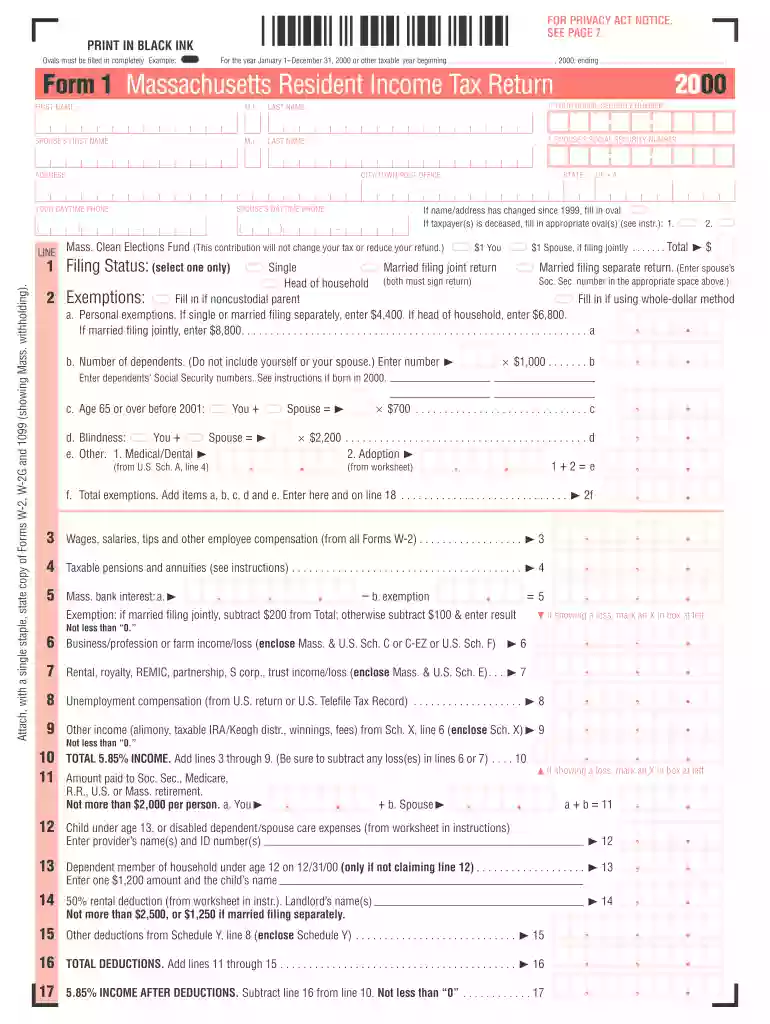
The Form 1 Massachusetts Resident Income Tax Return for the year 2000 is a critical document used by residents of Massachusetts to report their income, claim deductions, and determine their state income tax liability. This form is a standardized tool provided by the Massachusetts Department of Revenue, ensuring taxpayers accurately convey their financial information. Understanding this form is essential for meeting state tax obligations and avoiding potential penalties.
Utilizing Form 1 effectively requires a comprehensive understanding of its sections and their purposes. Taxpayers should start by gathering all necessary financial documents, including W-2s, 1099s, and records of deductions or credits. After compiling their income data, taxpayers must input these figures into the form, following instructions for each line item carefully. Accurately filling out each section will ensure a correct calculation of taxes owed or refunds due. It is crucial to double-check all entries to prevent submission errors.
Acquiring the Form 1 Massachusetts Resident Income Tax Return for 2000 can be done through several avenues. Taxpayers can download the form from the official Massachusetts Department of Revenue website. Alternatively, some libraries and government offices may still provide physical copies of this form from archives. For those preferring digital preparation, tax preparation software often includes past forms, making it easier to complete and file them electronically.
Gather Required Documents: Start by collecting all documentation reflecting your income, including W-2s and 1099 forms.
Record Personal Information: Fill in your personal details, such as name, address, and social security number, accurately.
Report Income: Enter all income sources on the appropriate lines. This includes wages, interest, dividends, and any other taxable income.
Claim Deductions and Credits: Identify eligible deductions and credits, furnish evidence as required, and deduct them from your gross income to determine taxable income.
Determine Tax Liability: Calculate your tax liability based on the remaining taxable income, considering the official tax rate for that year.
Verify and Sign: Double-check all entries for accuracy, and sign the document to certify its authenticity.
Submit the Form: File the form through mail or electronically before the deadline to avoid penalties.
Understanding key terms is vital for accurately completing the Form 1. Key terms include:
The deadline for filing the Massachusetts Resident Income Tax Return in 2000 was April 15, mirroring federal tax deadlines. It is paramount to adhere to this date to avoid potential late filing penalties and interest charges. Extensions may have been available upon request, granting taxpayers additional time to complete their returns accurately.
Failing to submit a completed Form 1 Massachusetts Resident Income Tax Return in a timely manner can lead to several penalties. These may include:
The advent of digital filing has streamlined the tax process significantly. While paper forms were once the primary method, digital filing offers advantages including immediate submission confirmation, integrated error checking, and faster processing times. However, paper forms remain an option for those preferring traditional methods or lacking internet access. It is critical to choose the filing method that best accommodates individual preferences and technological capabilities.
We've got more versions of the 2000 massachusetts form. Select the right 2000 massachusetts version from the list and start editing it straight away!
| Versions | Form popularity | Fillable & printable |
|---|---|---|
| 2025 | 4.4 Satisfied (54 Votes) | |
| 2024 | 4.9 Satisfied (28 Votes) | |
| 2023 | 4.5 Satisfied (35 Votes) | |
| 2022 | 4.8 Satisfied (26 Votes) | |
| 2021 | 4.8 Satisfied (30 Votes) | |
| 2020 | 4.3 Satisfied (154 Votes) | |
| 2019 | 4.1 Satisfied (27 Votes) | |
| 2018 | 4.1 Satisfied (52 Votes) | |
| 2017 | 4.2 Satisfied (65 Votes) | |
| 2017 | 3.9 Satisfied (48 Votes) | |
| 2016 | 4.4 Satisfied (637 Votes) | |
| 2015 | 4.4 Satisfied (317 Votes) | |
| 2014 | 4 Satisfied (60 Votes) | |
| 2013 | 4 Satisfied (44 Votes) | |
| 2012 | 4 Satisfied (49 Votes) |
At DocHub, your data security is our priority. We follow HIPAA, SOC2, GDPR, and other standards, so you can work on your documents with confidence.
You must file a Massachusetts Nonresident/Part-year Resident. Income Tax Return, Massachusetts Form 1-NR/PY, if you were not a resident of Massachusetts and youRead more
Apr 2, 2025 TAXATION. Income tax expense represents the sum of the current and deferred income tax expense. The tax currently payable is based on taxableRead more
For a faster refund, file your return electronically at mass.gov/dor. You must also complete and enclose Schedule HC. Massachusetts Department of Revenue.Read more


