




01. Edit your form online
Type text, add images, blackout confidential details, add comments, highlights and more.

Type text, add images, blackout confidential details, add comments, highlights and more.

Draw your signature, type it, upload its image, or use your mobile device as a signature pad.

Send it via email, link, or fax. You can also download it, export it or print it out.
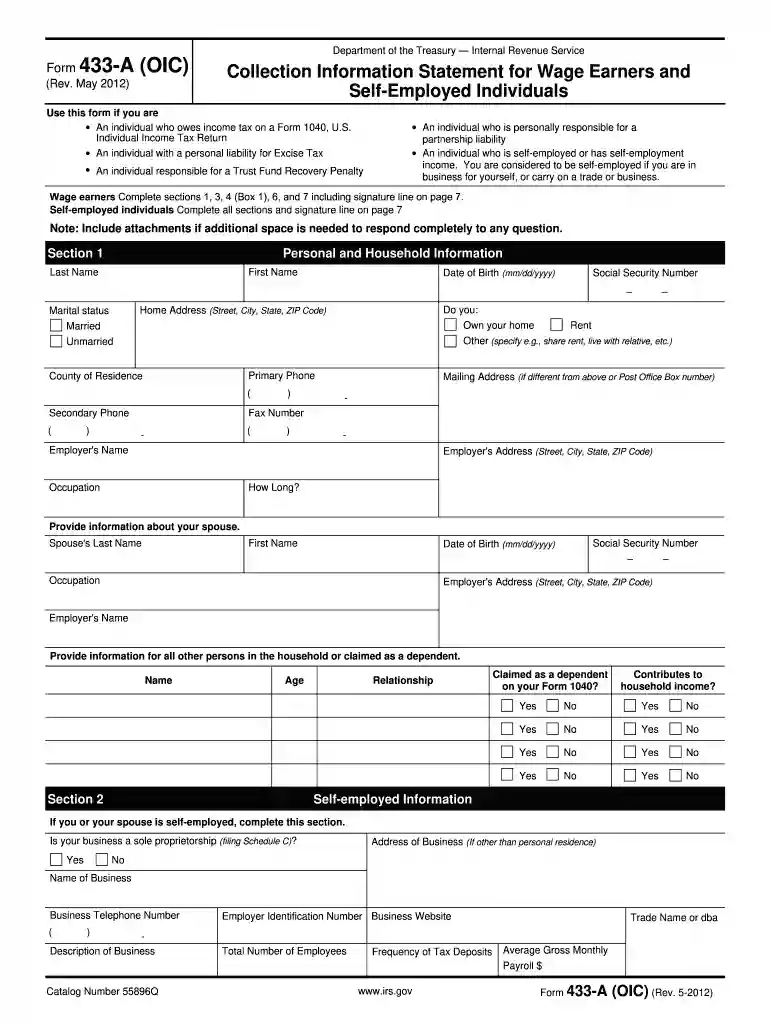
Form 433-A (OIC) is a Collection Information Statement used by the IRS specifically for individuals, including wage earners and self-employed persons, who are seeking to settle their tax liabilities. This form gathers detailed financial information, which the IRS uses to make decisions regarding an Offer in Compromise (OIC). An OIC is a program that allows taxpayers to settle their tax debt for less than the full amount owed. Understanding the purpose and requirements of Form 433-A (OIC) is crucial for anyone considering this form of tax resolution.
Using the 433-A fillable form from 2012 starts with understanding its structure and content requirements. The fillable format allows users to input information directly into the document on their computer, ensuring legibility and accuracy. It is crucial to:
To obtain the 433-A fillable form for 2012, there are several options:
Completing the form involves several detailed steps:
Several critical elements need attention:
The IRS provides specific guidance on how to complete and submit Form 433-A to ensure compliance:
Non-compliance with IRS requirements when filing Form 433-A can lead to potential penalties:
The IRS offers various methods to submit Form 433-A:
The 433-A form is primarily used by:
This comprehensive breakdown provides in-depth information about the 433-A fillable form from 2012, offering essential guidelines, detailed processes, and consequences of non-compliance.


We've got more versions of the 433a fillable form 2012 form. Select the right 433a fillable form 2012 version from the list and start editing it straight away!
| Versions | Form popularity | Fillable & printable |
|---|---|---|
| 2025 | 4.7 Satisfied (24 Votes) | |
| 2024 | 4.8 Satisfied (60 Votes) | |
| 2023 | 4.8 Satisfied (43 Votes) | |
| 2022 | 4.5 Satisfied (57 Votes) | |
| 2021 | 4.9 Satisfied (41 Votes) | |
| 2020 | 4.3 Satisfied (130 Votes) | |
| 2019 | 4.3 Satisfied (241 Votes) | |
| 2018 | 4.3 Satisfied (138 Votes) | |
| 2014 | 4.4 Satisfied (1237 Votes) | |
| 2012 | 4.3 Satisfied (61 Votes) |
At DocHub, your data security is our priority. We follow HIPAA, SOC2, GDPR, and other standards, so you can work on your documents with confidence.
A Complete Application comprises: Pilot Program Common Application Form (a fillable pdf) and. Proposal Materials as a second pdf document. 433a January 2012
After we review the completed Form 433-A, you may be asked to provide verification for the assets, encumbrances, income and expenses reported. Documentation mayRead more


